Camilleri’s 100th Celebration Thrills Audiences at the Italian Forum
By Alberto Macchione
The comedy play ‘La Lettera Anonima’, taken from ‘Un Mese con Montalbano’ opened at The Italian Forum Cultural Centre in Sydney’s Little Italy, in Leichardt, to delighted audiences. Funny, thrilling and engaging, the production is a feast for the senses, especially crafted by the Bottega d’Arte Teatrale, directed by Santo Crisafulli.
All this, while paying homage to the literary genius of Andrea Camilleri on the centanary of his birth. Utilising a multiverse of media, the Bottega fused cinema and sound with classic theatrical staging in a nod to the highly diverse and much adapted work of Camilleri.
Taken from the book ‘A Month With Montalbano’ the compelling plot follows an anonymous letter placed on the desk of the Inspector pointing to a possible murder attempt of a cheating wife. It is up to Montalbano to unfurl the plot and the author of the letter. Undoubtedly tensions, sharp wit and an intensely sensuous story are played out with the ingenious staging and articulate plot devices that the Bottega are so renowned for.
The play, staged on Saturday 5 and Sunday 6 July, attracted a rich and diverse audience.Elegantly narrated by our very own Allora Director, the very talented Marco Testa, the audience is quickly swept into a compelling and highly insightful interview with television’s Inspector Montalbano, Luca Zingaretti.
In the interview, Zingaretti speaks of Andrea Camilleri’s life, that of an author who began writing his Montalbano series when he was almost 80 years of age. While Camilleri moved from Sicily to Rome in 1949, through his Inspector Montalbano, he imagines a long-lost sicily of the immeate post-was years.
Montalbano is therefore a man of principles and a man of the south. “That’s why Montalbano is popular, because of his sense of a time passed, and of sense of timeless justice. Women would love to have him as their companion and men as their friend.”
A pattern of theatrical staging and musical numbers being interspersed throughout the play is quickly established. Fans of the Montalbano television show were able to recognise the story and characters and the heart of this play.
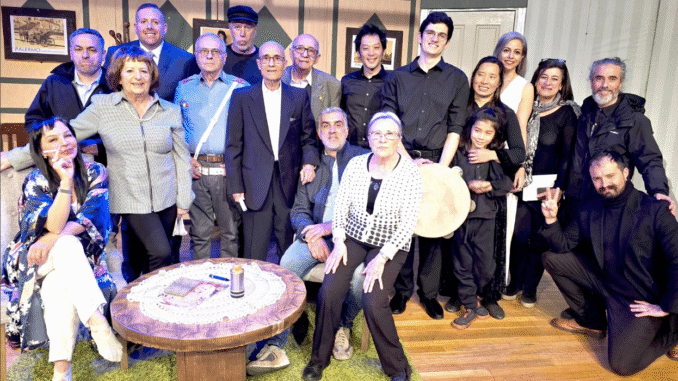
Director and writer, Santo Crisafulli played Inspector Montalbano brilliantly opposite his comedic foil Catarella (Isidoro Rapisarda). Cool counterpart Fazio was perfectly portrayed by Antonio Caputi who assured the familiarity of these mainstay police officers.
The ever-hilarious Maria Maugeri delivered a memorable turn as the spinster secretary of the Montelusa Agricultural Consortium, her sharp wit and impeccable timing earning roaring laughter from the audience.
Ciccio La Rosa, then, brought to life the role of the long-suffering “cornuto pacenziuso,” embodying a comic melancholy that balanced beautifully with the play’s more poetic moments.
And last but not least, Pippo Murgida, as the frazzled and overworked director, infused each scene with a whirlwind energy, perfectly capturing the absurd chaos of bureaucracy that fans of Camilleri’s world have come to know and love.
It was, however as always, Lina Sacco who stole the show, “last time you saw me as Fata Turchina and this time you saw me as