
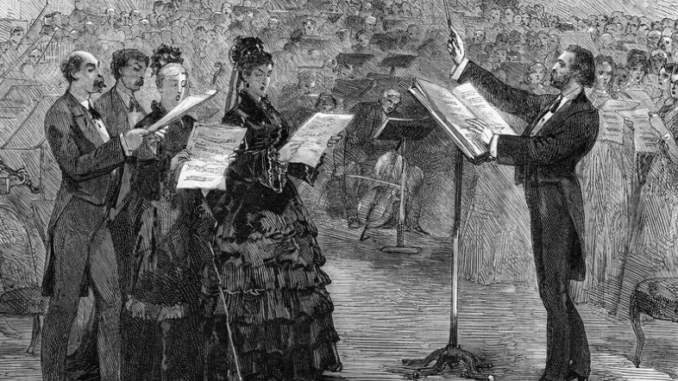
Giuseppe Verdi’s Requiem for Alessandro Manzoni remains one of the towering works of Italian sacred music, yet the circumstances surrounding its composition reveal a complex interplay of artistic duty, historical commemoration, and personal inspiration. As scholars David Rosen and Anna Piva detail, the Requiem premiered on 22 May 1874, marking the first anniversary of Manzoni’s death, but the path to its creation traces back several years earlier.
In November 1868, following the death of Gioacchino Rossini, Verdi proposed that Italy’s leading composers collaborate on a commemorative Requiem, to be performed in Bologna on the first anniversary of Rossini’s death. A commission, including Lauro Rossi, Alberto Mazzucato, and Stefano Ronchetti-Monteviti, assigned parts to each composer, and Verdi received the task of composing the Libera me.
By August 1869, Verdi had completed this movement, which he would later repurpose as the final section of his Requiem for Manzoni, demonstrating his method of thematic and structural cyclicality.
While some biographers speculate that Verdi had begun sketches for the Dies irae in the spring of 1869, Rosen emphasises that the evidence suggests the Libera me was fully autonomous and only later incorporated into the Requiem’s grand structure. Verdi’s letters reveal his ambivalence toward the execution of the Rossini Messa: he initially resisted, fearing the composite work would lack cohesion, yet he encouraged a public performance if the quality of the composition warranted it.
The Requiem for Manzoni, composed between 1873 and 1874, allowed Verdi to expand upon the material of the Libera me, integrating it with the Dies irae and other movements to form a unified, monumental sacred work. Rosen and Piva highlight that Verdi’s creative decision-making was influenced not by immediate necessity, but by the inevitability of commemorating Manzoni, then 88, and by his own continued commitment to vocal music following the completion of Aida.
Ultimately, the Requiem stands as both a homage to Manzoni and a testament to Verdi’s genius in transforming a single, earlier composition into a cohesive, profoundly moving masterpiece that endures in the canon of Western music.
