
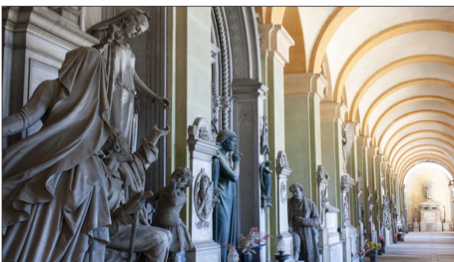
There are cemeteries you pass through quietly, and then there is the Cimitero Monumentale di Staglieno, a place you enter almost as you would a museum. Spread across some 330,000 square metres on the hills east of Genoa, Staglieno is not merely a burial ground but one of Europe’s most extraordinary open-air galleries of sculpture, architecture and emotion.
Created in the mid-19th century, Staglieno was born out of necessity. When burials within and around churches were banned in 1832, Italy’s cities were forced to rethink how they housed their dead. In wealthy, cosmopolitan Genoa, the answer was ambitious.
Architect Carlo Barabino was commissioned to design a monumental cemetery worthy of the city’s mercantile pride and cultural refinement. He would not live to see its opening in 1851, succumbing to the cholera epidemic of 1835, but his vision endured. His pupil, Giovanni Battista Resasco, completed the project, establishing a distinctly Mediterranean cemetery style that would later influence burial sites across Europe.
What distinguishes Staglieno is its unapologetic beauty. Long arcaded galleries shelter tombs adorned with angels, allegorical figures, grieving widows and entire family scenes frozen in marble. Death here is neither hidden nor sanitised; it is confronted with tenderness, theatricality and astonishing craftsmanship.
The cemetery’s Pantheon-like central chapel, originally known as the Cappella dei Suffragi, rises amid this sea of stone as both a spiritual anchor and an architectural focal point. Every pathway seems to tell a story, every sculpture capturing a moment of grief, devotion or remembrance.
Staglieno does not trade on royal names or global celebrity. Instead, it tells a more intimate Italian story. Among its notable graves are those of philosopher and patriot Giuseppe Mazzini, one of the leading figures of the Risorgimento, and beloved Genoese singer-songwriter Fabrizio De André.
The cemetery also includes distinct English, Protestant and Jewish sections, reflecting Genoa’s historic role as an outward-looking port city. In the English cemetery lies Constance Lloyd, wife of Oscar Wilde, adding a quiet literary footnote to the landscape.
For photographers and art lovers, Staglieno is endlessly generous. Light filters through the porticoes, softening marble into something almost human. Guided tours, including the celebrated “100 Women” itinerary, reveal how the cemetery chronicles female life from childhood to old age through the sculptural language of the 19th and 20th centuries.
Free to enter and rarely crowded, Staglieno remains one of Genoa’s most underrated treasures. It is a place that challenges our relationship with death, replacing fear with awe and reminding visitors that remembrance, when shaped by art, can be profoundly life-affirming.
More than a cemetery, Staglieno is a testament to memory, beauty and the enduring human desire to leave a mark upon the world.
Be the first to comment