The One Nation leader defends her position in the Senate and points to the national football team as an example of people from different backgrounds united under one flag. But the story of Nestory Irankunda reignites the debate over the meaning of multiculturalism in modern Australia
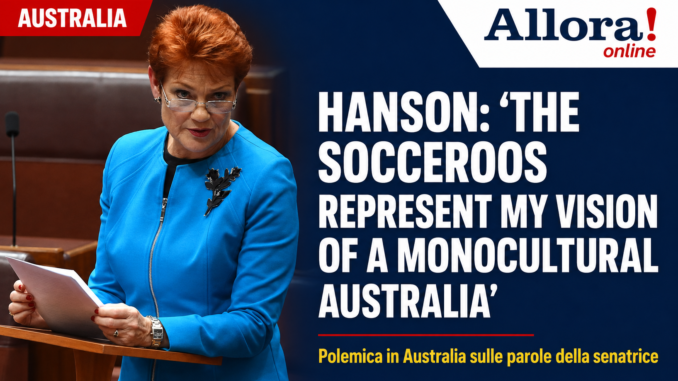
Pauline Hanson has again defended her proposal for a monocultural Australia, choosing the Socceroos as the symbol of the society she wants to build.
Speaking in the Senate, the One Nation leader rejected the criticism she received after her speech at the National Press Club last week, claiming her words had been distorted by the left to suggest that she wanted to ban foreign food or prevent the national team from succeeding because of players from migrant families.
“What rubbish, predictable and pathetic,” Hanson said before declaring that the Socceroos represented her idea of a monocultural Australia.
During the speech, the senator initially used the word “multicultural” before correcting herself and saying “monocultural”.
According to Hanson, the national team shows that people from different cultures and countries can wear the green and gold, represent one nation, stand under one flag and compete under the same rules.
“Australian monoculture is not exclusive. It is welcoming. It is an umbrella which covers all manner of difference. It is not a dirty word,” she said.
One national culture
Hanson’s explanation attempts to separate her position from the idea of a society closed to migrant communities or hostile to traditions brought from overseas.
The One Nation leader does not say Australians should abandon their family origins, food, religion or cultural customs. She argues instead that above those differences there should be one dominant national culture based on Australian law, language, values and identity.
For Hanson, the problem with multiculturalism is that it has encouraged the formation of separate communities, each attached to its own values and not always sufficiently integrated into the wider nation.
She therefore argues that Australia should be multiracial but monocultural, a formula she presents as inclusive and unrelated to ethnic background.
That distinction lies at the centre of the political debate.
Critics argue that modern Australian identity does not come from one fixed culture but from the meeting of First Nations peoples, British traditions and successive waves of migration from Europe, Asia, the Middle East, Africa and the Pacific.
The Socceroos as a symbol
Hanson’s choice of the Socceroos was deliberate.
For decades, the national football team has been one of the clearest symbols of Australia’s demographic transformation.
Different generations of the team have included the children of Italian, Greek, Croatian, Serbian, Turkish, Lebanese, African and Asian migrants, all united by the green and gold shirt.
For Hanson, that diversity supports her argument because individual origins may remain different while every player represents the same country and accepts the same rules.
Supporters of multiculturalism see the team in a very different way.
They argue that the Socceroos prove people with different identities, histories and cultures can be fully Australian without being absorbed into one dominant culture.
The disagreement therefore centres largely on the meaning of the words being used.
For Hanson, national unity requires a shared culture.
For her opponents, Australian unity comes from allowing multiple cultures to exist within the same democratic system.
The story of Nestory Irankunda
The player who perhaps best represents this contradiction is Nestory Irankunda, one of Australia’s leading figures at the 2026 World Cup.
The young forward was born in a refugee camp in Tanzania to parents from Burundi who had fled civil war. His family moved to Australia when he was only a few months old and he grew up between Perth and Adelaide, building his personal and professional future through Australian football.
Irankunda has become one of the most recognisable faces of the Socceroos and one of Australia’s goalscorers at the tournament.
His story combines African heritage, birth in a refugee camp and an upbringing shaped entirely in Australia.
It is difficult to imagine a clearer example of the country’s ability to turn a story of displacement and migration into national belonging.
Irankunda wears the green and gold, sings the Australian anthem and represents the country at the highest level. That does not require him to erase his family’s Burundian origins.
For Hanson, he is proof that people from different backgrounds can become part of one national culture.
For defenders of multiculturalism, he shows that Australia can be one nation without becoming culturally uniform.
Hanson attacks the left
Hanson accused the left of turning her speech into a caricature.
According to the senator, nobody is proposing a ban on foreign cuisines, an end to cultural celebrations or the exclusion of Australians born overseas or raised in migrant families.
One Nation argues that its critics are avoiding what it considers the real political issues, including migration levels, pressure on housing and services and the need for new arrivals to adopt Australian values.
Opponents respond that the word monoculture cannot be treated as neutral, particularly when it is accompanied by calls to ban migration from certain countries and by aggressive rhetoric directed at particular religious communities.
They argue that the appeal to national unity risks creating a hierarchy between traditions considered truly Australian and those merely tolerated on the margins.
Pressure on the Coalition
Hanson’s comments have also created problems for the Coalition.
Opposition Leader Angus Taylor initially avoided giving a clear statement of support for multiculturalism before later saying he believed in “a version” of it, combined with stricter migration rules and a stronger emphasis on shared values.
Several Liberal MPs then publicly reaffirmed that the party remained committed to multicultural Australia and recognised the essential contribution of migrant communities.
The pressure comes as One Nation rises in the polls.
Hanson’s party is targeting voters concerned about migration, housing, security and social change, while the Coalition is attempting to adopt a tougher position without abandoning a bipartisan commitment that has shaped Australian politics for decades.
One team, two interpretations
The argument over the Socceroos shows how the same national symbol can be used to support opposite political positions.
Hanson sees eleven players wearing the same colours, following the same rules and standing beneath one flag.
Her critics see athletes whose different backgrounds are part of the strength of the team and the nation.
Both interpretations recognise the need for a common Australian identity.
The difference lies in what should happen to personal and family identities once someone becomes part of the national community.
Should they remain private expressions beneath a dominant culture, or can they continue to shape the culture of the country itself?
Australian history suggests both processes have always existed at the same time.
Migrants have accepted Australian laws and institutions, but they have also transformed the nation’s food, sport, music, workplaces, cities and understanding of itself.
Australia under one flag
The image chosen by Hanson is powerful.
When the Socceroos play, individual differences are placed at the service of a common goal and millions of people support the same team under the Australian flag.
But the flag does not necessarily erase the stories carried by each player.
It can also represent the place where those stories find a shared home.
Irankunda’s journey makes that especially clear.
A child born in a refugee camp became a representative of Australia on the world stage. Not because he was forced to forget his origins, but because the country in which he grew up allowed those origins to become part of an Australian story.
The political question is whether that reality should be called monocultural, multicultural or simply Australian.
Hanson has chosen the first definition.
A large part of the country still sees the diversity of its people as one of the foundations of its national identity.
SEO META DESCRIPTION
Pauline Hanson says the Socceroos represent her vision of a monocultural Australia, while Nestory Irankunda’s story reignites the national debate over multiculturalism.
HASHTAGS
#PaulineHanson #OneNation #Socceroos #NestoryIrankunda #Multiculturalism #Monoculture #Australia #Migration #AustralianIdentity #AngusTaylor #AustralianSenate #WorldCup2026 #AustralianPolitics #AlloraOnline