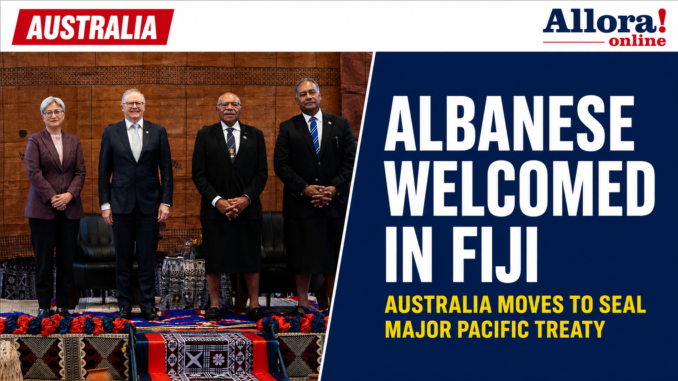
Prime Minister Anthony Albanese has been welcomed in Fiji ahead of the expected signing of the Vuvale Union with Fijian Prime Minister Sitiveni Rabuka, a landmark agreement designed to deepen security, economic and regional cooperation as Australia moves to strengthen its Pacific partnerships.
A traditional welcome before a strategic agreement
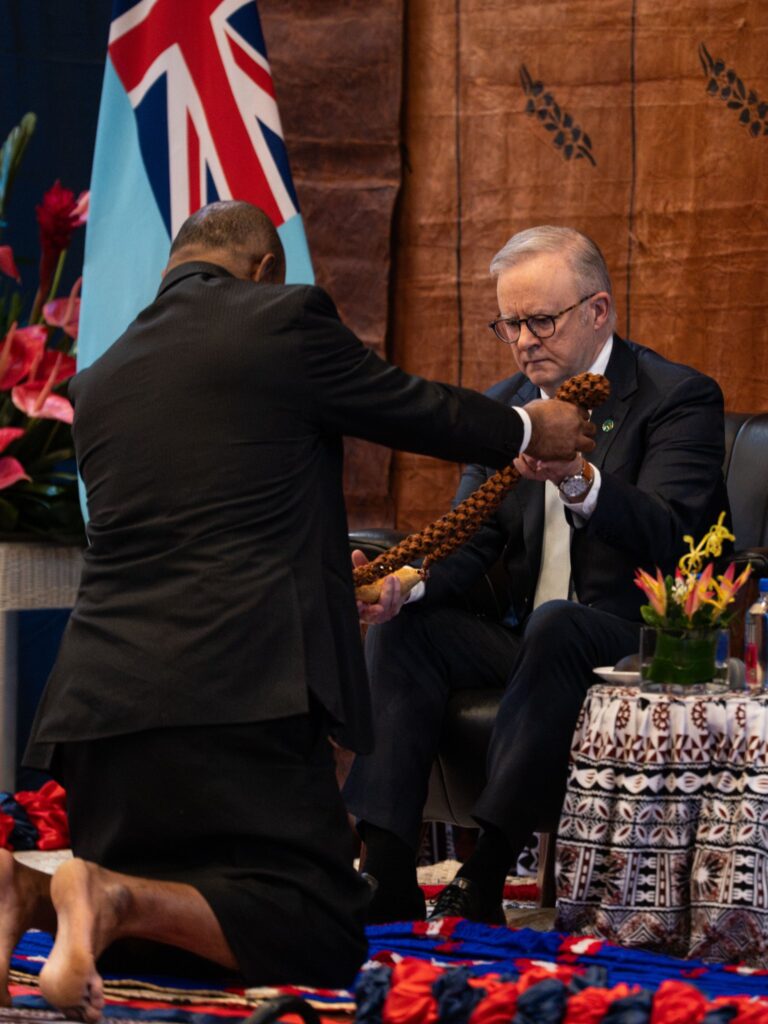
Prime Minister Anthony Albanese has received a traditional welcome in Fiji as Australia prepares to unveil a major new agreement with Suva, marking another step in Canberra’s push to reinforce its position in the Pacific.
The welcome ceremony came ahead of the expected signing of the Vuvale Union with Fijian Prime Minister Sitiveni Rabuka. The agreement is set to elevate the relationship between the two countries and deepen cooperation on security, development, trade and people-to-people ties.
Albanese used the moment to underline Australia’s message to the region: the Pacific is not a distant foreign policy arena, but part of Australia’s own strategic and cultural neighbourhood.
Albanese cites the Pacific as “home”
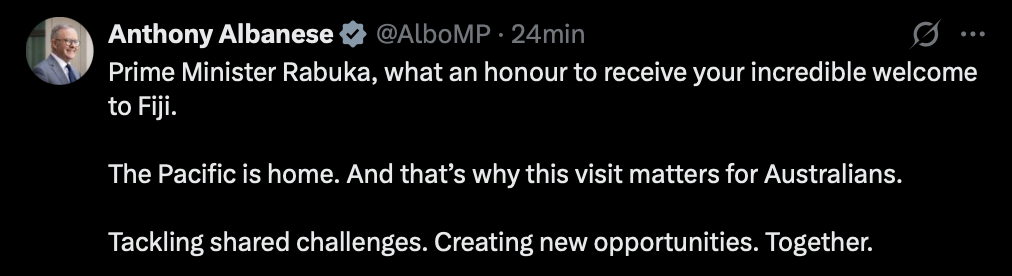
In a post on X, Albanese thanked Rabuka for the welcome and framed the visit as a moment of shared purpose.
“The Pacific is home,” the prime minister wrote, adding that Australia and Fiji were focused on “tackling shared challenges” and “creating new opportunities” together.
The language reflects the tone Canberra has increasingly adopted in the region: partnership, family, respect and long-term commitment, rather than simply security competition.
During the ceremony, Albanese also referred to the strong cultural and people-to-people links between Australia and Fiji, including the presence of representatives from the Yolngu Nation in northern Australia.
“Our partnership is strong, from my Vuvale to yours, Vinaka,” he said, using the Fijian word for thank you.
The meaning of Vuvale
The word Vuvale means family in Fijian and has become the symbolic foundation of the Australia-Fiji relationship.
Australia and Fiji already describe their partnership through the Vuvale framework, but the new Vuvale Union is expected to take that relationship further, turning political goodwill into a more formal strategic pact.
The Australian government said Albanese’s visit to Fiji and Solomon Islands from July 5 to 7 was aimed at reaffirming Australia’s enduring commitment to the Pacific and regional security. In Suva, Albanese is meeting Rabuka to discuss deepening the Fiji-Australia Vuvale Partnership and greater cooperation.
A Pacific deal with China in the background
The agreement comes at a critical time for the Pacific, where Australia and China continue to compete for influence through security partnerships, infrastructure, development funding and diplomatic engagement.
ABC reported that the Vuvale Union is expected to represent a “step up” from current defence arrangements, although the final text has not yet been made public. A Fijian government source told the ABC the pact involved “serious” promises and could create an “alliance” between the two countries.
That language matters. For Canberra, Fiji is not just another Pacific partner. It is a key regional power, a military contributor, a diplomatic voice and a central player in the future of Pacific security.
Australia builds a network of Pacific pacts
The Fiji visit follows the signing of the Nakamal Agreement with Vanuatu, a long-awaited security and development pact that gives Australia a stronger role in Vanuatu’s security and infrastructure landscape.
Reuters reported that the Vanuatu deal includes an Australian pledge of A$500 million over ten years and confirms that Vanuatu will not host foreign military infrastructure, while maintaining its sovereignty.
The Vanuatu agreement, the expected Fiji pact and the Australia-Papua New Guinea Pukpuk Treaty form part of a broader strategy: keep Pacific security anchored in Pacific partnerships and limit openings for external military influence.
From Suva to Honiara, Brisbane and Melbourne
Albanese’s Pacific diplomacy will continue after Fiji. He is expected to travel to Solomon Islands, where he will meet Prime Minister Matthew Wale and attend the country’s Independence Day celebrations.
Australia and Solomon Islands have already committed to working toward a comprehensive treaty based on mutual trust, respect and open dialogue.
Later in the week, Albanese will host regional leaders, including the prime ministers of Papua New Guinea and Tonga, in Brisbane around the State of Origin decider. The message is deliberate: sport, culture and security are all part of the same Pacific family diplomacy.
The prime minister will then meet Indian Prime Minister Narendra Modi in Melbourne, extending the week’s focus from the Pacific to the wider Indo-Pacific.
A diplomatic win for Canberra
For Australia, the expected Vuvale Union is more than a bilateral agreement. It is a diplomatic signal.
Canberra wants to show that it can still be the Pacific’s most trusted partner, not through pressure, but through presence, investment and long-term cooperation.
The ceremony in Fiji was therefore not just symbolic. It was part of a wider strategic contest playing out across the region. With China expanding its reach and Pacific nations demanding respect, sovereignty and tangible support, Australia is trying to prove that it understands the moment.
Albanese’s message was simple: the Pacific is home. The test now is whether Australia can turn that message into lasting trust.