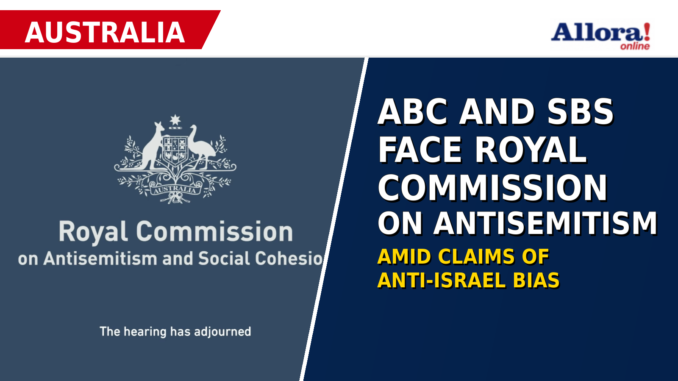
Australia’s public broadcasters, ABC and SBS, are appearing before the Royal Commission on Antisemitism and Social Cohesion amid claims of bias in their coverage of antisemitism and the Middle East conflict. Both broadcasters reject allegations of antisemitic bias and defend their reporting as accurate, fair and impartial.
ABC and SBS under scrutiny
The ABC and SBS are appearing before the Royal Commission on Antisemitism and Social Cohesion as part of hearings examining the spread of antisemitism, hateful speech, online content and the role of traditional media.
The third block of hearings has focused on how antisemitic content is disseminated across digital platforms, social media and broadcasting.
At the centre of the hearing are allegations that Australia’s public broadcasters have shown bias in their coverage of antisemitism and the conflict in the Middle East.
Senior executives to give evidence
Senior ABC officials are expected to appear before the Commission, including ABC Editorial Director Gavin Fang and ABC Ombudsman Fiona Cameron.
SBS will also be represented by senior figures, including Director of Audio and Language Content David Thanh Man Tue Hua, Director of News and Current Affairs Amanda Wicks and SBS Ombudsman Amy Stockwell.
Their evidence is expected to cover editorial standards, complaints processes, newsroom decision-making and how the broadcasters respond to allegations of bias or harmful content.
ABC rejects bias claims
Ahead of the hearing, the ABC rejected claims that its reporting had shown antisemitic or anti-Israel bias.
The national broadcaster said its journalism had been evidence-based, fair, impartial and consistent with its Charter obligations.
ABC also said its reporting had consistently included the experiences of Jewish Australians while providing broader social and political context around events in the Middle East.
Surge in complaints after October 7
Since the October 7, 2023 attacks in Israel and the subsequent war in Gaza, the ABC Ombudsman’s office has received a sharp increase in complaints.
In 2024-25, the office handled 4,192 complaints, with more than a quarter related to Middle East coverage.
To date, the ABC Ombudsman has recorded breaches in five instances of ABC coverage concerning the Middle East. However, ABC says no complaints of bias have been upheld in relation to ABC News coverage of the region.
SBS also in the spotlight
SBS is also facing scrutiny over its coverage of antisemitism, Israel and the Middle East.
The broadcaster is expected to defend its editorial processes and its role as a multicultural public broadcaster serving diverse Australian communities.
For SBS, the challenge is particularly complex: it must report on global conflicts while also reflecting the experiences of communities in Australia directly affected by those events.
Accusations from witnesses and critics
Some submissions received by the Royal Commission have reportedly been highly critical of both ABC and SBS.
Several witnesses and political figures have accused the broadcasters of failing to meet expectations of impartiality, particularly in their coverage of Israel, Gaza and antisemitism in Australia.
Liberal Senator Sarah Henderson has welcomed the decision to call the public broadcasters before the Commission, arguing that many Australians have lost confidence in the ABC and SBS because of what she described as repeated anti-Israel bias.
ABC and SBS reject that characterisation.
The question of impartiality
The hearing goes to the heart of public broadcasting in Australia.
ABC and SBS are publicly funded institutions with obligations to accuracy, balance, fairness and independence. When they cover highly divisive issues such as Israel, Gaza and antisemitism, their editorial choices are placed under intense scrutiny.
The challenge is significant: reporting on a war while avoiding language, framing or omissions that could contribute to community division or perceptions of bias.
The Royal Commission’s role
The Royal Commission is not expected to adjudicate every individual complaint made against the broadcasters.
Its broader task is to examine whether existing systems are adequate: editorial policies, complaints mechanisms, internal review processes and the ability of media organisations to respond to antisemitism or allegations of bias.
The key question is whether Australia’s public broadcasters have the tools, culture and accountability needed to cover such sensitive issues responsibly.
A test for public trust
The appearance of ABC and SBS before the Royal Commission is a major moment for Australian media.
At stake is not only the reputation of two broadcasters, but also public confidence in journalism at a time of rising antisemitism, polarisation and distrust.
For Jewish Australians who feel media coverage has failed them, the hearing is an opportunity to be heard.
For ABC and SBS, it is an opportunity to defend their standards, explain their processes and demonstrate that public broadcasting can remain independent, accurate and fair even in one of the most divisive news environments in the world.
Journalism under pressure
The conflict in the Middle East has become one of the most difficult stories for media organisations to cover.
Every headline, image, guest, omission and phrase can be interpreted as a political position. But difficulty does not remove responsibility.
The Royal Commission will now test whether Australia’s public broadcasters have met that responsibility — and whether their systems are strong enough to maintain trust across a divided national audience.