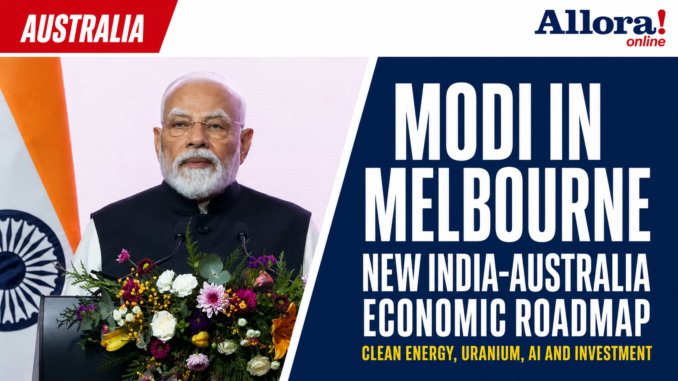
Indian Prime Minister Narendra Modi has addressed the Economic Roadmap Business Reception in Melbourne, presenting India and Australia as “natural and trusted partners” in a world marked by uncertainty, market disruption and energy insecurity. His message focused on clean energy, civil nuclear cooperation, critical minerals, infrastructure, artificial intelligence, semiconductors, education and long-term Australian investment in India.
Melbourne becomes the centre of India-Australia economic diplomacy
Narendra Modi’s visit to Melbourne has become a major moment in the growing economic and strategic partnership between India and Australia.
Speaking at the Economic Roadmap Business Reception, the Indian prime minister described Australia as a natural and necessary partner for India at a time when the world is facing uncertainty, market disruption and energy crises.
Modi told business leaders that their presence symbolised the confidence and shared ambition of both nations. His message was clear: the India-Australia relationship is ready to move from opportunity to execution.
From trade to strategic cooperation
Modi highlighted the progress made since the 2022 trade agreement between India and Australia, saying the deal had opened new market access and strengthened economic cooperation.
But he also made clear that the relationship must now move beyond trade.
The next phase, he said, should focus on investment, innovation, industry and global cooperation. Modi described the “runway of investment and innovation” as ready for take-off and urged business leaders to help take the partnership to new heights.
Clean energy at the centre
Clean energy was one of the strongest themes in Modi’s address.
India aims to reach 500 gigawatts of renewable energy capacity by 2030 and achieve net zero by 2070. Modi said India is building projects in hydro power, green hydrogen, solar modules and clean manufacturing to create a new innovation ecosystem.
Australia’s technology, capital and natural resources, he said, could accelerate India’s energy transition.
The opportunity is not only environmental. It is industrial and strategic.
Uranium and civil nuclear power
Modi also pointed to major opportunities in civil nuclear energy.
He said India had recently opened its nuclear sector to private companies and had set a target of 100 gigawatts of nuclear energy by 2047. Australia’s large uranium reserves, he suggested, could play an important role in supporting India’s nuclear energy ambitions.
This is one of the most strategic areas of the bilateral relationship. For India, Australian uranium can help support energy security and decarbonisation. For Australia, India represents a vast and growing long-term market.
Infrastructure: scale, speed and stability
Modi presented India’s infrastructure transformation as a major opportunity for Australian investors.
He pointed to ports, airports, roads, railways and urban infrastructure as sectors open to long-term investment. He also highlighted the pace of construction in India, citing around 34 kilometres of roads per day and more than 8 kilometres of railways per day.
His message to investors was built around three words: scale, speed and stability.
For Australia’s superannuation funds, infrastructure companies and long-term capital providers, India is positioning itself as one of the world’s most important growth platforms.
Green steel, low-carbon aluminium and critical minerals
The Indian prime minister also focused on industrial transformation.
He said India, now the world’s second-largest steel producer, can work with Australia on low-carbon aluminium, green iron and the modernisation of heavy industry.
The fit is clear. Australia has resources, renewable energy potential and critical minerals. India has manufacturing scale, industrial demand and a rapidly expanding domestic market.
Together, the two countries could build new clean industrial supply chains for the Indo-Pacific.
AI, quantum and semiconductors
Technology was another major pillar of the speech.
Modi cited India’s AI Mission, Quantum Mission, semiconductor programme and digital public infrastructure as areas where both countries can collaborate to create global solutions.
India wants to become a global hub for artificial intelligence, chips, data infrastructure and digital platforms. Australia can contribute through research, universities, capital, medical technology and innovation ecosystems.
The partnership is no longer limited to resources and education. It is moving into advanced technology and strategic industries.
Australian super funds and long-term capital
Modi also praised the role of Australian pension funds in India.
He said Australian funds had already invested billions in India, helping create stable and sustainable long-term growth. His message was aimed at increasing trust and attracting more Australian capital.
This matters because Australian superannuation capital is among the largest and most sophisticated pools of long-term investment in the world.
For India, that capital can help finance infrastructure, energy, logistics and technology. For Australia, it provides exposure to one of the fastest-growing major economies.
Education and talent mobility
Education remains one of the deepest links between the two countries.
Modi said India and Australia have a natural synergy in schools and higher education. He pointed to Deakin Universityand the University of Wollongong as examples of Australian institutions building a presence in India.
He said the goal is to transform student mobility into a broader talent partnership.
That means moving beyond Indian students coming to Australia and building a two-way ecosystem of skills, research, jobs and innovation.
Connecting Australian states with Indian regions
One of the most important parts of Modi’s speech was his focus on subnational cooperation.
He said the partnership must not be limited to two governments or a few major cities. It must connect states, regions, universities, companies and smaller business communities.
He gave concrete examples: Western Australia’s critical minerals can be linked with the manufacturing capacity of Odisha and Gujarat; clean energy and agriculture in South Australia and Tasmania can support new renewable and food-processing corridors; New South Wales and Victoria can connect their finance, education, medical technology and innovation ecosystems with Maharashtra, Karnataka and Telangana.
This is a strategic shift: the India-Australia relationship is being mapped not only between capitals, but between economic regions.
A partnership for the Indo-Pacific
Modi’s speech showed that India and Australia increasingly see each other as essential partners in the Indo-Pacific.
Australia brings resources, energy, universities, capital and technological expertise. India brings scale, manufacturing, a huge market, digital ambition and strategic weight.
The relationship is no longer only about trade or migration. It is about building new supply chains, securing energy transitions, advancing defence-adjacent technologies and creating alternatives in a disrupted global economy.
A roadmap for the future
The Economic Roadmap Business Reception in Melbourne was not simply a diplomatic event.
It was a business and strategic pitch.
Modi presented India as a long-term destination for Australian capital, a partner for clean energy and critical minerals, a collaborator in AI and semiconductors, and a growing market for education and talent.
For Australia, India is becoming one of the defining relationships of the next decade.
For India, Australia is a trusted partner in building the economic architecture of the Indo-Pacific.
The runway, as Modi suggested, is ready. The question now is how high both countries are prepared to fly together.