
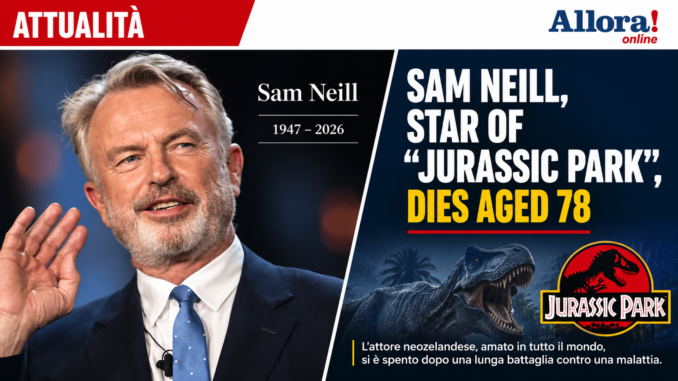
The New Zealand actor died in Sydney surrounded by his family. During a career spanning five decades, he appeared in more than 150 film and television productions
Sam Neill, one of the most recognisable and respected actors in international cinema, has died at the age of 78.
The New Zealand actor, best known for playing palaeontologist Dr Alan Grant in the “Jurassic Park” franchise, died in Sydney on Monday, July 13, surrounded by his family.
His death was announced by relatives in a message published on the actor’s Instagram account.
“Sam was surrounded by family and passed with the dignity that characterised his entire life,” the statement said.
His family also confirmed that Neill was cancer-free at the time of his death.
His battle with a rare form of lymphoma
Neill was diagnosed in March 2022 with angioimmunoblastic T-cell lymphoma, a rare and aggressive form of blood cancer.
The actor had spoken publicly about his illness and the difficult treatment he underwent over several years.
He later revealed that medical examinations had shown no remaining signs of cancer.
His family did not immediately announce the cause of death, describing his passing as sudden and unexpected.
Global fame through “Jurassic Park”
For millions of viewers, Sam Neill will always be remembered as Dr Alan Grant, the palaeontologist invited to inspect John Hammond’s revolutionary dinosaur park.
Directed by Steven Spielberg, “Jurassic Park” was released in 1993 and became one of the most successful films in cinema history.
Neill’s restrained, intelligent and often humorous performance helped turn Alan Grant into one of the franchise’s most beloved characters.
He returned to the role in “Jurassic Park III” and, many years later, in “Jurassic World Dominion”, reuniting with Laura Dern and Jeff Goldblum.
A five-decade career
Neill’s career extended far beyond the world of dinosaurs.
Over more than 50 years, he appeared in more than 150 film and television productions, moving easily between major Hollywood releases, independent cinema and television drama.
His international breakthrough began in the late 1970s with “My Brilliant Career”, a film that became an important part of Australian cinema history.
He later appeared alongside Nicole Kidman in “Dead Calm” and played Soviet naval officer Vasily Borodin in “The Hunt for Red October”.
From arthouse cinema to major productions
Neill was also part of the cast of Jane Campion’s “The Piano”, which won the Palme d’Or at the Cannes Film Festival.
His ability to combine elegance, vulnerability, menace and humour allowed him to take on a wide range of roles throughout his career.
He appeared in science-fiction and horror films such as “Event Horizon”, as well as historical dramas, comedies and family productions.
Television audiences also knew him for his role as Inspector Chester Campbell in “Peaky Blinders”, one of the most dangerous opponents faced by the Shelby family.
His deep connection with New Zealand
Born in Northern Ireland in 1947, Neill grew up in New Zealand, the country he always regarded as home.
Despite his international success, he remained closely connected to Australian and New Zealand cinema and continued to support productions from both countries.
One of his most popular later performances came in Taika Waititi’s “Hunt for the Wilderpeople”, in which he played a solitary man forced to care for a troubled young boy.
The film introduced Neill to a new generation of viewers and once again highlighted his ability to balance humour, tenderness and melancholy.
Actor, author and winemaker
Away from the screen, Neill lived a quieter life connected to the land and winemaking.
He owned Two Paddocks, a winery in New Zealand’s Central Otago region.
Through social media, he often shared images of the vineyard, farm animals and everyday life, revealing an ironic and down-to-earth personality far removed from Hollywood glamour.
He also wrote the memoir “Did I Ever Tell You This?”, completed during his battle with lymphoma.
The book was not only about illness, but also about family, cinema, friendships and the experiences that shaped his life.
Facing illness with humour and dignity
When Neill publicly revealed his diagnosis, he approached the subject with the same calmness and honesty that characterised many of his performances.
He did not hide the seriousness of the disease, but refused to allow cancer to define his entire life.
He continued working, writing and managing his winery while maintaining a direct relationship with his audience.
News that he had become cancer-free had been warmly welcomed by fans, making the announcement of his death even more unexpected.
The family’s farewell
In their statement, Neill’s relatives remembered a man who maintained his dignity, humour and privacy even during the most difficult moments.
They asked for respect while the family mourned his loss.
Tributes quickly arrived from fellow actors, filmmakers and viewers around the world, reflecting the affection felt for a performer who remained approachable despite his international fame.
An unforgettable screen presence
Sam Neill belonged to a rare group of actors capable of making almost any character believable.
He could play a hero, an ordinary man, a threatening antagonist or a warm and humorous father figure.
Even in the biggest productions, his performances remained controlled, intelligent and deeply human.
Cinema has lost a versatile and much-loved actor.
His films remain, along with the familiar hat of Dr Alan Grant, the expression of wonder before the dinosaurs of “Jurassic Park” and a career built with talent, intelligence and remarkable dignity.