Technology, energy and shared democratic values are redefining global balances
The relationship between India and Italy has entered a decisive new phase.
What was once a strong diplomatic friendship is now evolving into a “Special Strategic Partnership” built on shared democratic values, economic ambition and a common vision for the future.
At a time when the international order is being reshaped by geopolitical tensions, technological revolutions and energy transitions, Rome and New Delhi are positioning themselves as two increasingly important strategic partners linking Europe, the Mediterranean and the Indo-Pacific.
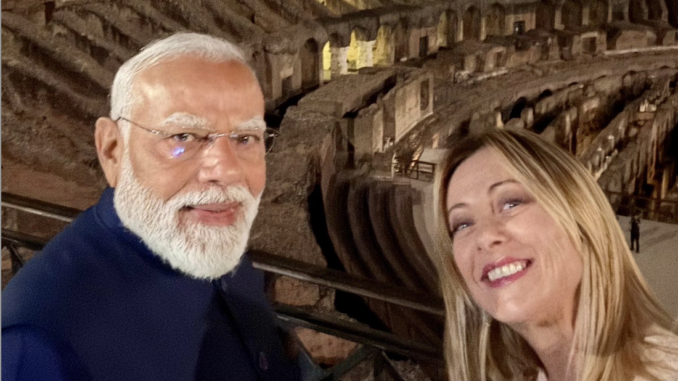
The recent summit between Giorgia Meloni and Narendra Modi confirmed this growing alignment. Behind the diplomatic symbolism lies a much broader project: the creation of a new economic and geopolitical corridor capable of influencing the global balance of power in the coming decades.
Both countries aim to increase bilateral trade to more than €20 billion by 2029, supported by the future EU-India Free Trade Agreement and by a rapidly expanding network of industrial, technological and academic cooperation.
But this partnership goes far beyond trade numbers.
Italy brings world-renowned industrial excellence, advanced manufacturing, aerospace expertise, luxury design, engineering capabilities and strategic infrastructure in the heart of the Mediterranean. India contributes one of the fastest-growing economies in the world, a massive technological ecosystem, engineering talent, digital innovation and an entrepreneurial landscape with more than 100 unicorns and over 200,000 startups.
Together, the two nations are attempting to create something much larger than a traditional commercial alliance: a co-creation platform for the industries of the future.
Artificial intelligence, quantum computing, advanced manufacturing, critical minerals, cybersecurity, semiconductors and clean energy are all becoming central pillars of this strategic relationship.
Particularly significant is the shared vision regarding Artificial Intelligence. Both governments have repeatedly stressed the importance of developing human-centric, ethical and trustworthy AI systems.
India’s concept of “MANAV” — placing the human being at the centre of technology — aligns naturally with Italy’s long-standing advocacy for an “algor-ethics” approach rooted in European humanist traditions.
This convergence is increasingly important in a world where technology is rapidly transforming economies, societies and democratic systems.
Rome and New Delhi are openly arguing that AI must serve humanity rather than replace it, and that digital innovation should strengthen democracy instead of undermining it.
The strategic partnership also extends into defence and maritime security.
As instability grows across the Middle East, the Red Sea and the Indo-Pacific, both countries are expanding cooperation in military technologies, naval systems, electronic warfare and maritime security infrastructure.
This is particularly relevant for the India-Middle East-Europe Economic Corridor (IMEC), the ambitious infrastructure project designed to connect India to Europe through the Gulf and the Mediterranean.
For Italy, IMEC could become a historic opportunity to transform the country into the primary European gateway linking Indo-Pacific trade routes with continental Europe.
For India, the corridor represents a strategic alternative to existing global supply chains dominated by China.
Energy cooperation is another crucial pillar.
India’s ambition to become a major exporter of green hydrogen complements Italy’s technological leadership in renewable infrastructure and Europe’s growing demand for energy diversification.
From hydrogen technologies to smart grids, resilient infrastructure and biofuels, the partnership reflects a shared understanding that energy security will define geopolitical influence in the coming decades.
At the same time, the growing collaboration between universities, research centres and innovation hubs demonstrates that this alliance is not purely economic or military. It is also cultural and civilisational.
India’s philosophy of “Vasudhaiva Kutumbakam” — “the world is one family” — resonates with Italy’s Renaissance humanism and its long tradition of placing culture, creativity and human dignity at the centre of society.
In many ways, the India-Italy partnership reflects the emergence of a broader geopolitical concept: the Indo-Mediterranean.
A new interconnected space where trade, technology, energy, data and strategic infrastructure flow between the Indian Ocean and Europe.
And within this emerging global architecture, India and Italy increasingly appear determined not merely to adapt to the future — but to help shape it.