
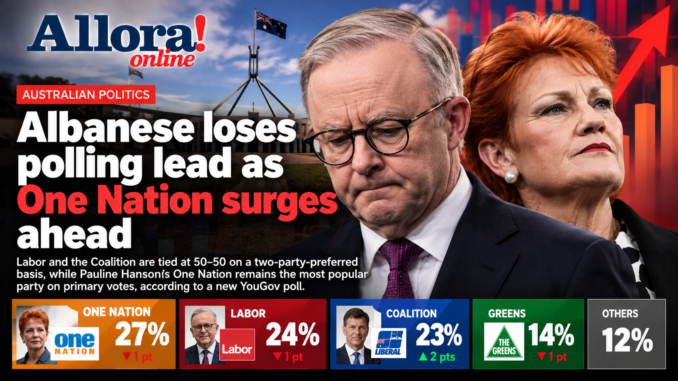
Labor and the Coalition are now tied at 50–50 on a two-party-preferred basis, while Pauline Hanson’s One Nation remains Australia’s most popular party on primary votes. A new YouGov survey reveals growing dissatisfaction with the government, deepening economic anxiety and the possibility of a dramatically reshaped political landscape.
Allora! Online – Political Desk
Australian Prime Minister Anthony Albanese is facing one of the most challenging moments of his political leadership after a new national opinion poll revealed that Labor has lost its two-party-preferred advantage for the first time since the 2025 federal election.
The latest News24.com.au Pulse/YouGov survey places Labor and the Liberal-National Coalition level at 50 per cent each after preferences, marking a significant shift in the political landscape and raising questions about the government’s ability to retain power at the next election.
Perhaps even more remarkable is the continued rise of Pauline Hanson’s One Nation, which remains the leading party in primary voting intentions, ahead of both major political parties.
The findings suggest that Australia’s traditional two-party political system is experiencing increasing pressure as voters express frustration with the cost of living, housing affordability, taxation and the country’s economic direction.
One Nation leads while Labor falls to a historic low
The latest survey, conducted among approximately 1,500 voters between October 13 and 20, paints a troubling picture for the government.
According to the results, One Nation leads on 27 per cent of the primary vote, followed by Labor on 24 per cent and the Coalition on 23 per cent.
The Greens attract 14 per cent, while independents and smaller parties account for the remaining 12 per cent, including 2 per cent for Community Strong Australia.
For Labor, the result represents a dramatic deterioration from its position following the 2025 federal election.
Its primary vote has fallen by more than 10 percentage points since that election, while support among working-class voters has reportedly dropped to just 20 per cent.
YouGov’s director of public data, Paul Smith, described Labor’s result as an unprecedented low in the polling organisation’s records.
The decline is particularly significant because working-class voters have historically represented an important part of Labor’s electoral support.
Their apparent movement away from the government highlights the difficulty Albanese faces in maintaining the broad coalition of voters that delivered his previous electoral success.
The Coalition, meanwhile, has recovered modestly, gaining two percentage points to reach 23 per cent. However, its continued position behind One Nation demonstrates that voter dissatisfaction is not automatically translating into greater support for the traditional opposition.
A 50–50 contest changes the political equation
For the first time since Labor’s victory in 2025, the News24 Pulse/YouGov polling indicates an evenly balanced contest between the government and the Coalition.
Labor previously maintained a 52–48 advantage on a two-party-preferred basis, but that lead has now disappeared.
The latest figures suggest that if an election were held under similar conditions, the outcome could be highly uncertain.
However, the national two-party-preferred figure cannot by itself determine which party would form government.
Australia’s preferential electoral system, the distribution of support across individual electorates and the growing strength of minor parties could produce a parliamentary composition very different from previous elections.
The emergence of One Nation as the leading party on first preferences further complicates conventional electoral calculations.
A strong national primary vote does not necessarily translate into an equivalent proportion of parliamentary seats, particularly when support is distributed unevenly across the country.
Nevertheless, the results indicate that the political competition is no longer confined to the familiar battle between Labor and the Coalition.
When Labor is measured against One Nation in a separate two-party-preferred scenario, Albanese’s party retains a 53–47 advantage, unchanged from the previous survey.
This distinction is important: One Nation leads in first preferences, but Labor continues to benefit from preference distributions in that hypothetical head-to-head contest.
Albanese’s personal approval reaches a new low
The government’s difficulties are reflected in the Prime Minister’s personal ratings.
According to the survey, Albanese’s net satisfaction rating has fallen to minus 30, the lowest recorded for him in the News24 Pulse series.
Only 32 per cent of respondents expressed satisfaction with his performance, while 62 per cent were dissatisfied and 6 per cent remained undecided.
These figures reveal a substantial deterioration in public confidence and suggest that the political challenge extends beyond dissatisfaction with individual government policies.
Opposition Leader Angus Taylor also faces negative public perceptions.
His net satisfaction stands at minus 14, with 35 per cent satisfied and 49 per cent dissatisfied.
Despite Albanese’s declining approval, he retains a narrow advantage over Taylor as preferred prime minister.
The results place Albanese on 41 per cent and Taylor on 39 per cent, with 20 per cent undecided.
Against Pauline Hanson, Albanese maintains a stronger lead of 50 to 42 per cent, although the gap has narrowed from 10 percentage points in the previous survey to eight.
The figures suggest that while Australians are increasingly dissatisfied with the government’s performance, neither the traditional opposition nor One Nation has established an overwhelming advantage in perceptions of national leadership.
Economic pressure fuels political uncertainty
Economic concerns remain central to the changing political environment.
Australian households continue to confront pressure from grocery prices, housing costs, energy bills and uncertainty about the wider economy.
The survey found that 65 per cent of voters expect unemployment to increase over the next 12 months, indicating considerable concern about the country’s economic outlook.
Treasurer Jim Chalmers has faced intensified political scrutiny over inflation, interest rates and taxation measures following the 2026 federal budget.
Changes involving capital gains tax, trusts and investment property arrangements have become points of disagreement between the government and its opponents.
One Nation has sought to capitalise on these concerns by presenting itself as an alternative to Labor’s economic policies.
Hanson has pledged to reverse several government tax measures, including restoring the 50 per cent capital gains tax discount, removing proposed changes to the taxation of trusts and protecting negative gearing for up to two investment properties.
The party argues that its economic approach would provide greater certainty for households and investors.
Labor, however, faces the challenge of defending its economic reforms while convincing voters that its policies will deliver lasting improvements in living standards.
The growing strength of One Nation suggests that economic dissatisfaction may be encouraging some voters to reconsider their traditional political allegiances.
The fragmentation of Australia’s political system
Perhaps the most important message emerging from the latest survey is the continued fragmentation of political support.
With Labor attracting 24 per cent of primary votes, the Coalition 23 per cent and One Nation 27 per cent, no major political force commands even one-third of the electorate at first preference.
This represents a striking departure from the historical dominance of Australia’s two principal political blocs.
The Greens remain an important electoral presence, while independents and other minor parties continue to attract a meaningful share of voters.
Such fragmentation could make future elections increasingly difficult to predict.
In particular, the possibility of a hung parliament, expanded crossbench representation or new parliamentary agreements cannot be dismissed.
However, opinion polls remain snapshots of public sentiment rather than definitive forecasts.
Voter preferences can shift significantly before an election, and the translation of national voting percentages into parliamentary seats depends on numerous local factors.
What does this mean for the next federal election?
For Albanese, the findings represent a clear political warning.
The government must confront declining primary support, deteriorating personal approval ratings and an electorate increasingly concerned about its financial security.
For the Coalition, the picture is more complicated.
Although it has recovered some ground and drawn level with Labor after preferences, it has not regained its traditional position as the dominant alternative on primary votes.
For Pauline Hanson, the results demonstrate that One Nation’s recent polling strength is not simply an isolated movement.
The party has maintained its lead over Labor and the Coalition, reinforcing the possibility that it could play an increasingly influential role in Australia’s next parliamentary contest.
Yet the real test will come when voters are required to choose not merely which party best expresses their dissatisfaction, but which representatives they trust to govern.
A political turning point for Australia?
Australian politics appears to be entering a period of unusual uncertainty.
The government has lost its polling advantage, the traditional opposition remains under pressure, and One Nation has established itself as a formidable competitor for first-preference support.
The latest figures do not establish that Labor will lose the next federal election. Nor do they demonstrate that One Nation is certain to become the official opposition or form part of a future government.
They do, however, reveal a significant transformation in public attitudes.
Economic insecurity, dissatisfaction with established political parties and changing voter loyalties are reshaping the national debate.
The challenge for Australia’s political leaders is no longer simply to win back voters from their traditional opponents.
It is to restore confidence among an electorate increasingly willing to look beyond the country’s established political institutions.
For the first time since the 2025 election, the political question is not merely how large Labor’s advantage remains, but whether that advantage exists at all.
And with One Nation continuing to lead the primary vote, Australia’s next federal election may prove far less predictable than either major party would have imagined.
