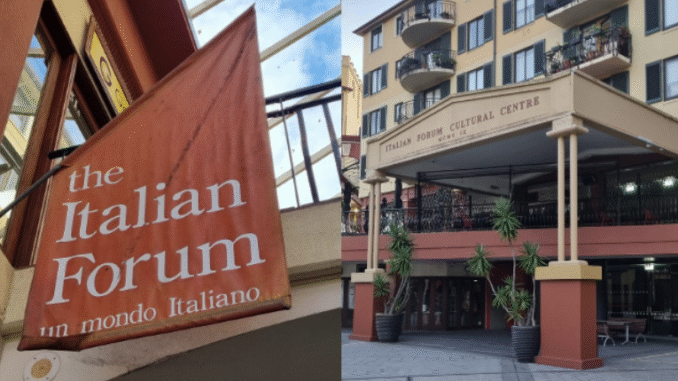
Allora! has been informed that a theatre company has secured the lease of the Italian Forum Cultural Centre in Leichhardt, ending months of uncertainty over the future of the iconic venue. But the news now sparks fresh concerns about community access to the space that once served as the heart of Sydney’s Italian-Australian community.
The identity of the theatre company and specific lease terms have not been disclosed, fueling concerns among locals who fear being locked out of their former cultural hub. Co.As.It., the not-for-profit organisation that purchased the venue in 2015, failed to sell the centre and piazza to private developer Redstone for $11 million in 2023.
For the ten years prior, the Cultural Centre was leased to Actors Australia, who arguably left the building in a state of disrepair at the end of their contract, with “cabling for screen activation cut and even essential flooring carpets removed”, according to one source. During that same period, Co.As.It. retained access to the venue for only 20 days each year.
In 2019, the Cultural Centre hosted just eight public events, down from dozens in previous years. Rising venue hire costs and declining patronage had already transformed the once-vibrant space into an underutilised venue. The pandemic further reduced activity, prompting Co.As.It. to seek a buyer for the heritage-listed site.
When Co.As.It. advertised the centre for lease last year at $380,000 per year (net, plus GST), it offered both short-term and long-term arrangements. The identity of the successful tenant – a theatrical company – has now been revealed, but the specific terms of their lease remain under wraps.
Some have called this lack of information “a lightning rod for community frustration. Without knowing the details of the arrangement, we are left to speculate about everything from rental duration to community access provisions,” stated a local business owner, asking to remain unnamed for fear of reprisals.
Co.As.It. seems to have informally noted that “there will be opportunities for the community to use the Centre,” but skepticism runs deep.
Many fear that access will be limited to those who are “simpatici” – personally agreeable – to the Co.As.It. Board or management, rather than genuinely serving the broader Italian-Australian community and general public.
Perhaps most concerning is the absence of the promised community consultation process. Despite repeated announcements about engaging with locals to guide the centre’s future, no such consultation has materialised. This silence has left many questioning whether the current arrangement truly serves community interests or simply meets the organisation’s internal priorities.
In addition to these concerns, the physical state of the Italian Forum Cultural Centre has become a pressing issue. The facilities are now visibly ageing, with very little in the way of renovations or upgrades undertaken over the years.
At the same time, the costs associated with hiring the venue have become increasingly unsustainable for artistic and community groups. Local organisations have found themselves priced out of the space, unable to shoulder the high fees required to stage events or cultural activities. As a result, the Centre’s potential as a vibrant cultural hub remains largely untapped, and its accessibility to the broader community continues to erode.
The Italian Forum Cultural Centre was conceived as something special—a space where Italian heritage could flourish in Sydney, where culture could be celebrated and preserved for future generations. Today, with its future tied to a commercial lease and details shrouded in opacity, the community is left asking a fundamental question: Is this the best they deserve?
The hope remains that the new era will breathe fresh life into the precinct. A theatrical company could bring regular programming, draw new audiences, and create opportunities for cultural exchange.
But without transparency about the lease terms, community access provisions, or long-term vision, these hopes feel more like wishful thinking than realistic expectations.