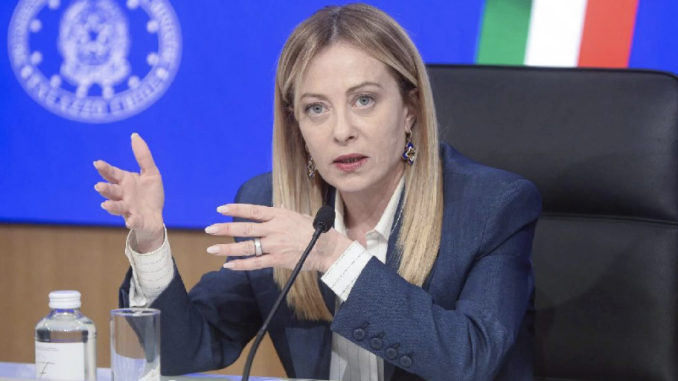
Giorgia Meloni’s government is set to become the second longest-serving administration in the history of Italy’s republic, marking a rare moment of political continuity in a country often characterized by frequent government turnover.
The current executive led by Giorgia Meloni has reached a duration that places it ahead of the Berlusconi IV government, at approximately 1,287 days in office. This milestone positions Meloni’s cabinet behind only the second government of Silvio Berlusconi, which lasted 1,412 days between 2001 and 2005.
Italy is known for short-lived governments, with the average administration historically lasting little more than a year. Against this backdrop, Meloni’s tenure stands out as an exception. The next symbolic target is the Berlusconi II government, the longest in republican history. That administration, also led by Berlusconi, remained in office for nearly a full legislative term, setting a benchmark that current projections suggest Meloni could challenge if political stability continues.
The comparison inevitably reaches further back into Italy’s political history. During the First Republic, longer governments were rare but not absent. The record for that era is often associated with the administration of Bettino Craxi, whose government in the 1980s marked a relative phase of stability in an otherwise fragmented system.
More recently, governments have tended to be shorter-lived, even when politically significant. The administration of Matteo Renzi (2014–2016) is among the longest in the modern era, while earlier coalition experiments such as Romano Prodi’s first government (1996–1998) were notable for both their reform ambitions and their fragility. Looking further back, landmark figures such as Aldo Moro and Alcide De Gasperi led governments that shaped Italy’s post-war institutions, though even those administrations were often subject to shifting parliamentary coalitions.
Commenting on the milestone, Giovanbattista Fazzolari, undersecretary to the Prime Minister, emphasized continuity as a central achievement of the current administration.
Fazzolari described the government’s longevity as particularly significant in a country where political turnover is typically rapid. He argued that stability itself has both domestic and international value, reinforcing Italy’s credibility.
However, he also stressed that duration alone is not the key metric. Instead, he highlighted policy outcomes such as employment levels, fiscal stability, and investor confidence as the real indicators of success.
Among the figures cited by the government is a projected fiscal impact of tax reforms, including adjustments to income tax brackets and reductions in labor costs. According to Fazzolari, these measures effectively shift around €21 billion annually from public revenues to households and workers.
Despite the symbolic milestone, the government faces a complex policy environment in 2026. International tensions remain a central concern, including the ongoing conflict between Russia and Ukraine and broader geopolitical instability involving Iran, the United States, and Israel. These external pressures are seen as key tests for the government’s ability to maintain both economic stability and diplomatic influence.
If the current trajectory continues, Meloni’s government could further climb the historical rankings of Italy’s longest-serving administrations. Yet, in a political system historically marked by fragmentation and coalition shifts, longevity remains both a statistical achievement and a political exception.
For now, the government’s position in the ranking confirms a notable fact: Italy’s current executive has already entered a category of rare durability, with only a few administrations in republican history having lasted longer underscoring both political resilience and the continuing challenges of governing Italy today at present level overall reinforcing its standing while testing coalition cohesion and policy delivery across domestic reforms and international strategic commitments ahead moving forward while balancing fiscal discipline, electoral expectations, coalition dynamics, and evolving European Union priorities.