By Anna De Peron
It is difficult to find a parking space. A sea of mud spattered cars line up beside the ditches bordering the sugar cane paddocks. This is the tiny hamlet of Silkwood, population 6oo, twenty five kilometres south of Innisfail, in Far North Queensland. The sleepy village with its handful of high set houses, enveloped in lush green and dappled with the brilliant hues of the bougainvilleas, comes alive for one day every year on the first Sunday in May. The reason? The celebration of the Feast of the Three Saints. This feast can be traced back to the Roman Empire, when Saint Cirino, Saint Filadelfio and Saint Alfio were martyred in 253 AD at Lentini, Sicily, in the time of the Emperor Tertullian. The remains of the Saints are kept in the village of Sant’ Alfio and a feast in their honour is held there every year.
This Sicilian tradition was brought to Silkwood by Rosario Tornabene, a migrant from Sicily. His wife was seriously ill after the birth of their child. It is said that Rosario had dream in which the Three Saints appeared and reassured him that she would recover. She did get well again, and Rosario had the statues of the Saints brought to Silkwood from Italy as an expression of votive thanks. The feast in honour of the Three Saints began in 1950. It is now regarded not only as a religious event but also as a celebration of Sicilian heritage in Far North Queensland.
The crowd at Silkwood is largely Sicilian, however, the feast has become a major drawcard on the events calendar of Far North Queensland for all Italians.
I finally manage to squeeze my car in between two Land Cruisers and join the throng making its way to the small, white building – the Catholic Church. The clouds hang heavily on the sides of the mountains, but everyone here is confident that the Three Saints will perform their yearly miracle. It never rains in Silkwood on the day. This is quite a feat since it is still the wet season and drenching downpours are the order of the day!
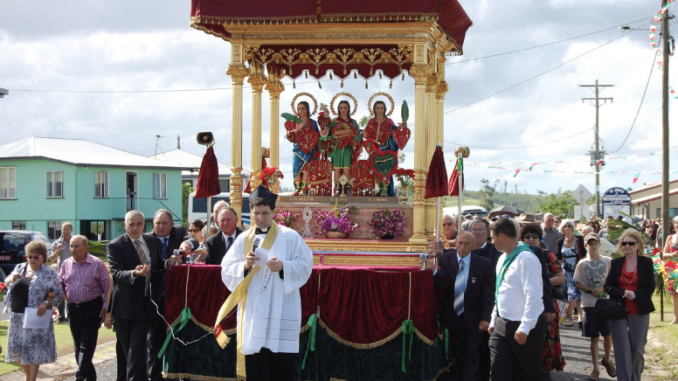
At the front of the church there is a large float. It is lavishly decorated with plush red velvet and golden ornamentation. The statues of the Three Saints draped in early Roman Christian garb, have been placed beneath the gilded doric columns.
The ceremony begins, officiated by priests and the solemnity of the event is accentuated by the presence of the Bishop of Cairns.
The officials from the committee of the festival prepare to unveil the statues and carry the float in procession. As the priests begin Benediction, the people are extolled to make their votive offerings to the Saints. Every time someone makes an offering there are loud cries of “Viva Sant’ Alfio!”
Nowadays, offerings are limited to ten or twentydollar notes, with the occasional fifty thrown in. According to the locals, back in the golden era of the cane cutters, people would donate enormous amounts of money and at the end of the procession the statues were covered with valuable jewellery.
Benediction over, the float is positioned to be carried around the streets. I am startled by a loud boom. I learn that the signal for the procession to get on the way is heralded by the bangs of firecrackers.
The explosions reverberate at regular intervals throughout the event. Men in suits and women and children in their Sunday best, slowly fall into step behind the float as it is carried around the streets of Silkwood. The priests lead and chant litanies, they are followed by the Cairns Municipal Band, belting out traditional Italian sacred hymn such as “Noi vogliam Dio…”
It is a strange scene. The religious procession with its roots in the ancient history and traditions of Sicily, is normally associated with the old villages blanched and parched by the fierce Sicilian sun.
Here in Silkwood, the pageant takes place against the backdrop of the emerald walls of the sugar cane, banana plantations and the rainforest, all swathed in grey mist and heavy with humidity. As the procession moves along in its Baroque splendour, flocks of brolgas fly overhead and the tropical parrots screech in the palm trees. Some locals lean over their verandas and gaze in awe at the mesmerising spectacle.
It is now 4.30pm. The clouds still hover menacingly, and it is getting dark. Still not a drop of rain. After the completion of its round, the procession returns to the front of the church. The float is carried inside, and the people follow. High Mass in Italian, is concelebrated by the priests and the Bishop.
The solemn atmosphere of the procession and the Mass, is replaced by the animated chatter of people who haven’t seen each other for a while. Pies, hot dogs and hamburgers vie with canolli, arancini, lasagne and toasted cicceri. Sicilian dialect is spoken only by the older generations. There is a lot of reminiscing about the cane cutting days of their grandfathers.
The food stalls are replenished with mountains of pasta, sausages and sweets. The beer and the wine flow, the air pervades with general bonhomie. At about ten o’clock the children get stroppy and everyone eagerly anticipates the fireworks display. The black clouds are brilliantly lit by the sprays and the whirls of the light show and the air shattered by the cracks of the explosions. Then silence.
The Festa is finished. Good byes are said and people make their way to the cars and buses. Another successful Feast of the Three Saints is over until next year. And it didn’t rain. Although it came close.