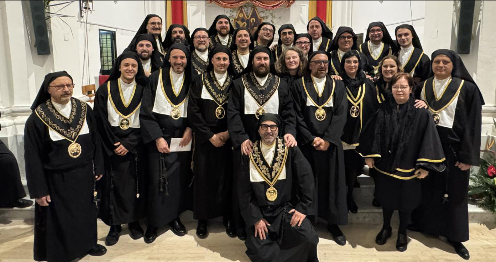
In the heart of Abruzzo, the medieval town of Lanciano in the province of Chieti comes alive every Holy Thursday with a tradition steeped in history and solemnity. Since the late 16th century, the Incappucciati—members of the Confraternity of San Filippo Neri—have processed through the town’s streets, donning long black robes, medallions bearing symbols of mortality, and hooded faces in an act of penance for Christ’s betrayal at the Last Supper.
The procession begins at the Church of Santa Chiara, advancing slowly through the historic centre, accompanied by the mournful strains of sacred music performed by a local band. At the centre walks the Cireneo, a figure chosen annually by the Prior of the Confraternity, whose identity remains a closely guarded secret. Barefoot and hooded, he carries the heavy Cross of Calvary on his shoulders, symbolically bearing not only Christ’s burden but also the hopes, prayers, and sorrows of the entire community.
For Lanciano’s residents, witnessing the Cireneo is a moment of profound reflection and shared devotion. The procession, together with the following Good Friday rites, embodies the intensity and depth of local faith. Torchlight flickers along the streets, the rhythm of ancient racanelle punctuates the night, and the city’s collective heartbeat seems to unite in silent contemplation.
The Incappucciati tradition is unique in Abruzzo, a rare example of the fusion of personal penitence, communal identity, and historical continuity. It transforms the streets into a living stage where centuries-old rituals meet contemporary devotion, preserving the spiritual and social fabric of Lanciano. For both participants and observers, Holy Thursday is a yearly renewal of faith, memory and belonging, a testament to the enduring power of tradition in the life of a city.