The Mediterranean Sea has once again become the stage of an international confrontation that goes far beyond a humanitarian mission.
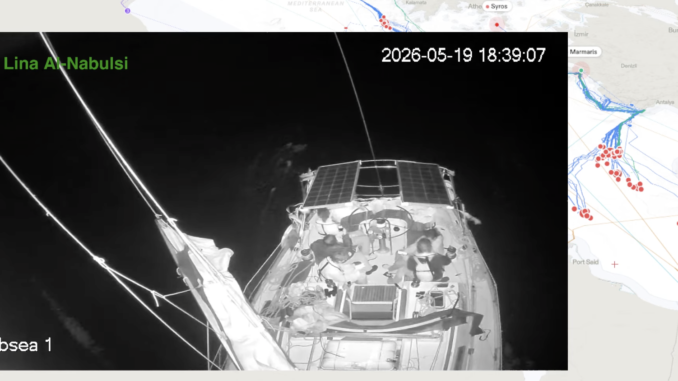
The interception of the Global Sumud Flotilla by Israeli naval forces in international waters has reignited accusations of piracy, violations of international law and the growing diplomatic fracture surrounding the war in Gaza. At the centre of the latest crisis are dozens of activists, journalists, doctors and human rights defenders — including at least 29 Italians — now detained after Israeli forces stopped multiple vessels attempting to reach Gaza.
But behind the dramatic images of military boarding operations, rubber bullet accusations and emergency diplomatic contacts lies a much deeper story: a geopolitical and moral battle over the future of the Middle East, international law and the limits of state power during wartime.
The sea route to Gaza: symbolism stronger than cargo
The flotilla itself was never likely to materially change conditions inside Gaza.
Most of the vessels carried limited humanitarian supplies compared to the scale of the catastrophe unfolding in the enclave. Yet the mission was never only about aid. It was about symbolism.
For activists, breaking the naval blockade means challenging what they describe as the collective punishment of Palestinians. For Israel, stopping the flotilla is presented as a matter of national security and prevention of support networks linked — directly or indirectly — to Hamas.
Israeli Prime Minister Benjamin Netanyahu openly praised the Israeli Navy for “thwarting an evil plan” designed to undermine Israel’s isolation measures against Hamas.
The language used by both sides reveals how far this conflict has evolved beyond military operations. Every ship, every interception and every protest has become part of a global propaganda war.
Italy caught between diplomacy and public pressure
For Italy, the incident creates a delicate political balancing act.
Foreign Minister Antonio Tajani requested an urgent clarification from Israeli authorities after activists claimed that rubber bullets had been used against civilian vessels. He also demanded that Italian citizens be released as soon as possible.
At the same time, Rome remains one of Israel’s important European partners and has generally avoided direct confrontation with the Netanyahu government.
The presence of Italian journalists, activists and even members of parliament aboard the flotilla dramatically increases public scrutiny inside Italy, especially as images and livestreams circulate widely on social media.
The political risk for European governments is growing: remaining silent may be perceived domestically as complicity, while openly condemning Israel risks deepening already fragile diplomatic relations.
International waters and the battle over legality
One of the central disputes concerns where the interceptions occurred.
According to the flotilla organisers and several European officials, the vessels were stopped in international waters, far from Israeli territorial jurisdiction.
Israeli authorities argue the naval blockade of Gaza is legal under security doctrine linked to the ongoing war with Hamas.
Critics, however, argue that boarding civilian vessels outside territorial waters constitutes a breach of international maritime law.
This legal ambiguity is not new. Similar controversies erupted during previous flotilla incidents, most notably the 2010 Mavi Marmara raid, which left multiple activists dead and triggered a major diplomatic crisis between Israel and Turkey.
What makes the current situation more explosive is the broader global context: the Gaza war has already isolated Israel diplomatically in large parts of Europe, Latin America and the Global South.
Europe begins to harden its tone
The reaction across Europe suggests patience is wearing thin.
Spain summoned Israel’s chargé d’affaires in Madrid and condemned the interception as a violation of international law. Portugal also formally protested after two Portuguese doctors aboard the flotilla were detained.
Meanwhile, 49 Members of the European Parliament signed a letter requesting diplomatic protection for the activists involved in the mission.
These are not isolated diplomatic gestures. They reflect a growing political divide between European public opinion and parts of Europe’s traditional foreign policy establishment.
Across European capitals, support for Israel’s military operations is increasingly colliding with mounting humanitarian concerns over Gaza.
Gaza’s war reshapes global politics
The flotilla story cannot be separated from the larger transformation taking place internationally.
The war in Gaza is no longer viewed simply as a regional conflict. It has become a global moral and geopolitical fracture point touching energy markets, migration, diplomacy, security alliances and domestic politics in dozens of countries.
For activists aboard the flotilla, the mission represents civil resistance against what they describe as collective punishment and occupation.
For Israel, the blockade is framed as an existential security necessity during wartime.
Between those two narratives lies a widening diplomatic abyss that Western governments are struggling to navigate.
And as the Mediterranean once again fills with military patrols, intercepted vessels and competing claims of legality, one reality becomes increasingly clear: this conflict is no longer contained within Gaza’s borders.
It is reshaping international relations far beyond the Middle East itself.
Source: Statements from Italian authorities and Global Sumud Flotilla