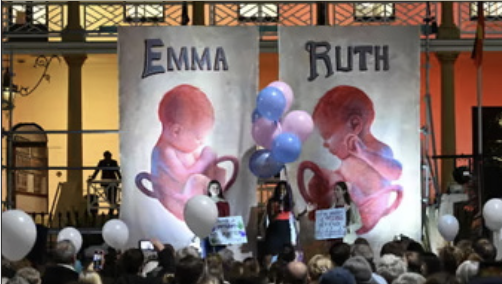
Outside the sandstone façade of Parliament House, the winter air on 2 June carried more than the chill of a late autumn evening. It carried chants, placards, prayers and the steady cadence of a public debate that has once again placed abortion laws at the centre of New South Wales politics.
Hundreds of Sydneysiders — families with prams, students, clergy and long-time activists — gathered for a rally supporting a private member’s bill set to be introduced by Libertarian MLC John Ruddick. The proposal seeks to prohibit abortions performed on the basis of an unborn child’s sex, a measure its supporters frame as a safeguard against discrimination before birth.
The gathering unfolded with a blend of civic protest and religious observance. Bishop Tony Percy opened proceedings with the Lord’s Prayer, setting a tone that oscillated between political urgency and spiritual reflection. His remarks drew attention to what he described as the “miracle” of life, recalling personal encounters with newborns that, in his words, underscored the intrinsic dignity of every child.
At the heart of the rally stood Dr Joanna Howe, a prominent anti-abortion campaigner, who argued that the proposed legislation addresses what she considers a serious ethical gap in existing law.
Citing research conducted by Edith Cowan University and Curtin University, supporters of the bill claim that sex ratios at birth in parts of Australia show a statistically significant imbalance, suggesting the possibility of sex-selective practices.
Dr Howe told the crowd that unborn children lack legal protections despite what she described as widespread terminations occurring each year in New South Wales. Her message was framed in moral rather than purely legal terms, insisting the debate extends beyond policy into questions of human rights and equality.
Political voices added further weight to the event.
Barnaby Joyce, federal MP for New England, addressed attendees with a forceful defence of the bill’s intent, arguing that opposition to sex-selective abortion should transcend party lines. He urged the crowd to maintain pressure on lawmakers, framing the issue as one of fundamental consistency in the value placed on human life.
John Ruddick, meanwhile, positioned the legislation as straightforward and unambiguous, asserting there were “no good arguments” against it.
He described the bill as a test of whether society recognises equal moral worth regardless of sex, while encouraging supporters to remain vocal in the parliamentary debate ahead.
Among the crowd, banners reading “Unborn Lives Matter” and “Make Women, Not War” were held aloft. Some participants travelled from regional centres including Newcastle and Tumut, turning the rally into a convergence of local and metropolitan activism.
Families attended with children in tow, a visual statement of continuity and conviction that organisers highlighted as symbolic.
Dr Melissa Lai of Pro-Life Health Professionals Australia later addressed attendees, acknowledging cultural complexities surrounding son preference while insisting that such patterns should not influence medical decisions.
Her remarks focused on equality from the earliest stage of life, urging protection for unborn girls as a matter of principle.
As the evening progressed, chants of “The Time Is Now” rippled through the crowd, building in intensity. For supporters, the rally was not merely a show of dissent but a coordinated push to influence legislative outcomes in the state’s upper house.
Not all voices were political.
Some attendees spoke in personal terms about conscience, faith and moral responsibility. Others framed their presence as a response to what they see as a widening gap between public sentiment and parliamentary decision-making.
By night’s end, the steps outside Parliament House had become a focal point for a broader national conversation — one that continues to divide opinion sharply across Australia.
The coverage, originally reported by The Catholic Weekly, reflects an ongoing intersection of faith, politics and public policy in a debate that shows no sign of fading from the national agenda in the months ahead