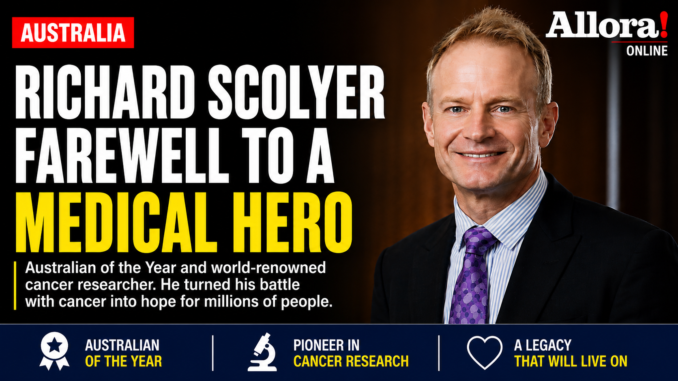
Australia and the international medical community are mourning the loss of Professor Richard Scolyer, who passed away in Sydney at the age of 59 after a courageous battle with an aggressive brain cancer.
His family confirmed his death on Sunday. Scolyer was widely regarded as one of the world’s leading melanoma researchers, but in recent years he became equally known for turning his own diagnosis into a groundbreaking scientific experiment that inspired patients and researchers around the globe.
In 2023, Scolyer was diagnosed with a Grade 4 glioblastoma, one of the deadliest forms of brain cancer. Faced with a devastating prognosis, he chose to undergo an experimental treatment based on immunotherapy approaches that he had helped pioneer for advanced melanoma. In doing so, he became the first patient in the world to receive this innovative combination of immunotherapy before surgery for this type of brain tumour.
Together with Professor Georgina Long, Scolyer helped revolutionise the treatment of advanced melanoma. Their research transformed what was once considered a near-certain death sentence into a disease that many patients can now survive for years. In recognition of their extraordinary contribution to medical science, the pair were jointly named Australian of the Year in 2024.
His personal journey captured the attention of the nation. Through regular public updates and social media posts, Scolyer openly shared his treatment, setbacks and hopes, offering inspiration to cancer patients and their families while raising awareness about the importance of medical research.
Although his cancer returned during 2025, the experimental treatment significantly extended his life beyond initial expectations. It also allowed him to continue contributing to science and spend precious time with his wife, Dr Katie Nicoll, and their three children.
Over the course of his distinguished career, Professor Scolyer authored more than 800 scientific publications, helped establish the world’s largest melanoma biobank and mentored countless doctors and researchers. His work has saved lives across the globe and changed the way melanoma is treated.
Richard Scolyer’s legacy extends far beyond the laboratory. He demonstrated remarkable courage, resilience and determination, showing the world that even in the face of a terminal diagnosis, scientific curiosity and hope can make an extraordinary difference.
Today, Australia loses one of its greatest scientists. Yet his legacy will endure through the lives he saved, the discoveries he helped create and the inspiration he provided to millions facing their own battles.
The editorial team at Allora! extends its deepest condolences to Professor Richard Scolyer’s family, friends, colleagues and all those whose lives were touched by his extraordinary work.
Today, Australia loses far more than a distinguished professor of medicine. It loses a visionary scientist, a compassionate human being and a symbol of courage in the face of adversity. Richard Scolyer devoted his life to giving hope to others and, in his final years, transformed his own battle into a lesson of resilience, dignity and service to humanity.
His legacy will live on not only in the medical breakthroughs that have saved countless lives, but also in the example he set for future generations. Australia is a better country because of Richard Scolyer, and the world of medicine is richer because of his contribution.
Rest in peace, Professor Richard Scolyer. Your work, your courage and your humanity will never be forgotten.