
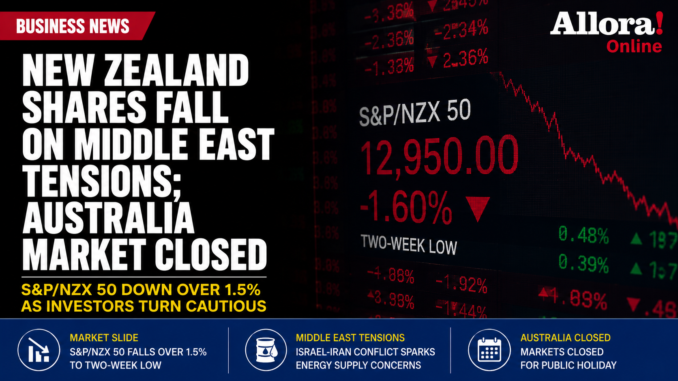
WELLINGTON – New Zealand shares fell sharply on Monday as renewed fighting in the Middle East rattled investors and reignited concerns about global energy supplies, while Australian markets remained closed for a public holiday.
The benchmark S&P/NZX 50 Index dropped more than 1.5 per cent in early trading, falling to a two-week low of 12,950 points as traders reacted to escalating tensions between Israel, Iran and Hezbollah.
The decline followed a weekend of renewed military action in the region. Israel launched strikes in Lebanon despite an existing ceasefire arrangement, while Iran responded to attacks against its ally Hezbollah by firing missiles toward Israel. The developments have revived fears that the conflict could spread further across the region and disrupt critical oil shipping routes, particularly through the Strait of Hormuz.
Financial markets have been closely monitoring the situation, with investors increasingly concerned that any prolonged disruption to energy supplies could fuel inflation and weaken global economic growth.
The New Zealand market, already facing a fragile domestic recovery, was particularly vulnerable to the shift in sentiment.
Although the country’s economy has technically emerged from recession, growth remains subdued and business confidence continues to face headwinds. Higher geopolitical risks, uncertainty over global trade conditions and tighter fiscal policy have added pressure to an economy still struggling to regain momentum.
Investors are also watching the Reserve Bank of New Zealand, which has signalled growing concern over inflation risks linked to international developments.
Deputy Governor Karen Silk warned last month that inflationary pressures could intensify even if the Middle East conflict were resolved quickly. The central bank has indicated it will continue monitoring high-frequency economic data ahead of its next policy meeting.
The Reserve Bank left the Official Cash Rate unchanged at 2.25 per cent in May, but money markets are increasingly betting on a rate increase next month. Interest-rate swaps are currently pricing in more than a 70 per cent probability of a 25-basis-point hike in July.
Transport and logistics companies led Monday’s declines.
Mainfreight fell 3.5 per cent, while Freightways Group lost 2 per cent as investors moved away from economically sensitive stocks. Auckland International Airport also declined 1 per cent amid concerns that rising geopolitical uncertainty could weigh on travel demand and global economic activity.
With Australian markets closed and global investors focused on developments in the Middle East, analysts said market direction this week is likely to remain heavily influenced by geopolitical headlines and movements in oil prices.
For now, investors appear to be taking a cautious approach as fears of a broader regional conflict continue to overshadow signs of economic recovery in New Zealand.