
The Festival di Sanremo was once the crown jewel of Italian popular culture — a stage where melody mattered, lyrics carried weight and artistry took precedence over spectacle. For decades, it served as a mirror of the nation’s evolving identity while retaining a sense of decorum that allowed families to watch together without embarrassment. That image feels increasingly distant.
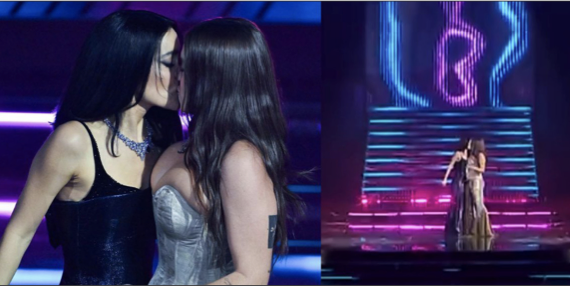
The latest edition has once again shifted attention away from music and toward controversy. During the covers and duets night, Levante and Gaia delivered a high-voltage rendition of I maschi, the rebellious anthem by Gianna Nannini. The performance culminated in a kiss between the two artists — a moment that might once have been interpreted simply as theatrical flourish.
Instead, it became the defining headline of the evening.
As the singers leaned in, cameras operated by Rai abruptly widened the shot, making the gesture barely visible to viewers at home.
Social media erupted within minutes. Some accused the broadcaster of censorship; others mocked the “binocular” view forced upon the audience. Political undertones quickly surfaced, with critics invoking the name of
Prime Minister Giorgia Meloni in insinuations about editorial pressure.
Yet beyond the predictable online outrage lies a deeper issue. The kiss itself was not shocking in 2026. What is striking is how predictable such moments have become. Each year seems to bring a new incident designed — or at least destined — to dominate headlines. Whether through overt sensuality, calculated provocation or ambiguous boundary-pushing, Sanremo increasingly appears structured around creating viral “moments” rather than celebrating music. There was a time when controversy at Sanremo emerged organically from artistic experimentation or social commentary. Today, provocation often feels pre-packaged. The festival’s promotional machinery thrives on anticipation of scandal. Ratings spike. Hashtags trend. The following day’s debate becomes the product. In the process, something essential is eroded.
A music festival should be anchored in music. Instead, the conversation routinely revolves around wardrobe choices, suggestive choreography and gestures calibrated for maximum digital amplification. Artistic expression is conflated with sensationalism; intimacy becomes spectacle; cultural discourse reduces itself to algorithm-friendly outrage.
None of this is about rejecting diversity or creative freedom. Italy has changed, and so has its audience. Representation matters. Modern artists should not be constrained by outdated taboos. But there is a growing perception that Sanremo no longer seeks balance. The pendulum has swung from refinement to excess.
Longtime viewers — those who remember evenings defined by songwriting craftsmanship and vocal mastery — increasingly feel alienated. They see a festival that once symbolized national cohesion now chasing fragmentation and provocation. What was once elegant risks appearing coarse. The question facing Sanremo is not whether it can provoke. It clearly can. The question is whether it still remembers why it mattered in the first place.
Be the first to comment