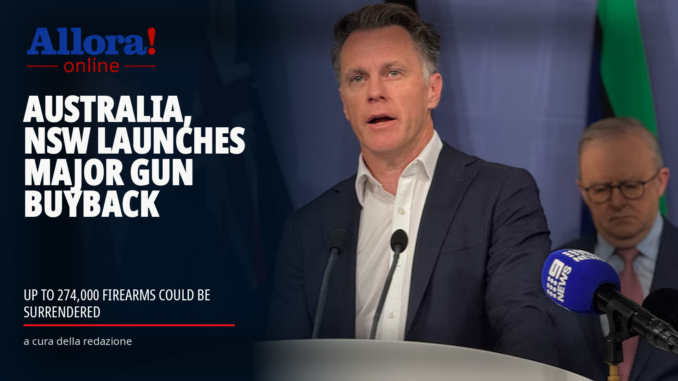
Albanese, Burke and Minns outlined the plan during a press conference in Sydney. The scheme will begin on 2 November and could become the largest gun buyback operation in NSW since the Port Arthur reforms.
By the Editorial Team
The New South Wales Government will become the first state to begin implementing Australia’s new National Gun Buyback Scheme, with up to 274,000 registered firearms potentially affected by the program.
The plan was outlined during a press conference in Sydney attended by Prime Minister Anthony Albanese, Home Affairs Minister Tony Burke, NSW Premier Chris Minns and NSW Minister for Police and Counter-terrorism Yasmin Catley.
The press conference, broadcast live by Australian media including 9News, placed gun reform and public safety at the centre of the political debate following the terrorist attack at Bondi Beach in December 2025.
Buyback to begin on 2 November
The NSW scheme is scheduled to start on 2 November 2026.
Government estimates suggest that up to 274,000 firearms, representing roughly 24 per cent of registered guns in New South Wales, could be affected by the new restrictions.
Around 50,000 firearms licence holders may also be impacted by changes to ownership limits and the reclassification of certain weapons.
The program represents one of the most significant changes to Australian gun laws in decades.
Albanese: fewer guns in the community
During the Sydney press conference, Albanese defended the need for stronger gun laws and highlighted the number of firearms currently registered across Australia.
The Federal Government argues that reducing the number of guns in circulation is an important element of improving community safety and preventing firearms that are no longer permitted under the new rules from remaining in private hands.
The Commonwealth and NSW governments will share the cost of the buyback 50-50, while the Federal Government will also contribute towards administrative expenses and the destruction of surrendered firearms.
The program will be administered by NSW Police.
Minns compares scale with Port Arthur
NSW Premier Chris Minns said the scale of the operation could exceed the gun buyback conducted in New South Wales following the 1996 Port Arthur massacre.
That tragedy triggered historic national gun reforms under then-prime minister John Howard and led to the surrender and destruction of hundreds of thousands of firearms across Australia.
Thirty years later, the debate over gun ownership has once again returned to the centre of Australian politics.
Minns has made clear that his government intends to proceed with tougher restrictions, arguing that the measures are necessary following the Bondi attack.
How much will gun owners receive?
Under the first phase of the NSW program, compensation will depend on the type of firearm surrendered.
Payments include approximately $1,000 for revolvers and some centrefire rifles, $850 for semi-automatic pistols and double-barrel shotguns, $650 for single-barrel shotguns and $450 for air rifles.
A second phase is expected to begin in early 2027 for higher-value firearms.
Eligible weapons valued above $3,000 may be subject to an individual assessment, with compensation reaching as much as $10,000 per firearm in some cases.
Financial assistance is also expected to be available for eligible firearms dealers and businesses affected by the reforms.
Political battle intensifies
The policy is already generating strong political opposition.
Critics, including representatives from the NSW Coalition and One Nation, argue that the government risks penalising responsible and law-abiding gun owners rather than focusing sufficiently on illegal weapons, terrorism and violent extremism.
Supporters of the reforms argue the opposite: that reducing the total number of firearms available in the community is an essential preventative measure.
Minns has signalled that he is prepared to defend the policy politically, even if gun laws become a major issue at the next NSW election.
Tony Burke also questioned on migration
The presence of Home Affairs Minister Tony Burke at the press conference also led journalists to raise questions about immigration policy.
Burke indicated that further migration measures remain under consideration through the Federal Government’s Cabinet process.
He also addressed questions about Working Holiday visas, saying applications continue to be processed, although more slowly than previously.
It means the Sydney press conference produced two significant political storylines: the immediate announcement of the NSW gun buyback and continuing questions surrounding the Albanese Government’s broader immigration agenda.
A major test for Australian gun policy
The comparison with Port Arthur is inevitable.
Australia’s 1996 reforms fundamentally changed the country’s relationship with firearms and became internationally recognised as one of the most significant gun-control programs introduced by a Western democracy.
The new NSW buyback will now test whether governments can impose another substantial reduction in legally held firearms while maintaining public support.
The central political question will remain controversial: how far should governments restrict legal gun ownership in the name of public safety, and how effective will those restrictions be in preventing terrorism and serious crime?
For Albanese and Minns, the answer is clear enough to proceed.
From 2 November, New South Wales will begin putting that policy into practice.