
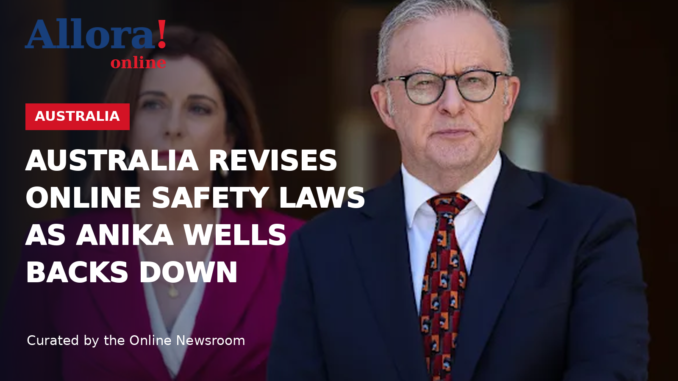
The Albanese Government has removed a controversial provision from its Digital Duty of Care legislation that would have allowed the Communications Minister to define new categories of serious online harm. The revised bill strengthens parliamentary oversight while maintaining tougher safety obligations for technology companies and additional protections for children.
Allora! Online – Redazione
The Australian Government has announced a significant revision to its proposed Digital Duty of Care legislation, removing powers that would have allowed Communications Minister Anika Wells to determine new categories of serious online harm without requiring parliamentary approval.
The decision follows widespread criticism from opposition parties, crossbench representatives and free speech advocates, who warned that the original proposal would have concentrated excessive regulatory authority in the hands of a single minister.
Wells confirmed the changes ahead of her address to the National Press Club, presenting the revised legislation as an attempt to balance stronger online protections with democratic accountability.
Parliament, not the minister, will determine new online harms
Under the original proposal, the Communications Minister would have been empowered to introduce additional categories of serious online harm through ministerial rules.
Critics argued that such discretion could potentially allow future governments to expand restrictions on online content without sufficient parliamentary scrutiny.
The revised legislation removes that authority.
Instead, any new category of serious online harm will require a legislative amendment debated and approved by Parliament.
Wells acknowledged that concerns raised during consultation on the draft legislation had influenced the government’s decision.
The change represents an important concession on the scope of executive power, ensuring that future expansions of the regulatory framework will be subject to parliamentary scrutiny.
Freedom of speech at the centre of the debate
The original proposal had attracted criticism from the Coalition, the Greens and One Nation, despite their differing political positions.
Their concerns focused on the possibility that broadly defined categories of harmful online material could create uncertainty about freedom of expression and the limits of government intervention.
A recent public survey highlighted those divisions.
Approximately 20 per cent of respondents believed the proposal gave the Communications Minister excessive power to determine harmful content, while another 28 per cent supported stronger online safety legislation but opposed granting that authority to the minister.
Meanwhile, 42 per cent supported the legislation as necessary to protect users from harmful online content, and 10 per cent expressed no opinion.
Although the survey does not establish a national consensus, it illustrates the political sensitivity surrounding digital regulation and the balance between individual freedoms and public protection.
Big Tech must take greater responsibility
Despite withdrawing the controversial ministerial powers, the Albanese Government is maintaining the central objectives of its Digital Duty of Care framework.
Wells argues that major technology companies should be subject to safety obligations comparable to those imposed on businesses operating in other industries.
Her central argument is that responsibility for preventing serious online harm should not rest primarily with victims.
Instead, companies designing and operating digital platforms should be required to take reasonable steps to reduce foreseeable risks associated with their services.
The proposed framework seeks to establish minimum safety standards across online services, with particular attention to seriously harmful and illegal material.
The Communications Minister has also challenged major technology companies over whether their business models adequately prioritise the safety of families and vulnerable users.
The broader political question is whether commercial incentives linked to advertising, engagement and algorithmic recommendations can coexist with stronger obligations to protect users.
Additional protections for children and teenagers
The legislation proposes enhanced safeguards for users under the age of 18.
The government has identified several categories of material and platform features that may present particular risks to young people.
These include content promoting eating disorders, glorifying criminal behaviour, encouraging dangerous stunts, exposing minors to pornography, or facilitating sexist abuse, harassment and bullying.
The proposed protections reflect growing concern about how digital environments can affect young people’s wellbeing and exposure to harmful behaviour.
However, the legislation will need to establish clear obligations for technology providers, including how risks are identified, assessed and mitigated without unnecessarily restricting legitimate expression.
“My Feed, My Way”: users to gain more control over algorithms
Another significant element of the proposed legislation is the government’s My Feed, My Way initiative.
Under the proposal, social media platforms would be required to offer users greater choice over whether their feeds are controlled by recommendation algorithms.
Users who prefer to see content from friends, accounts and creators they actively follow would have the option to choose that experience instead of relying on algorithmic recommendations.
The measure challenges one of the defining features of modern social media platforms: the ability of automated systems to determine which content receives the greatest visibility.
For technology companies, the proposal could require changes to platform design and user settings.
For Australians, it could introduce greater transparency and individual control over their online experiences.
Professional journalism receives an important exemption
The revised legislation also includes an exemption for professional news material when reporting on prohibited content.
This provision is particularly significant for journalists, publishers and digital news organisations.
News coverage frequently involves reporting on violence, crime, extremism, harassment and other subjects that may overlap with categories of harmful material.
Without adequate safeguards, broadly drafted online safety legislation could create uncertainty for legitimate reporting undertaken in the public interest.
The exemption is intended to preserve the ability of professional news organisations to report on such matters while maintaining the broader objectives of online safety regulation.
Its practical effectiveness will depend on the final legislative definitions and how the distinction between professional journalism and other forms of online publication is applied.
A defining test for Australia’s digital policy
The Digital Duty of Care proposal represents another major step in Australia’s efforts to regulate the influence and responsibilities of technology companies.
For the Albanese Government, the challenge is to demonstrate that stronger protections can be introduced without creating excessive executive discretion or undermining legitimate public debate.
For opposition parties and civil liberties advocates, the removal of the ministerial rule-making powers addresses one of the most controversial features of the original draft, although other aspects of the legislation may continue to attract scrutiny.
Technology companies will face questions about the costs, implementation and scope of the proposed obligations.
Meanwhile, journalists and digital publishers will be watching closely to determine whether the protections for professional news content provide sufficient clarity and independence.
By returning the authority to define new serious online harms to Parliament, the government has made a significant concession on democratic oversight. The legislation’s ultimate success, however, will depend on whether Australia can protect vulnerable users while preserving freedom of expression, editorial independence and public accountability in the digital environment.