
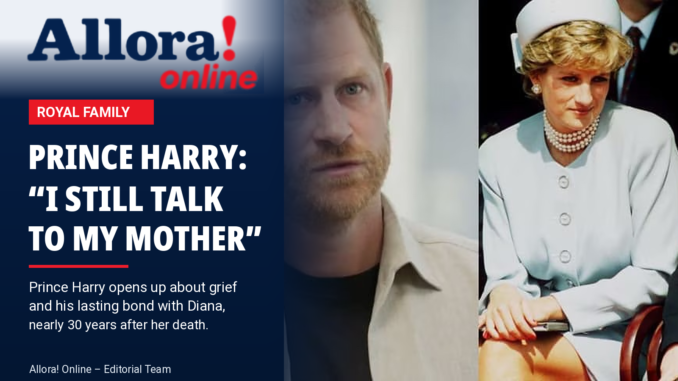
The Duke of Sussex opens up about his enduring connection with his mother, the painful memory of their final telephone conversation and how fatherhood and therapy have transformed his experience of grief. In an emotional interview with GQ, Harry reflects on losing Princess Diana at just 12 years old and learning that moving forward does not mean forgetting someone you love.
Almost three decades after the death of Princess Diana, Prince Harry has revealed that he still speaks to his mother, sometimes feeling that she responds to him in ways he cannot fully explain.
The Duke of Sussex, now 42, made the deeply personal admission during an interview with journalist Zach Baron for GQ’s One More Question, reflecting on the lasting impact of losing his mother when he was only 12 years old.
Diana, Princess of Wales, died on 31 August 1997 following a car crash in Paris. Her death shocked the world and left her two sons, Prince William and Prince Harry, facing an intensely public tragedy at an exceptionally young age.
Nearly 30 years later, Harry says his connection with his mother remains an important part of his everyday life.
Rather than describing elaborate conversations, he explained that he often thinks about her through simple questions about the life she never had the opportunity to see.
He wonders what the world might look like if Diana were still alive, how his family might be different and what she would think of the life he has built with his wife Meghan and their two children.
For Harry, these moments represent a continuing emotional and spiritual connection with his mother.
“Sometimes I do get a response”
During the conversation, Baron asked Harry about the thoughts that come to mind when he remembers Diana.
The Duke explained that he does not necessarily spend long periods analysing his emotions. Instead, memories of his mother often emerge through brief, personal reflections.
He sometimes directs questions towards her, hoping to feel a sense of guidance or reassurance.
“Sometimes I do get a response,” he acknowledged.
Harry described feeling his mother’s presence or energy at particular moments in his life, especially when reflecting on his family and the responsibilities of parenthood.
He presented this as a personal experience rather than a claim that could be independently verified.
His comments offered an intimate picture of how he continues to remember Diana, not simply as a globally admired public figure but as the mother whose presence he still misses.
Although his life has changed dramatically since childhood, Harry suggested that the emotional relationship he has with her memory has continued to evolve.
The final telephone call he has never forgotten
One of the most painful aspects of Harry’s childhood remains the last telephone conversation he had with Diana.
The young prince was staying at Balmoral with his brother William when their mother called from Paris shortly before her death.
At the time, Harry was eager to return to playing with his cousins and did not realise that the conversation would be their last.
In the interview, he returned to the regret that has remained with him throughout adulthood.
He explained that if he had known what was about to happen, he would have approached the call entirely differently.
It is an ordinary childhood moment that became extraordinarily significant only after the tragedy.
Harry has spoken previously about feeling guilty for rushing the conversation, even though he was just a child behaving naturally.
The knowledge that he could never speak with his mother again transformed that seemingly unremarkable telephone call into one of his most enduring memories.
For years, he struggled with the emotions surrounding that final exchange.
Only later, particularly after becoming a parent himself, did he begin to understand the experience from a different perspective.
Becoming a father changed how Harry understood grief
The birth of Harry’s children, Prince Archie and Princess Lilibet, has played an important role in reshaping his understanding of his mother’s death.
Harry and Meghan have two children: Archie, seven, and Lilibet, five.
The Duke explained that becoming a father helped him reconsider the guilt he had carried since childhood.
He began to understand more clearly how children think, behave and respond to the world around them.
That experience allowed him to view his final conversation with Diana with greater compassion towards his younger self.
At 12, he could not possibly have known that a short telephone call would become the final opportunity to speak with his mother.
Parenthood has also strengthened his awareness of the emotional atmosphere parents create for their children.
Harry recalled recognising, when Archie was a baby, that his own stress could affect the way his son responded to him.
He began making a conscious effort to settle his emotions before returning home, so that he could be more fully present as a father.
These experiences helped him reflect on the responsibilities of raising children while carrying unresolved experiences from his own childhood.
For Harry, family life has become an important part of learning how to live with the past without allowing it to dominate the present.
Therapy helped him confront decades of suppressed emotion
Prince Harry has spoken openly in previous interviews, documentaries and his memoir Spare about the psychological impact of Diana’s death.
For many years, he struggled to express his feelings and found it difficult to cry.
During the GQ interview, he explained that therapy had been particularly important in changing his relationship with grief.
“Therapy was the thing that really changed it for me,” he said.
The Duke described how professional support helped him recognise emotions he had previously suppressed.
Rather than seeing sadness as something to avoid, he gradually learned to acknowledge it.
He explained that this process was not always comfortable.
Becoming more emotionally aware could make some experiences feel harder, but it also helped him establish stronger connections with his family and friends.
Harry believes that many people, particularly men, grow up in environments where emotional vulnerability is discouraged.
His own experience has led him to challenge the idea that strength requires people to conceal their suffering.
He now regards openness about grief as an important part of emotional resilience.
“You learn to live with it”
One of the most significant messages from Harry’s interview concerns the idea that grief does not necessarily disappear with time.
“You learn to live with it,” the Duke said.
For many years, he explained, he feared that moving beyond the most painful aspects of grief might somehow mean abandoning his mother’s memory.
He questioned whether feeling happy or finding peace would amount to a betrayal of Diana.
This conflict made it difficult for him to separate the enduring love he felt for his mother from the sadness associated with her death.
Through therapy and personal reflection, he came to understand that remembering someone does not require remaining overwhelmed by loss.
Harry now believes it is possible to preserve a loved one’s memory while continuing to build a fulfilling life.
His approach reflects the idea that bereavement can change over time, with memories gradually finding a different place in a person’s life.
Rather than seeking to erase grief, he has attempted to understand it and incorporate it into the way he lives.
A tragedy experienced under the eyes of the world
Harry’s experience of losing his mother was shaped not only by the circumstances of her death but also by the extraordinary level of public attention surrounding it.
Princess Diana was one of the most photographed and recognised women in the world.
Her death prompted an unprecedented outpouring of public emotion, with millions mourning a woman many had never personally met.
For Harry and William, the loss was profoundly personal, yet much of their grief unfolded in front of television cameras and enormous crowds.
The image of the two young princes walking behind Diana’s coffin during her funeral remains one of the defining moments of modern royal history.
Harry has previously described how difficult it was to understand the scale of public mourning while processing the loss of his own mother.
Even today, people continue to approach him and recall exactly where they were when they heard the news of Diana’s death.
Such encounters remind him that his mother occupied an exceptional place in public life.
However, they also reinforce the difference between the world’s memory of Diana and his own experience of losing a parent.
To millions, she was the People’s Princess.
To Harry, she was simply his mother.
A new chapter for Harry, Meghan and their children
The interview also offered insight into Harry’s changing family circumstances.
After six years living in California, the Duke and Duchess of Sussex have recently returned to the United Kingdom with Archie and Lilibet.
Harry explained that the decision was influenced by a desire to give his children the opportunity to experience British life and develop a closer connection with the country where he grew up.
The move was made relatively quickly, despite being something the couple had considered previously.
Their children have begun attending school in Britain, an experience Harry said they have been enjoying.
He also welcomed the opportunity to reconnect with relatives and friends and allow his children to spend more time with their extended family.
The decision marks another transition for the Sussexes, whose departure from royal duties in 2020 led them to establish a new life in the United States.
Although Harry acknowledged that relationships within the royal family remain complicated, he expressed hope that past disagreements could eventually give way to reconciliation.
The interview also touched on his father, King Charles III, whose health has been a source of personal concern.
Harry said his father was improving, while reflecting on how the illness of a surviving parent can revive questions about bereavement and the prospect of future loss.
Diana’s influence continues through Harry’s work
Beyond his private reflections, Harry said his mother’s memory continues to influence his professional and charitable activities.
The Duke has long been involved in initiatives supporting veterans, mental health awareness, humanitarian projects and people affected by trauma.
His recent work includes a MasterClass programme exploring grief and loss, developed with bereavement researcher Dr Mary-Frances O’Connor.
The programme draws upon both scientific understanding and Harry’s personal experiences.
His intention, he explained, is to make conversations about bereavement more accessible and to encourage others to recognise that emotional struggles can be discussed openly.
Harry believes that sharing personal experiences may help people who feel isolated by loss.
He also hopes that those facing particularly difficult periods can understand that suffering does not necessarily prevent them from finding purpose and fulfilment later in life.
This perspective has become an important part of the way he speaks about Diana.
Her influence is no longer confined to memories of childhood or moments of sadness.
It is also present in the values he attempts to carry forward through his family and work.
Nearly 30 years later, a mother’s memory remains
Princess Diana would have turned 65 in July 2026.
The approaching thirtieth anniversary of her death is likely to prompt renewed reflection on her life, her humanitarian work and her influence on the British royal family.
For Harry, however, remembrance is not limited to anniversaries or public commemorations.
It continues through everyday thoughts, questions and moments when he feels particularly connected to the mother he lost so young.
His latest interview offers a reminder that grief does not necessarily follow a predictable timetable.
For some people, remembering a loved one involves photographs, familiar places or family traditions.
For others, it may involve speaking aloud to someone who has died, imagining the advice they might offer or reflecting on the life they could have shared.
Harry’s experience is his own, but the emotions he describes are recognisable to many people who have experienced bereavement.
Nearly three decades after Princess Diana’s death, her youngest son is no longer the 12-year-old boy the world watched at her funeral. He is now a husband, a father and a man who has spent much of his adult life trying to understand the loss that shaped his childhood.
He cannot change that final telephone conversation or recover the years he never had with his mother.
But he believes he can continue to carry her memory into the life he is building today.
And for Prince Harry, that connection remains deeply personal, enduring and meaningful.
Allora! Online – Editorial Team