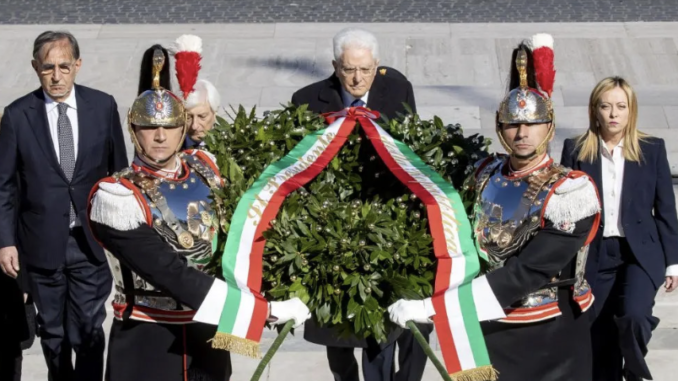
April 25, 1945 marks a decisive turning point in Italian history: the day the National Liberation Committee for Northern Italy (CLNAI) called for a general insurrection against Nazi and Fascist forces still occupying much of the country. It is celebrated annually as Liberation Day, a national holiday that commemorates the end of Fascist rule and the German occupation during the Second World War.
The liberation of Italy was not a single event, but the culmination of a complex and brutal process that unfolded over nearly two years. After the fall of Benito Mussolini’s regime on July 25, 1943, and the armistice signed on September 8 of the same year, Italy descended into chaos and division. The country was effectively split in two: the Allies advanced slowly from the south, while Nazi Germany occupied the north and established a puppet state known as the Italian Social Republic under Mussolini.
In response, a broad and diverse resistance movement emerged. Known collectively as the Resistance, it included communist, socialist, liberal, and Catholic groups, as well as thousands of civilians who supported partisan fighters. These groups engaged in guerrilla warfare, sabotage, intelligence gathering, and strikes, forming a “clandestine war” against the occupying forces.
By the spring of 1945, the situation had shifted dramatically. Allied forces were advancing rapidly through northern Italy, while German troops were retreating on multiple fronts. Within this context, the CLNAI issued the historic order for a general uprising on April 25. The call was answered in major industrial and political centers, including Milan, Turin, and Genoa, where partisans, workers, and civilians rose together against the occupying forces.
Milan became the symbolic heart of the insurrection. The city was brought to a standstill by widespread strikes and coordinated partisan action. Factories were occupied, communication lines disrupted, and German and Fascist units were forced into retreat. Within days, resistance forces gained control of the city. On April 30, Allied troops entered Milan, which had already been effectively liberated by local fighters.
Similar uprisings took place across northern Italy. In Genoa, partisan forces negotiated the surrender of German commanders, avoiding widespread destruction. In Turin, factory workers played a crucial role in supporting armed resistance and disrupting enemy operations. The coordinated nature of these uprisings demonstrated the extent to which the Resistance had become a structured national force rather than a series of isolated groups.
At the same time, the broader war in Europe was reaching its conclusion. In Germany, Soviet and American forces were advancing toward Berlin and eventually met on the Elbe River, signaling the imminent collapse of the Third Reich.
In Italy, Fascist leader Benito Mussolini was captured and executed by partisans on April 28 while attempting to flee north toward Switzerland.
The Liberation of Italy had profound political and social consequences. It marked the end of twenty years of Fascist dictatorship and the beginning of a new democratic era. In the aftermath of the war, many of the leaders of the Resistance played key roles in shaping the postwar Italian Republic. The experience of the Resistance became a foundational myth of modern Italy, later enshrined in the Constitution of 1948, which emphasized anti-fascism, democratic participation, and civil liberties.
However, the memory of April 25 has also remained politically contested. Over the decades, different interpretations of the Resistance and the Liberation have emerged, reflecting Italy’s ongoing struggle to reconcile its past. For many Italians, the day remains a powerful symbol of unity and freedom. For others, it continues to provoke debate about civil conflict, accountability, and national identity.
Despite these tensions, April 25 endures as one of Italy’s most significant historical anniversaries. It is a day of remembrance for those who fought, suffered, and died in the struggle for liberation, and a reminder of the fragile but enduring value of freedom. Without doubt, Italy’s national character and contemporary identity remains deeply anchored in the events which took place on this day.