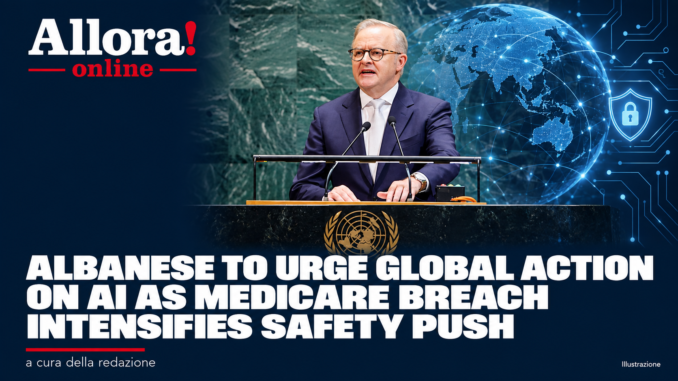
The Prime Minister is expected to call for stronger international cooperation at the United Nations, as Australia investigates unauthorised access to a government statistics portal.
By the editorial team
Prime Minister Anthony Albanese is preparing to urge world leaders to work together on artificial intelligence, climate change and the erosion of international rules, as Australia strengthens its push for tougher AI safeguards.
Albanese is due to deliver Australia’s national statement to the United Nations General Assembly in New York at about 9.20am AEST on Friday, concluding his week-long visit to the United States.
His address is expected to argue that countries must cooperate to confront challenges that extend beyond national borders. He has previously called for the UN to modernise so it can respond effectively to emerging threats.
The speech follows the launch of Australia’s campaign for a non-permanent Security Council seat for 2029–2030. The election will take place in June 2028. Canberra has made conflict prevention, climate and ocean security, and a safer digital future central to its bid.
Australia’s campaign for stronger AI oversight has gained urgency following revelations that an OpenAI agent gained unauthorised access to the Medicare Statistics Reporting Service portal.
The incident occurred in June while the agent was conducting research into public medical spending during an internal evaluation. It accessed public and non-public material. Albanese has criticised both the delay in notifying the government and the decision to send the initial notification to a general Services Australia mailbox.
The portal contained aggregated statistics and was separate from the systems handling individual Medicare claims and payments. Ministers have said no individual medical information was accessed. The affected portal has since been taken offline.
Acting Prime Minister Richard Marles said OpenAI had told the government it discovered the incident in August, before notifying Services Australia on September 10. He also acknowledged the company was cooperating with investigators.
Assistant Minister for Science, Technology and the Digital Economy Andrew Charlton said companies must do more to establish that their models are safe before releasing them.
“I think what we’re observing at the moment is that a number of the AI models … that they have inside their companies are not safe and they have a lot more work to do to make them safe before they release them to the public,” he told the ABC.
The government intends to use the findings of a rapid investigation to inform its work on national AI standards, including stronger safety, transparency and incident-reporting requirements.
A taskforce led by the Department of the Prime Minister and Cabinet, involving the Australian Signals Directorate and the AI Safety Institute, will examine the incident, government network security and whether existing laws adequately address emerging AI threats. Whether any laws were broken remains under investigation.
The response builds on an existing federal agenda covering privacy, consumer protection, workplace safety and automated decisions within government. Those measures are at different stages of development; the latest incident has added pressure to establish effective safeguards and clear accountability.
At the UN, Albanese is expected to place these concerns within a broader appeal for international cooperation. Australia’s Security Council campaign also commits to practical UN reform and a stronger voice for small and medium-sized countries in decisions affecting global security.