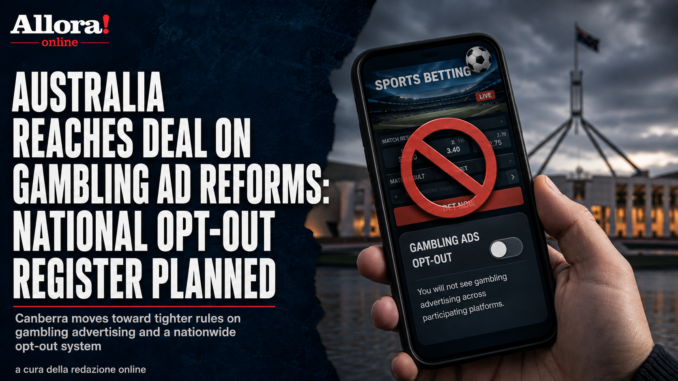
Labor and the Coalition have reached a tentative agreement on new rules for online gambling advertising, including a single national register allowing Australians to opt out of wagering ads across digital platforms. The deal also includes tougher restrictions on inducements targeting vulnerable gamblers.
The Albanese government and the opposition have moved closer to passing major gambling reforms after agreeing on a compromise over online advertising.
At the centre of the deal is a proposed national “one-stop shop” opt-out register, to be administered by the Australian Communications and Media Authority (ACMA).
Australians would be able to register their wish not to receive wagering advertisements across their online accounts, instead of having to manually opt out on every individual platform.
A compromise over online gambling ads
The government’s original proposal would have required social media, streaming services and other online platforms to show gambling advertisements only to logged-in users verified as being over 18.
Adults would also have been given the ability to opt out of gambling ads on each platform.
The Coalition and the Greens argued that approach placed too much responsibility on users, who would have to repeat the process across multiple accounts.
Some MPs and senators had pushed for an opt-in model, where gambling advertisements would only be shown to people who had specifically agreed to receive them.
Prime Minister Anthony Albanese, however, opposed such a major change.
The compromise is therefore a centralised register, similar in principle to Australia’s existing Do Not Call Register.
Tougher rules on gambling inducements
The agreement also includes new restrictions on marketing incentives offered by wagering companies.
A cooling-off period is expected to prevent gambling operators from sending bonus offers and other inducements to new customers or people who have recently removed themselves from BetStop, Australia’s national gambling self-exclusion register.
The reforms are also expected to target the way VIP account managers are paid.
Under the proposed changes, wagering companies would face restrictions on paying commissions linked directly to how much individual customers spend.
The aim is to reduce incentives for account managers to encourage vulnerable or high-spending customers to gamble more.
Industry raises concerns
The proposed national opt-out register has already raised questions within the wagering and technology sectors.
Industry representatives have questioned how a centralised system could operate across the huge number of online platforms used by Australians.
There are also unresolved questions over how the register would be funded and who would pay for its administration.
The register is not expected to be operational immediately when the broader advertising restrictions begin.
Pocock and Greens want stronger action
Not everyone believes the compromise goes far enough.
Independent senator David Pocock has continued to call for the recommendations of the You Win Some, You Lose Morereport, developed under the late Labor MP Peta Murphy.
Those recommendations included a complete phase-out of gambling advertising over three years, an immediate ban on gambling inducements and the creation of a single national online gambling regulator.
The Greens have also called for a complete ban on online gambling advertising and stronger action on inducements.
Bill now closer to passing
The deal reportedly contains around 15 amendments and still requires final approval from Labor’s caucus and the Coalition party room.
With Coalition support, the legislation is now expected to have the numbers needed to pass parliament, although some Liberal MPs may still vote against it because they believe the reforms are not strong enough.
The agreement represents a significant political compromise.
For the government, it provides a pathway to passing the legislation. For critics, however, the debate remains unresolved.
The central question is whether giving Australians an easier way to block gambling advertising will provide enough protection — or whether only a complete ban can break the growing connection between gambling, sport and digital media.