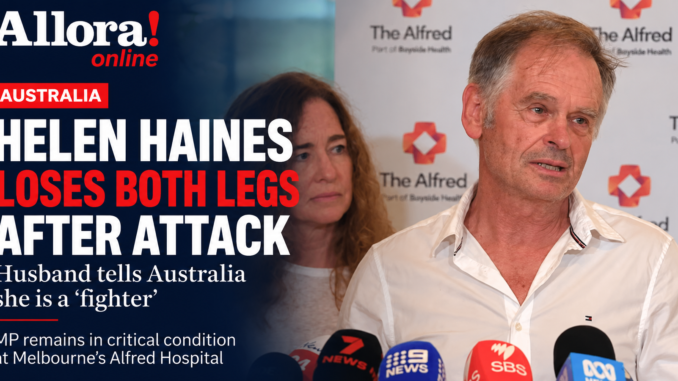
The 65-year-old independent MP remains in critical condition at Melbourne’s Alfred Hospital. Her husband, Phil Haines, confirms the double amputation and speaks emotionally about his wife’s strength and determination. Governor-General Sam Mostyn calls for greater respect and civility in Australian political debate.
Allora! Online – Editorial Team
A tragedy that has shocked Australia and deeply affected the nation’s political community continues to unfold. Helen Haines, an independent member of Australia’s federal parliament, has lost both legs following a violent incident on Monday, 19 October, outside her electorate office in Wangaratta, in north-eastern Victoria.
The devastating consequences of the attack were confirmed by her husband, Phil Haines, who spoke publicly for the first time on Wednesday outside Melbourne’s Alfred Hospital, where the 65-year-old MP remains in a critical condition.
Standing beside him was Australia’s Governor-General, Sam Mostyn, who attended not only in her official capacity but also as a personal friend of the injured parliamentarian.
The emotional appearance offered Australians a deeply personal glimpse into the suffering of a family whose lives have been dramatically changed.
“Helen is a fighter, and she will do everything she can to recover”
Speaking with visible emotion, Phil Haines described the difficult hours his family had endured since Monday’s attack.
Doctors were forced to amputate his wife’s left leg shortly after the incident. Medical specialists had initially hoped to save her right leg, but the severity of her injuries eventually made a second amputation unavoidable.
“As a result of that, Helen’s left leg was amputated on Monday,” Mr Haines explained.
“We had been hoping her right leg would be saved, but as of this afternoon or this morning, the surgeons also had to remove her right leg.”
Despite the devastating news, he spoke of his wife’s extraordinary determination and the family’s unwavering hope for her recovery.
“But we know she is a fighter, she is a determined person to do her best, with our support and love, to recover,” he said.
“And that is what we hope for.”
His words, delivered with remarkable composure, reflected both the enormous personal tragedy and the strength of a family determined to face the difficult journey ahead.
Although her injuries are life-changing, Mr Haines expressed gratitude that his wife remains alive and that her heart and cognitive functions have not been severely compromised.
For the family, this offers an important source of hope.
Forty years of marriage and a lifetime together
Behind Helen Haines’s public role as a federal parliamentarian lies a family story spanning almost four decades.
Phil Haines, a farmer and agricultural scientist, married Helen in 1986. The couple lives on a farming property in Victoria’s picturesque King Valley, one of the state’s best-known agricultural and wine-producing regions.
They were preparing to celebrate their 40th wedding anniversary next month.
The couple has three children and two grandchildren.
During his emotional statement, Phil reflected on the qualities that have defined his wife throughout their marriage.
“Her heart is huge — she is a very compassionate, caring, loving person, incredibly supportive of all around her,” he said.
“And her mind — she has the sharpest intellect. She has always had the most intense desire to learn, to read, to synthesise and to understand what’s going on.”
He expressed gratitude that, despite the severity of her injuries, her heart and mind remained in good condition.
“We are grateful and thankful that, at this stage, both her heart and her mind are in good shape.”
The path to recovery will undoubtedly be long, complex and emotionally demanding.
Yet throughout his remarks, Phil Haines made clear that the violence inflicted upon his wife would not define the woman she is, nor erase the remarkable contribution she has made to her family and community.
The attack outside her electorate office
The incident occurred on Monday afternoon, 19 October, at approximately 3:30pm in Murphy Street, Wangaratta.
According to investigators, Helen Haines was near her vehicle outside her electorate office when she was struck by a Toyota LandCruiser.
Witnesses reportedly told police that the driver struck the MP, pinning her against her vehicle, before reversing and hitting her again.
She suffered catastrophic injuries to her lower limbs and required immediate emergency medical treatment.
Haines was subsequently airlifted to Melbourne’s Alfred Hospital, one of Australia’s leading major trauma centres.
Police believe the incident was targeted, although investigators have not established a definitive motive.
A 43-year-old man from Tarrawingee, near Wangaratta, identified as Brendan Nugent, has been charged in connection with the incident.
The charges reportedly include dangerous driving causing serious injury, intentionally causing serious injury, and a Commonwealth offence relating to causing harm to a federal public official.
Nugent appeared before Wangaratta Magistrates’ Court and was remanded in custody.
The allegations remain subject to judicial proceedings, and no determination of criminal guilt has been made.
Governor-General Sam Mostyn calls for civility in Australian politics
The presence of Governor-General Sam Mostyn alongside Phil Haines gave the emotional hospital appearance particular national significance.
Ms Mostyn confirmed that King Charles III had been receiving updates on the injured parliamentarian’s medical condition.
Her remarks also addressed a broader and increasingly urgent issue: the deterioration of civility in public debate and the dangers of political hostility.
The Governor-General urged Australians to rediscover the importance of respectful disagreement, reminding the nation that democratic debate must never become a justification for personal abuse or violence.
“We don’t have to all agree, but we can wrestle the issue, not the person,” she said.
“Words matter, whether spoken or in written form, increasingly in the virtual world.”
Her message was particularly relevant at a time when social media platforms, political polarisation and increasingly hostile public discourse are reshaping how citizens interact with elected representatives.
Ms Mostyn encouraged Australians to exercise what she described as their “muscle of decency”, emphasising that respect for others remains fundamental to a healthy democracy.
Her appeal was not simply a response to one shocking incident, but a reminder that democracy depends upon the ability to disagree without dehumanising those who hold different views.
Cathy McGowan: “We are not going to let violence win”
A similar message was delivered by former independent MP Cathy McGowan, who represented the federal electorate of Indi before Helen Haines.
In 2013, McGowan made Australian political history by ending the Coalition’s 82-year hold on the seat, establishing a new era of community-driven independent representation.
She subsequently supported Helen Haines as her successor in the 2019 federal election.
Speaking to Fran Kelly on ABC Radio National, McGowan urged Australians to respond to the attack by strengthening their commitment to democracy, transparency and community solidarity.
Her message was particularly directed towards Victorians preparing for the upcoming state election in November.
McGowan encouraged voters to reject intimidation and aggressive political conduct.
“Call out bad behaviour, stop the violence,” she said.
For the former parliamentarian, the strongest response to what happened to Helen Haines would be a renewed commitment to the principles that shaped the independent movement in Indi: openness, honesty, accountability and respectful political participation.
The Indi community stands united
Across the towns and rural communities of the Indi electorate, the news of Haines’s injuries has generated widespread sadness and disbelief.
Residents and supporters in Wangaratta, Wodonga and surrounding communities have gathered to express solidarity with the parliamentarian and her family.
One of the most recognisable symbols of support has been the orange cockatoo, associated with the community independent movement that helped elect both McGowan and Haines.
The symbolism carries particular emotional significance.
Cockatoos are social birds, often moving in groups and communicating loudly with one another. For McGowan, they represent a community that stays together and supports its members during difficult times.
Referring to a community vigil, she described the birds as a symbol of solidarity and mutual support.
“We’re not going to let violence win,” she declared.
The message reflects a determination among local residents not to allow fear or intimidation to undermine their political engagement or the close relationship between elected representatives and the people they serve.
Political violence raises urgent questions about parliamentary security
The attack on Helen Haines has reignited a difficult debate about the safety of Australian parliamentarians and the increasing hostility directed towards public figures.
Australia has traditionally maintained a relatively accessible political culture, where MPs are expected to engage directly with constituents through community events, local meetings and electorate offices.
Unlike political figures in some other countries, many Australian parliamentarians carry out their everyday duties without permanent personal security protection.
This accessibility remains an important feature of Australian democracy.
However, a growing number of threats, harassment incidents and aggressive confrontations has raised concerns about whether existing security arrangements are sufficient.
According to figures reported by the Associated Press, the Australian Federal Police received 1,067 reports involving threatening, harassing or offensive communications directed at senior officeholders, federal parliamentarians and their staff during the most recent financial year.
The figure represented a 12 per cent increase compared with the previous year.
Following the attack, federal security agencies have reportedly held briefings with parliamentarians to assess possible risks and respond to concerns about personal safety.
Prime Minister Anthony Albanese has strongly condemned the attack while emphasising the importance of preserving direct contact between elected representatives and the Australian public.
The challenge facing authorities is how to improve protection without creating barriers that distance politicians from the communities they represent.
There is also a broader concern that escalating hostility may discourage ordinary citizens from entering public life, ultimately weakening democratic participation.
A personal tragedy and a national moment of reflection
As the police investigation continues, attention remains focused on Melbourne’s Alfred Hospital.
Helen Haines faces an extraordinarily challenging medical and rehabilitation journey, involving not only the physical consequences of losing both legs but also the psychological impact of a violent and traumatic experience.
Her condition remains critical, and further medical updates will be necessary to determine the progress of her recovery.
For Phil Haines and their family, however, political considerations are secondary.
Their immediate concern is Helen’s survival, her wellbeing and the possibility of rebuilding their lives together.
The attack has deeply affected a country where political debate, despite growing divisions, has traditionally been underpinned by the principle that elected representatives should be able to carry out their duties without fearing for their safety.
Helen Haines’s story has therefore become more than a personal tragedy.
It has become a national reminder of the fragility of democratic values, the consequences of violence and the importance of defending the dignity of political participation.
Yet beyond the public statements, the police investigation and the national conversation about political conduct, one deeply human reality remains.
A husband is standing beside his wife after almost forty years of marriage, determined to support her through the most difficult battle of their lives.
His message is one of love, hope and resilience.
Helen is a fighter. And she will keep fighting.