Allora! Online – Redazione
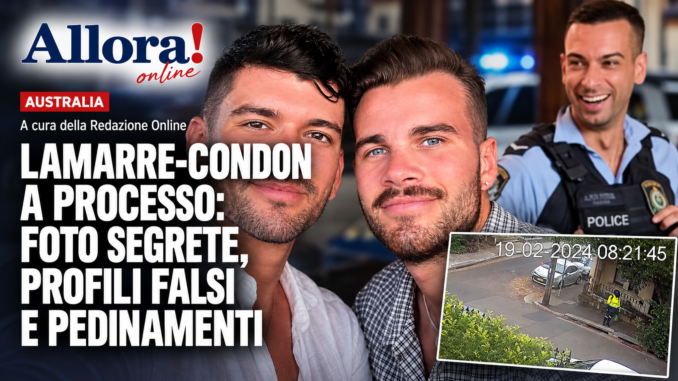
Explosive testimony has emerged in the NSW Supreme Court murder trial of former police officer Beau Lamarre-Condon, accused of killing television presenter Jesse Baird and Qantas flight attendant Luke Davies in February 2024. A former friend told the jury that the accused secretly photographed Baird through his bedroom window, monitored his movements and created fake dating profiles to interfere with his relationships. Lamarre-Condon has pleaded not guilty to murder and maintains that he acted in self-defence.
The trial of former NSW Police officer Beau Lamarre-Condon has heard extraordinary allegations of surveillance, manipulation and obsessive behaviour in the months leading up to the deaths of Sydney couple Jesse Baird and Luke Davies.
Lamarre-Condon, 31, is accused of murdering the two men at Baird’s Paddington home on February 19, 2024, before allegedly attempting to conceal their bodies in rural New South Wales.
He has pleaded not guilty to the murder charges and is contesting the prosecution’s account of the deaths, arguing self-defence.
The NSW Supreme Court jury has been hearing evidence from a former friend of the accused, identified for legal reasons by the pseudonym Elizabeth Kennedy.
Her testimony has provided a detailed account of what she says Lamarre-Condon told her about his relationship with Baird, his attempts to monitor the television presenter’s private life and the events surrounding the disappearance of the two men.
The allegations remain evidence before the court and must be assessed by the jury.
Alleged photographs taken through bedroom window
One of the most disturbing allegations concerns photographs allegedly taken of Jesse Baird inside his home.
Kennedy told the jury that Lamarre-Condon had photographed his former partner having sex with another man through a window on two separate occasions.
According to her testimony, the accused subsequently sent the photographs to her through the encrypted messaging application Signal.
Kennedy claimed that Lamarre-Condon had positioned himself outside the property and photographed what was happening inside.
On one occasion, she said, a person inside the home noticed somebody near the window, causing Lamarre-Condon to leave.
She told the court that she warned him about his conduct, describing it as alarming.
However, according to her account, he did not appear particularly concerned.
The testimony forms part of the prosecution’s effort to establish the nature of the relationship between the accused and Baird before the deaths.
Fake dating profiles allegedly used to interfere with relationships
Kennedy also told the jury that Lamarre-Condon allegedly created dating profiles impersonating Baird.
According to her evidence, the accounts were used to communicate with other men and discourage them from pursuing relationships with the television presenter.
She described one incident in which Lamarre-Condon allegedly arranged for a man from the dating application Grindr to visit Baird’s home while pretending to be Baird.
The man reportedly entered the property and spoke directly with the television presenter.
Kennedy said Lamarre-Condon considered the plan unsuccessful because it had created an opportunity for the two men to communicate.
She also alleged that he monitored the encounter from a vehicle parked across the street.
These claims have not been independently established as facts and remain subject to the court’s assessment of the witness’s evidence.
Former officer allegedly entered Baird’s home while he slept
The jury also heard testimony about an alleged unlawful entry into Baird’s Paddington home in 2023.
Kennedy claimed that Lamarre-Condon visited her and asked her to leave her mobile phone in another room before sharing what he described as an extraordinary secret.
She told the court that the accused admitted entering Baird’s property while the television presenter was asleep.
According to the witness, Lamarre-Condon had obtained a copy of a key to the property.
She alleged that he entered the home, removed Baird’s phone from its charger and took it outside.
He then allegedly deleted contacts and photographs, modified alarm settings and activated location sharing through Snapchat.
Kennedy said he subsequently returned the phone to the house.
The witness described Lamarre-Condon as appearing excited about having accomplished the intrusion, while also acknowledging that his behaviour was wrong.
Snapchat location allegedly used to monitor Baird
Kennedy told the court that the accused was particularly interested in monitoring Baird’s movements through social media.
She alleged that he was concerned Baird might discover that location sharing had been activated and disable it.
According to the witness, Lamarre-Condon frequently checked the television presenter’s whereabouts and attempted to engineer encounters with him.
The jury also heard that he allegedly accessed Baird’s phone, removed contacts and interfered with communications involving other people.
Kennedy said Lamarre-Condon became frustrated when Baird limited his access to social media content.
The pair had briefly dated, but according to her testimony, Baird was not interested in resuming the relationship.
The prosecution is examining this alleged conduct as part of the broader circumstances preceding the deaths.
The deaths of Jesse Baird and Luke Davies
Jesse Baird, a television presenter, and Luke Davies, a Qantas flight attendant, were allegedly killed inside Baird’s Paddington home on February 19, 2024.
Their disappearance prompted a major police investigation and widespread public concern.
Prosecutors allege that Lamarre-Condon was responsible for both deaths and subsequently took steps to conceal what had occurred.
The defence disputes the prosecution’s version and maintains that Lamarre-Condon’s actions arose from circumstances involving self-defence.
The competing accounts are central to the trial.
The jury must consider forensic evidence, witness testimony and the accused’s explanation before reaching any verdict.
Friend’s evidence led police towards rural property
Kennedy’s involvement in the investigation became particularly significant several days after the two men disappeared.
The jury heard that she contacted police on February 23, 2024, after travelling with Lamarre-Condon to Cella Farm near Bungonia, in the NSW Southern Tablelands.
According to the prosecution, the accused had allegedly transported the bodies to the rural property and attempted to sink them in a dam.
Kennedy told investigators that she had accompanied him on a drive to the farm on February 21.
The jury heard that Lamarre-Condon allegedly left her near the property’s entrance before cutting a padlock.
Prosecutor Brett Hatfield SC previously told the court that Lamarre-Condon’s behaviour changed during the return journey.
The accused allegedly avoided toll roads, instructed Kennedy not to use her phone and repeatedly referred to needing to return to the property.
Her information prompted investigators to examine the area as part of the search for the missing men.
Bodies allegedly moved after unsuccessful disposal attempt
The prosecution alleges that Lamarre-Condon initially attempted to conceal the bodies in a dam at Cella Farm.
When that effort allegedly failed, he is accused of moving them to another location approximately 20 kilometres away, near a Greek monastery.
The bodies were eventually discovered several days after Kennedy first approached police.
Lamarre-Condon surrendered himself to police on February 23.
Prosecutors allege that by that stage he was aware investigators were examining his possible involvement in the disappearance.
The alleged movements of the bodies, the journey to Bungonia and the timing of the accused’s actions are being considered as part of the Crown’s case.
Dispute over a Taylor Swift song and alleged conversation
Another contentious aspect of the proceedings concerns a statement written by Lamarre-Condon in June 2025.
According to the statement, the accused claimed that Kennedy had encouraged him not to contact police after learning of the deaths.
He alleged that she referred to Taylor Swift’s song No Body, No Crime while discussing the disposal of the bodies.
The prosecution strongly disputes that account.
Crown prosecutor Brett Hatfield SC told the jury that the alleged conversation was false and argued that Lamarre-Condon had already decided to conceal the deaths.
The conflicting accounts highlight the importance of Kennedy’s credibility and the interpretation of events after February 19.
Kennedy gave information to police under an undertaking that her disclosures would not be used against her in criminal proceedings.
The court has heard that she has not been charged with wrongdoing.
Surgery took place before alleged trip to dispose of bodies
The jury has also heard evidence concerning medical treatment Lamarre-Condon received during the period covered by the allegations.
A surgeon from St Vincent’s Hospital provided a statement confirming that the former officer underwent an operation on the morning of February 21, 2024.
The procedure reportedly lasted approximately 15 minutes under general anaesthetic.
According to the medical evidence, Lamarre-Condon was in the operating theatre around 7am and had left hospital by approximately 9:30am.
The prosecution alleges that he later travelled to the rural property where he attempted to dispose of the bodies.
The surgeon’s statement noted that patients are generally advised not to drive until the following day after receiving a general anaesthetic.
The timing of the operation forms part of the detailed chronology being examined by the court.
Prosecution alleges false cancer diagnosis was used to contact Baird
Earlier evidence also concerned messages allegedly sent to Baird after he reduced contact with Lamarre-Condon in November 2023.
The prosecution claims that the accused fabricated a cancer diagnosis in messages presented as coming from another person.
Those communications allegedly referred to a cancerous tumour, treatment and surgery.
The jury has heard that Lamarre-Condon underwent medical procedures during 2023, including an operation in December.
However, prosecutors maintain that the claim of cancer was false.
The purpose and authenticity of the messages form another part of the dispute over the accused’s conduct before the deaths.
Ballistics testing examines bullet hole in bedroom door
Forensic evidence is also playing a significant role in the proceedings.
The jury has been shown material concerning a bullet hole discovered in a bedroom door at Baird’s Paddington home.
According to evidence presented in court, the hole was not identified until July 2026, having previously been concealed by a hook.
Investigators subsequently removed the door and conducted ballistic testing at the Sydney Police Centre Shooting Range.
The test involved firing a weapon associated with the case into the door to compare the resulting damage.
NSW Police ballistics expert Lucas Van Der Walt told the court that the test shot was discharged from approximately five centimetres away.
He said the original shot appeared to have been fired from a very similar distance.
The jury was also shown comparisons of wood splintering around the bullet holes.
Prosecution and defence offer different accounts of shooting
The ballistic evidence is particularly relevant because the prosecution and defence disagree over how Luke Davies sustained his fatal injuries.
Prosecutors allege that Lamarre-Condon shot Davies through a door while Davies was attempting to contact emergency services.
The defence argues instead that Davies shot himself during a struggle.
The court has heard that investigators did not locate a bullet or corresponding impact mark inside the bedroom.
The ballistic expert outlined several possible explanations, including the possibility that a bullet struck an object that was subsequently removed from the scene.
The jury must evaluate this evidence alongside the other forensic findings and testimony.
A high-profile trial with serious allegations
The deaths of Jesse Baird and Luke Davies shocked Sydney and attracted national attention, particularly because the accused had been a serving police officer.
The case has raised questions about alleged misuse of access, personal relationships, stalking behaviour and the handling of evidence.
However, the present proceedings concern specific criminal charges, and the jury must determine guilt or innocence on the evidence presented.
Kennedy’s testimony, the forensic reconstruction and the competing explanations offered by prosecutors and the defence remain central to that process.
The NSW Supreme Court trial continues as jurors consider allegations that Beau Lamarre-Condon monitored his former partner, interfered with his relationships and subsequently concealed the deaths of Jesse Baird and Luke Davies.
Lamarre-Condon denies murder and maintains a self-defence argument. No verdict has been reached, and the allegations aired during the trial remain subject to judicial determination.
This is a developing court report. All disputed claims have been attributed to witness testimony, prosecution allegations or the defence’s account.