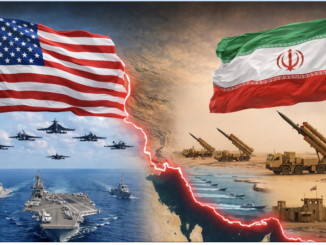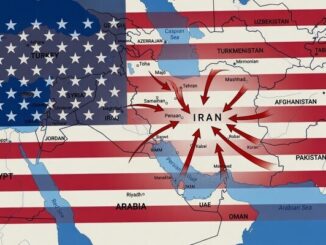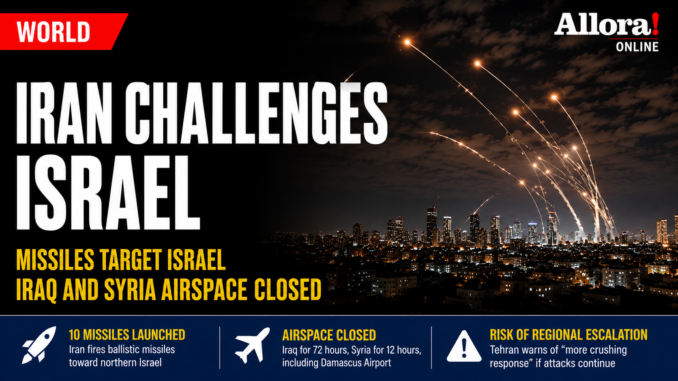
The Middle East has entered another period of extreme tension after Iran launched ballistic missiles toward Israel, prompting Iraq and Syria to temporarily close their airspace amid fears of a wider regional conflict.
Iraq’s Civil Aviation Authority announced the closure of Iraqi airspace for the next 72 hours, while Syrian authorities suspended air traffic for 12 hours, including operations at Damascus International Airport.
The measures reflect growing concern that the confrontation between Iran and Israel could rapidly escalate beyond current battle lines and draw additional countries into the conflict.
Trump Urges Iran to Return to Negotiations
U.S. President Donald Trump called on Iran to return to diplomatic negotiations following the missile attacks.
“You’ve shot your missiles, that’s enough. Get back to the table and make a deal,” Trump said in an interview with Fox News.
According to the president, Washington and Tehran had been close to reaching an agreement on the Iranian nuclear issue, with a deal potentially expected within days.
“We were very close. I would say an agreement would have been signed on Monday, Tuesday or Wednesday of next week. And now this happens,” Trump stated.
Trump also revealed that he intends to contact Israeli Prime Minister Benjamin Netanyahu to urge restraint and discourage any direct military retaliation against Iran.
The U.S. president further indicated that he was “not happy” with Israel’s recent strikes on Beirut, highlighting Washington’s concern that further escalation could undermine ongoing diplomatic efforts.
Tehran Issues Strong Warning
Iran responded with a stern warning, threatening more severe attacks if Israel continues military operations in southern Lebanon and Beirut.
According to Iran’s state-run Press TV, Iranian military officials accused Israel of crossing “all red lines” with its recent attacks on Lebanese territory.
Tehran specifically condemned Israeli strikes targeting Dahiyeh, a southern suburb of Beirut widely regarded as a Hezbollah stronghold.
“The Zionist army must stop its attacks on southern Lebanon and Dahiyeh,” Iranian officials stated. “If it expands its attacks on that region or responds to Iran’s action, it will face even more crushing and regret-inducing blows, and devastating attacks will be launched.”
Iran also accused Israel of acting with the support and approval of the United States, further raising tensions between the regional rivals.
Growing Risk of Regional War
The latest developments underscore fears that the conflict is evolving beyond a confrontation between Israel and Hezbollah.
For the first time in months, there is an explicit threat of direct military confrontation between Iran and Israel, with the United States, Lebanon, Syria and Iraq increasingly affected by the unfolding crisis.
The closure of Iraqi and Syrian airspace is a clear indication that regional governments are preparing for the possibility of broader military operations and additional missile exchanges.
International observers are now closely watching Israel’s next move. Any significant retaliation against Iranian targets could trigger a new cycle of escalation, jeopardizing diplomatic efforts and threatening stability across the Middle East.
For now, the region remains caught between diplomacy and war, with tensions at their highest level in months and the possibility of a wider conflict looming over the entire region.