Over the past decade, Italy has quietly become one of Europe’s most important pharmaceutical hubs. Production, research, jobs and exports have all surged, turning the sector into one of the strongest engines of the Italian economy. Today pharmaceuticals account for about 10 per cent of Italy’s total exports, a remarkable figure for an industry once seen as secondary to fashion, food or machinery.
At the heart of this success are three pillars: multinational groups operating in Italy, a strong network of contract manufacturers, and a core of Italian-owned companies known as the FAB13 – the 13 historic pharmaceutical firms of Made in Italy.
Together, they show how tradition and innovation can grow side by side. The FAB13 include well-known names such as Menarini, Chiesi, Recordati, Angelini, Zambon and Dompé. According to a report by economist Marco Fortis of the Edison Foundation, their performance in 2024 was particularly strong. Aggregate revenues rose by 12 per cent compared to 2023, reaching €18.9 billion. Foreign markets drove most of this growth, with international revenues up 14 per cent, while the domestic market grew only 2 per cent due to weak national demand.
Exports were the real star. The FAB13 recorded export growth of 16 per cent in 2024, far above the already impressive 10 per cent increase of Italy’s overall pharmaceutical exports. Investments also surged: total investment (excluding acquisitions) grew by 21 per cent, while spending on research and development jumped by 27 per cent to €1.4 billion.
Employment followed the same positive trend. The FAB13 workforce grew by 3 per cent overall, with a 2 per cent rise in Italy and 4 per cent abroad. In total they employ about 50,400 people, around 15,000 in Italy and 35,000 overseas. Half are women, more than 80 per cent hold a diploma or university degree, and over 90 per cent have permanent contracts. Research is central: in Italy, 56 per cent of FAB13 employees work in R&D.
Their global footprint is impressive. The FAB13 operate 65 production sites worldwide, 29 of them in Italy, and 51 research centres. They control 289 subsidiaries across the globe, allowing them to combine strong roots at home with a truly international reach. This structure guarantees efficiency, innovation and, crucially, security of supply for millions of Italian patients.
In recent years these companies have expanded through acquisitions, partnerships and licensing deals abroad. They are leaders in personalised medicine and orphan drugs for rare diseases, often working at the frontiers of biomedical innovation. This makes them not only an economic asset, but also a strategic one for public health.
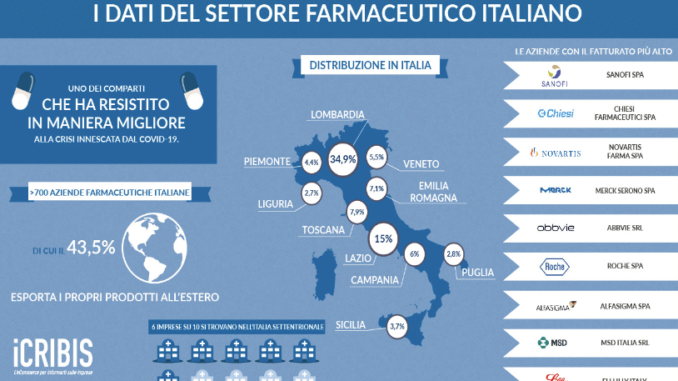
The broader pharmaceutical industry in Italy tells a similar story. In 2024, companies associated with Farmindustria – both Italian and multinational – reached a production value of €56.1 billion, up 87 per cent from 2016. Exports hit €53.8 billion, an extraordinary 152 per cent increase over the same period. High-tech pharmaceutical exports have almost tripled since 2016.
Italy is now the world’s sixth-largest exporter of medicines and the third largest exporter of packaged drugs, after Germany and Switzerland. The sector employs around 67,000 people, 12 per cent more than in 2016, and invests about €4 billion a year, over half of it in research.
Political leaders see pharmaceuticals as a pillar of the “new Made in Italy”.
The Minister for Enterprises and Made in Italy, Adolfo Urso, has called the FAB13 “ambassadors of Italian industry in the world” and announced new innovation agreements worth €731 million to support research projects with high technological impact. Other policymakers stress the need for stability and smart regulation. They argue that issues such as the complex “payback” system – which forces companies to refund part of public drug spending – must be reformed because it discourages investment. In a world moving beyond pure globalisation, quality, innovation and strong domestic roots are seen as Italy’s best competitive weapons.
As Marco Fortis notes, Italian pharmaceuticals now stand alongside fashion, mechanics and food as a signature national strength.
The FAB13 show how companies can “keep their head and heart in Italy” while expanding across the world. In doing so, they are not only improving health for millions, but also proving that Italy can lead in one of the most advanced industries of the 21st century.