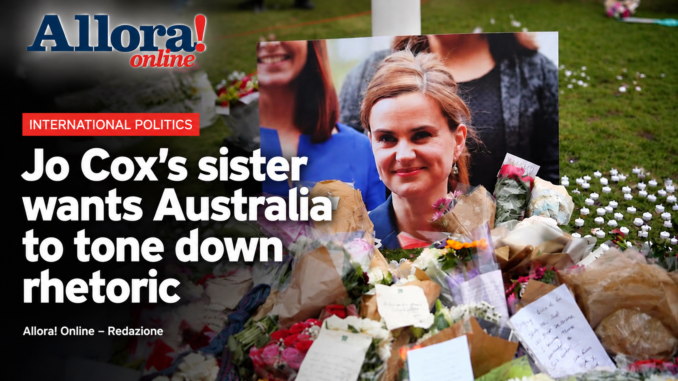
The sister of murdered British MP Jo Cox has warned that political violence does not emerge in isolation, calling on Australia to confront rising hostility, online abuse and increasingly aggressive political rhetoric following the devastating attack on independent MP Helen Haines.
Allora! Online – Redazione
The brutal attack on Australian independent MP Helen Haines has sparked a national debate about political violence, public safety and the growing climate of hostility surrounding democratic institutions.
Among the strongest voices calling for change is Kim Leadbeater, a British Labour MP whose sister, Jo Cox, was murdered by a far-right extremist in 2016.
Speaking to the ABC’s 7.30 program, Leadbeater urged Australia to recognise the attack on Haines as a moment of national reflection, warning that political violence cannot be separated entirely from the wider culture of anger, intimidation and division.
Her message carries particular significance because of her family’s tragic experience.
Jo Cox was just 41 when she was shot and stabbed outside a constituency meeting in northern England. Her murder shocked Britain and prompted widespread promises to restore civility to political debate. A decade later, her sister believes too little has changed.
A devastating attack on Australian democracy
Helen Haines, the independent federal member for Indi, was critically injured on Monday, October 19, after being struck by a four-wheel-drive vehicle outside her electorate office in Wangaratta, north-eastern Victoria.
The 65-year-old parliamentarian suffered catastrophic injuries and underwent emergency surgery at Melbourne’s Alfred Hospital.
Police have charged 43-year-old Brendan Nugent with dangerous driving causing serious injury, intentionally causing serious injury and causing harm to a Commonwealth public official.
Investigators allege the attack was targeted, although the precise motive remains under investigation.
Prime Minister Anthony Albanese condemned the incident and called for greater respect in Australian political life, stressing the importance of protecting the country’s democratic traditions.
For Kim Leadbeater, however, the tragedy raises questions that extend far beyond the criminal investigation.
Political violence does not happen in isolation
Leadbeater warned that repeated acts of violence against public representatives reflect a disturbing deterioration in political culture.
“Things don’t happen in a vacuum,” she told the ABC.
Her concern is not simply about individual acts of aggression, but about the atmosphere in which hostility towards politicians becomes increasingly normalised.
Political disagreement, she stressed, is essential to democracy. Yet there is a fundamental difference between challenging a political position and treating elected representatives as legitimate targets for hatred or intimidation.
She urged Australians to seek common ground rather than allow political differences to destroy mutual respect.
Leadbeater also expressed frustration that, despite the murder of her sister and subsequent attacks on politicians in Britain, discussions about political safety continue to follow the same pattern.
A tragedy occurs, the public expresses shock, politicians promise change, and eventually attention moves elsewhere.
For the families directly affected, however, the consequences never disappear.
Social media and the normalisation of abuse
The debate has also exposed the disturbing scale of intimidation experienced by Australian politicians.
Social Services Minister Tanya Plibersek revealed that threats of violence and sexual assault have been a recurring feature of her political career.
She recalled receiving a handwritten message at her family home wishing painful deaths upon her children.
While threats against elected representatives are not new, Plibersek believes social media has dramatically intensified the problem.
She described the phenomenon as the “industrial scale of that abuse”.
The minister also revealed that, shortly after the attack on Haines, a social media user posted a threatening comment directed at independent senator Jacqui Lambie.
Plibersek had publicly defended Lambie against a controversial One Nation cartoon mocking a personal medical condition.
The response included a disturbing reference to the type of vehicle involved in the attack on Haines.
For Plibersek, the incident demonstrated how quickly political hostility can descend into language that appears to endorse serious violence.
Concern crosses political divisions
Coalition MP Andrew Hastie also warned about the consequences of increasingly aggressive political communication.
He expressed concern that social media platforms allow emotionally charged and hostile messages to reach enormous audiences, potentially influencing people already vulnerable to extreme behaviour.
Hastie revealed that he had experienced an increase in online abuse over recent months and had consequently delegated responsibility for his social media accounts to staff.
His concerns reflect a broader democratic challenge.
If intimidation becomes an accepted part of political life, capable individuals may become increasingly reluctant to seek public office.
The consequences would extend beyond individual politicians, affecting the quality of parliamentary representation and ultimately the decisions made on behalf of Australians.
Democracy needs disagreement, not hatred
The attack on Helen Haines has brought renewed attention to a principle that should remain fundamental in every democracy: political opponents are not enemies.
Australians have a long tradition of robust political debate, fierce parliamentary exchanges and open criticism of elected officials.
That tradition must be protected.
Criticism, public scrutiny and disagreement are indispensable to democratic accountability. Calls for more respectful debate must never become an excuse to silence legitimate opposition or discourage journalists and citizens from questioning those in power.
But freedom of expression also carries responsibilities.
Threats, intimidation, dehumanising language and the celebration of physical violence cannot be treated as ordinary instruments of political disagreement.
The challenge facing Australia is therefore not to eliminate political conflict, but to maintain the boundary between democratic confrontation and personal hostility.
A warning Australia cannot afford to ignore
Ten years after Jo Cox’s murder, Kim Leadbeater continues to confront a question that has never received a satisfactory answer: how many tragedies must occur before political societies genuinely change?
Her appeal comes at a particularly painful moment for Australia, as Helen Haines and her family face the devastating consequences of an attack that has shaken the nation.
The responsibility to respond extends beyond Parliament.
Political leaders, media organisations, social media platforms and ordinary citizens all influence the language and behaviour that shape public debate.
The outcome of the criminal investigation will determine individual legal responsibility. The broader examination of Australia’s political culture requires a different kind of collective response.
A democracy must be strong enough to tolerate sharp criticism, passionate disagreement and competing political visions without allowing hostility to become violence.
The most meaningful response to the attack on Helen Haines would be to ensure that the shock felt across Australia becomes more than another temporary expression of national outrage.
Democracy does not require citizens to agree. It requires them to recognise that disagreement must never become a justification for violence.