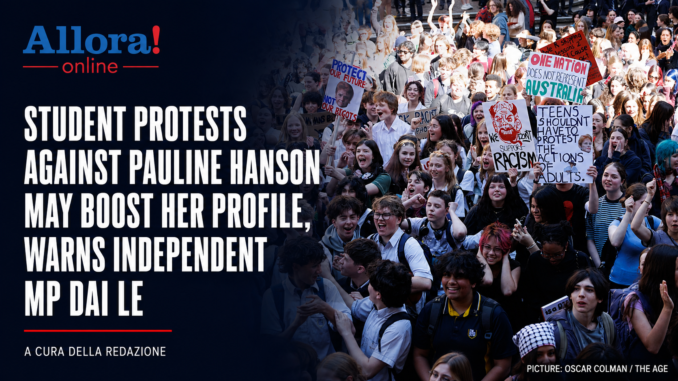
Independent MP Dai Le has warned that the student protests held across Australia against Pauline Hanson could have the unintended effect of giving the One Nation leader even greater political prominence.
Thousands of students took part in “Say no to Hanson” demonstrations around the country, with many leaving school to join rallies opposing One Nation’s policies.
In Sydney, hundreds gathered at Town Hall as part of the coordinated protests, despite warnings to remain in class.
Dai Le said students have a democratic right to protest, but drew a distinction between university students and those still completing high school.
Speaking on Nine’s Today show, Le said university students were entitled to demonstrate in their own time, describing the right to protest as one of the strengths of Australian democracy.
However, she suggested Year 11 and Year 12 students should place greater emphasis on their studies, particularly those preparing for the HSC.
“It could give Hanson more prominence”
Le also questioned whether the demonstrations might ultimately benefit Pauline Hanson and One Nation politically.
She argued that by placing Hanson at the centre of large public protests, demonstrators risk increasing attention on both the senator and her party.
According to Le, the rallies could “give her more prominence” and push One Nation further into the public spotlight.
Her comments highlight one of the broader political questions surrounding protest movements: whether strong opposition can sometimes amplify the profile of the political figure being targeted.
Thousands of students take to the streets
The “Say no to Hanson” demonstrations saw students in several Australian cities leave classrooms and gather publicly to voice their opposition to One Nation’s positions.
The rallies also reopened debate about whether school students should participate in political demonstrations during class time.
Supporters of the protests argue that young people should be encouraged to participate in democracy and make their voices heard.
Critics, however, say students — particularly those in senior high school — should prioritise their education and avoid missing classes for political action.
For Le, the issue is not only about whether students have the right to protest, but also whether the strategy could ultimately strengthen the visibility of the very politician they are opposing.