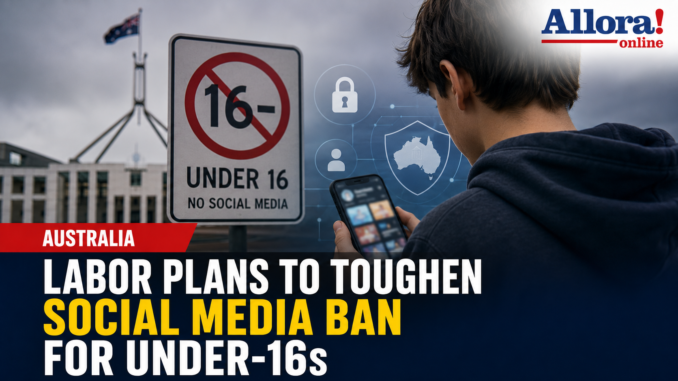
Anthony Albanese admits the current laws may not be strong enough to hold major platforms accountable. The government is considering tougher enforcement powers, new rules for algorithms and a legal duty to prevent foreseeable digital harm
The Australian federal government is preparing a new crackdown on major technology companies to ensure the social media ban for children under 16 is properly enforced.
Prime Minister Anthony Albanese has confirmed that strengthening the law is now a priority for Labor after eSafety Commissioner Julie Inman Grant warned that she does not have strong enough powers to force digital platforms to fully comply with the rules.
Since December, platforms including Instagram, Facebook, TikTok, Snapchat, YouTube, Twitch, Kick and X have been legally required to take reasonable steps to prevent Australians under the age of 16 from creating or maintaining accounts.
Companies that fail to comply can face fines of up to $49.5 million.
However, despite millions of accounts being removed, deactivated or restricted, many teenagers are still accessing the services or managing to create new profiles.
The result is that a law presented as a world-first measure to protect children risks being weakened by insufficient enforcement and by the ability of platforms to argue that they have taken only the “reasonable steps” required under the legislation.
ALBANESE: “THERE IS MORE TO DO”
Speaking during Question Time, Albanese openly acknowledged that the government’s work is not finished.
“There is more to do,” he said.
The prime minister explained that the government was considering the comments made by the eSafety Commissioner and examining what further legislative changes may be needed to strengthen the system.
According to Albanese, the issue is particularly complex because previous generations never had to deal with technology companies capable of exercising such a powerful influence over the daily lives of both children and adults.
The prime minister accused major digital corporations of holding extraordinary power without being subjected to an appropriate level of accountability.
“We cannot allow companies that are unaccountable, that make enormous profits and have extraordinary power, to decide the rules themselves,” he said.
For Albanese, control must remain in the hands of Australians and their democratically elected institutions, rather than in the boardrooms of multinational technology companies.
ESAFETY COMMISSIONER WARNS OF LIMITED POWERS
Julie Inman Grant has described the current legislative structure as having only very “thin scaffolding”.
She said she does not have sufficiently powerful tools to intervene quickly when platforms apply the ban inconsistently or systematically allow children to avoid age restrictions.
The government had previously warned that the eSafety Commissioner would “throw the book” at companies that failed to stop young Australians from accessing social media.
However, no fines have yet been issued against the major platforms, despite evidence that many children have retained their accounts or created new ones.
Part of the problem lies in the way the legislation was designed.
Companies must show that they have taken reasonable steps, but they are not required to establish the age of every individual user with absolute certainty.
There is also no legally binding minimum threshold for the number of underage users that platforms must identify and remove.
This leaves companies with significant freedom to choose their own age-assurance systems and enforcement methods.
4.7 MILLION ACCOUNTS REMOVED OR RESTRICTED
Early figures showed a significant impact.
Around 4.7 million accounts believed to belong to Australians under the age of 16 were removed, deactivated or restricted during the first phase of the ban.
The figure was presented as an important initial success.
However, a later report released by the eSafety Commissioner found that many children were still able to access social media.
Some used false dates of birth, others relied on accounts belonging to parents, while many took advantage of age-verification systems that were relatively easy to bypass.
In other cases, platforms allegedly failed to identify users who appeared clearly younger than the minimum age.
The central challenge is creating a reliable system that protects children without forcing all Australians to provide identity documents or biometric information to technology companies.
The government will therefore need to find a balance between safety, privacy and effective enforcement.
ALGORITHMS ALSO UNDER SCRUTINY
The government’s proposed reforms are not expected to focus only on users’ ages.
Albanese has indicated that the government is also examining the way algorithms operate, including the automated systems platforms use to decide which content users see.
The issue was raised in parliament by independent Wentworth MP Allegra Spender, who asked whether the government would consider giving all Australians the right to opt out of personalised recommendation systems.
The prime minister did not confirm that such an option would be introduced, but said algorithms would be considered as part of a proposed digital duty of care.
Algorithms do not simply display content in chronological order.
They analyse user behaviour and predict which videos, images or posts are most likely to generate a click, reaction or share.
The system therefore tends to promote content that is more emotional, provocative or engaging.
According to Albanese, this mechanism can gradually push people towards increasingly extreme positions.
A user may begin by looking at mainstream material about identity, ethnicity or religion and, after a series of automated recommendations, find themselves exposed to neo-Nazi propaganda, violent material or extremist conspiracy theories.
The risk applies to children, but not only to them.
Adults can also be drawn into radicalised online environments through repeated exposure to content selected primarily to hold their attention.
A LEGAL DUTY TO PREVENT HARM
The government is currently consulting experts and industry representatives on a new legal responsibility for digital platforms.
The proposed digital duty of care would require companies to prevent foreseeable harm caused by their services.
The current system largely acts after harmful or illegal content has already been published, ordering it to be removed.
The new approach would instead be preventive.
Platforms would have to identify in advance the risks created by their algorithms, recommendation systems, chatbots, automated accounts and features designed to maximise engagement.
A company would no longer be able to simply remove harmful content after receiving a complaint.
It would have to show that its service had been designed in a way that reduced the likelihood of the harm occurring in the first place.
This could represent one of the most significant changes in Australian digital regulation.
Responsibility would no longer focus only on the user who uploads harmful material, but also on the company that promotes it, recommends it and profits from it.
CRACKDOWN ON AI “NUDIFY” SERVICES
At the same time, the eSafety Commissioner has intensified action against artificial intelligence services used to create fake sexually explicit images.
Three additional AI-powered “nudifying” platforms have withdrawn their services from Australia following enforcement action.
These services allow users to upload a photograph of a person and generate an artificial nude or sexualised version of the image.
The technology has also been used in schools to create fake intimate images of students and, in some cases, material that may be classified as child sexual exploitation content.
Inman Grant rejected the suggestion that these were harmless tools.
She said the services were increasingly being used to produce degrading and abusive material capable of causing serious psychological harm to victims.
The three services will remain unavailable in Australia until suitable age-assurance systems are introduced.
Their landing pages may remain visible, but content will be blurred and users will be unable to access the main functions.
AUSTRALIA AS A GLOBAL PIONEER
Australia’s under-16 social media ban has been promoted as the first national measure of its kind in the world.
Albanese said another 16 countries had followed or were considering the Australian model.
The government views this international attention as evidence of Australia’s leadership in regulating major digital platforms.
But being first also means dealing with problems that do not yet have definitive solutions.
Age verification, privacy protection, cooperation from technology companies and the ability to prevent teenagers from bypassing restrictions all remain unresolved challenges.
Labor must now prove that the ban is not merely a political statement but a law that can be effectively enforced.
A NEW CONFRONTATION WITH BIG TECH
Strengthening the rules could trigger a new conflict between Canberra and the world’s largest technology companies.
Platforms frequently argue that strict age-verification systems could undermine privacy, wrongly exclude adult users or require the collection of excessive amounts of personal information.
The government responds that these same companies already use highly sophisticated technologies to analyse behaviour, target advertising and maximise profits.
According to this argument, the same capabilities should also be used to protect children.
Albanese’s political message is clear: companies cannot be allowed to decide for themselves what level of protection is sufficient.
Parliament must set the standards, and the eSafety Commissioner must have the tools required to enforce them.
TURNING THE LAW INTO REAL PROTECTION
The Australian ban has already produced a significant result, with millions of accounts removed or restricted.
But the size of that figure alone does not prove that all children are now off social media or protected from harmful content.
Many are still finding ways to gain access, others are moving to less regulated platforms, and some are using increasingly difficult-to-control artificial intelligence tools.
The next phase will therefore be critical.
The government will need to increase the powers of the regulator, clarify the responsibilities of technology companies and impose meaningful consequences on those that fail to comply.
It will also need to address the way platforms select and promote content, because the problem is not only who can create an account, but what happens after a person gains access.
The challenge is to prevent technological power from becoming stronger than the ability of the state to protect its citizens.
Albanese’s message to global technology companies is direct: in Australia, the rules will not be decided by algorithms or commercial interests.
They will be decided by Australians.