Italian researchers at the Queensland Brain Institute (QBI) are helping drive major advances in neuroscience, with work that spans brain development, neuronal repair, dementia and stroke. Their research is strengthening Queensland’s reputation as a centre for world-class brain science and contributing to discoveries with global health significance.
Among the leading figures is Professor Massimo Hilliard, originally from Naples, whose laboratory at QBI focuses on molecular and cellular neurobiology. His team studies how neurons develop, how they maintain their structure, and how damaged nerve cells can be repaired. Using the tiny roundworm C. elegans as a model, the lab investigates the biological mechanisms that control axon organisation, degeneration and recovery after injury.
That work is particularly important because axons are the long fibres that allow nerve cells to communicate across the nervous system. Understanding how they are protected and repaired could help scientists develop new strategies for treating neurological injury and disease. The Hilliard laboratory has also explored axonal fusion, a process that can reconnect severed nerve fibres and may one day inform approaches to nerve repair.
Dr Matilde Balbi is also making a significant contribution to the institute’s neuroscience research. Trained at the University of Naples, Dr Balbi works on brain imaging and the regulation of cerebral blood flow in health and disease. Her research is especially relevant to stroke, where interrupted blood supply can rapidly damage brain tissue and lead to lasting disability. By examining how blood flow is controlled in the brain, and how this regulation changes in disease, Dr Balbi’s work is helping build a better understanding of the mechanisms behind stroke and dementia. This kind of research is vital for identifying early warning signs, improving diagnosis and guiding the development of more effective treatments.
The work of Professor Hilliard and Dr Balbi sits within a broader and highly active neuroscience community at QBI, where more than 300 researchers and staff are engaged in understanding the brain in health and disease. The institute’s research spans neurodevelopment, connectivity, injury repair, ageing and neurodegeneration, with a strong focus on translating discoveries into practical benefits for patients and communities.
Italian researchers have become an important part of that effort. Their presence at QBI reflects the strength of international scientific exchange and the value of bringing together expertise from different research traditions. It also highlights the enduring connection between Queensland and Italian institutions, including collaborations with centres in Naples and other parts of Italy.
Another Italian researcher contributing to this environment is Dr Annalisa Paolino, a postdoctoral fellow from the University of Insubria, whose work examines mammalian brain evolution and development. Dr Alessandra Donato is contributing to the Clem Jones Centre for Ageing Dementia Research, while Dr Ramon Martinez-Marmol is working in the Hilliard laboratory on neuronal fusion. Together, they form part of a vibrant scientific community helping to push the boundaries of neuroscience research.
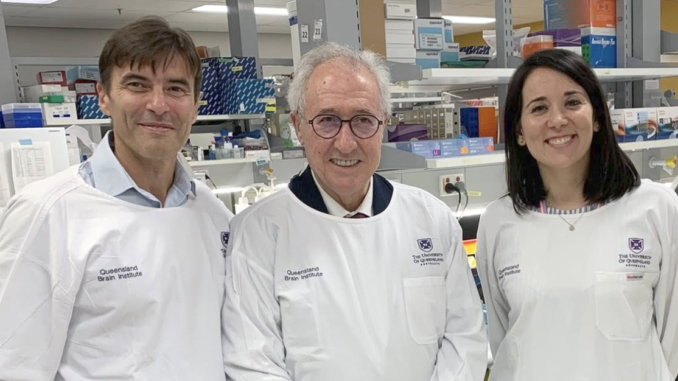
The importance of this Italian scientific presence at QBI was underscored by a recent visit from Senator Francesco Giacobbe OAM, Senator of the Republic of Italy. During the visit, he met with Professor Hilliard and Dr Balbi and saw firsthand the calibre of research being undertaken by Italian scientists in Queensland.
The visit provided an opportunity to recognise not only the achievements of individual researchers, but also the wider contribution of the Italian community to Australian science. It also reinforced the importance of international cooperation in tackling some of the most complex and pressing health challenges of our time, including dementia and stroke.
As neurological disorders continue to affect millions of people worldwide, the work being carried out at QBI stands as a powerful example of what can be achieved when talent, collaboration and long-term scientific vision come together.
For Italian researchers in Queensland, their excellence is not only a source of pride for the community, but also a meaningful contribution to the future of brain health.