The United States and Nigerian armed forces have killed Abu Bilal al-Minuki, described by President Donald Trump as the “number two global leader” of Islamic State and “the most active terrorist in the world.”
The announcement was made directly by Trump on his social media platform, where he praised what he called a “meticulously planned and highly complex mission” carried out jointly by American special forces and Nigerian military units.
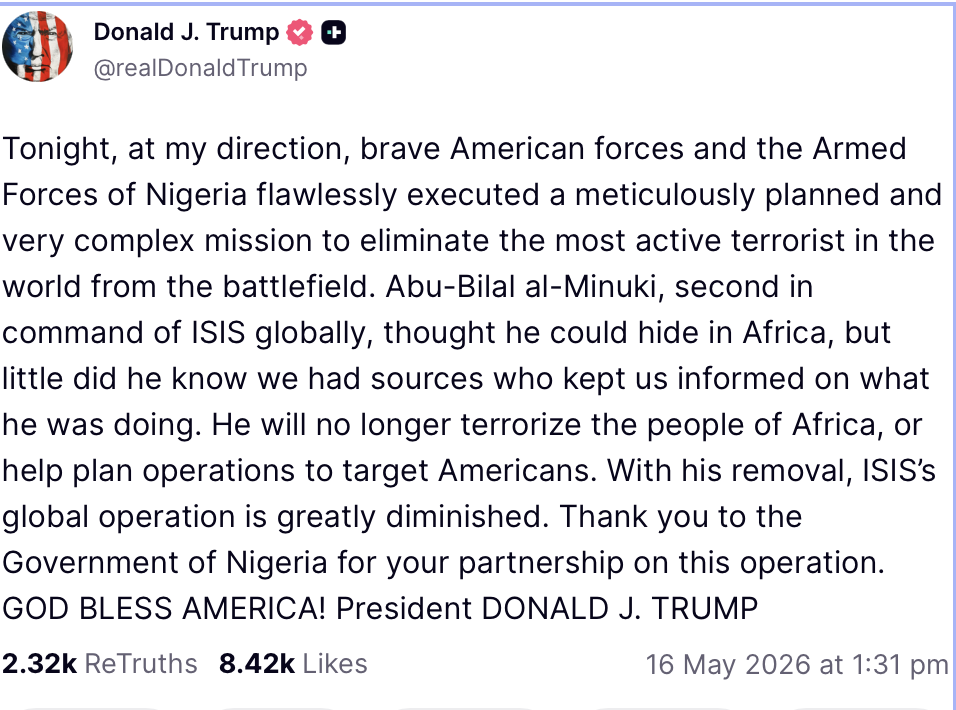
“Tonight, on my orders, brave U.S. forces and the Nigerian military successfully eliminated the world’s most active terrorist from the battlefield,” Trump wrote, adding that al-Minuki believed he could hide in Africa without being detected.
According to the U.S. Treasury Department, Abu Bilal al-Minuki — also known as Abu Bakr ibn Muhammad ibn Ali al-Mainuki — was born in 1982 in the northeastern Nigerian state of Borno, one of the epicentres of jihadist violence in Africa.
Washington had officially designated him a global terrorist in 2023.
Security officials considered him one of the top coordinators of ISIS operations across West Africa and the Sahel region, overseeing several branches of the extremist organisation and helping direct international activities linked to the group’s global network.
Trump claimed that his elimination would “significantly reduce ISIS operational capabilities worldwide.”
The operation highlights the growing military cooperation between the United States and Nigeria, particularly in the fight against jihadist groups operating across the Sahel and Lake Chad regions.
Northern Nigeria has faced years of instability caused by extremist organisations, insurgencies and criminal gangs responsible for massacres, kidnappings and attacks on civilian communities.
American military involvement in the region has intensified in recent years. Last Christmas, U.S. forces reportedly conducted coordinated strikes in Sokoto State against ISIS-linked targets, marking a major escalation in joint counterterrorism operations with Abuja.
The latest operation sends a strong geopolitical message: despite the weakening of ISIS in the Middle East, the group’s African branches remain a major global security concern — and Washington appears determined to prevent the continent from becoming the organisation’s new strategic stronghold.