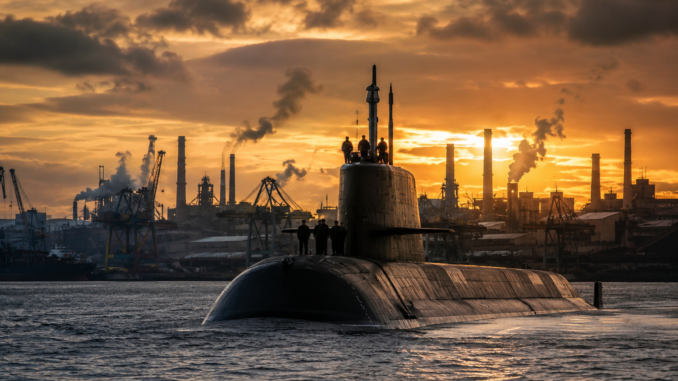
Australia is moving toward one of the most controversial military decisions in its modern history: the construction of a nuclear submarine base on the country’s east coast. And according to previously confidential New South Wales government documents, the preferred location appears to be Port Kembla, an industrial city located about 75 kilometres south of Sydney.
But the same documents contain a striking warning: the future base “could be a target for Australian military adversaries.”
The proposal is part of the AUKUS agreement between Australia, the United States and the United Kingdom, under which Canberra plans to acquire and eventually build nuclear-powered submarines. It represents a historic shift in Australia’s defence posture and a deeper integration into the Western military alliance in the Indo-Pacific.
Government assessments reportedly identified Port Kembla as the strongest candidate because of its existing port infrastructure, industrial capacity and expansion potential. Officials believe the site could support naval vessels, submarine facilities and a dry dock capable of servicing nuclear-powered submarines.
Supporters of the project argue that the economic benefits could be substantial. Estimates suggest the project could inject more than 426 million Australian dollars into the New South Wales economy through infrastructure investment, highly skilled jobs and long-term industrial development.
Yet behind the promises of economic growth lies a far more complex national debate.
The documents acknowledge that local residents are likely to view the base as both an environmental and military risk. Public concern centres on the fact that the submarines would carry nuclear reactors fuelled by highly enriched uranium — material closer to weapons-grade fuel than that used in conventional civilian nuclear plants.
Even more concerning is the government’s admission that, in the event of an international conflict, the base itself could become a strategic military target.
This is the heart of the national dilemma facing Australia.
For decades, Australia positioned itself as a stable regional power geographically distant from the world’s major conflicts. But the strategic landscape has changed dramatically. Rising tensions between the United States and China, growing militarisation in the Indo-Pacific and concerns over regional security have pushed Canberra closer to Washington’s strategic orbit.
Critics argue that Australia risks turning itself into a frontline state in a future geopolitical confrontation. Community groups, environmental organisations and anti-nuclear activists have already mobilised against the proposal. More than forty organisations signed the “Port Kembla Declaration”, opposing the transformation of their city into a nuclear military hub.
Political divisions are also deepening. While the federal government continues to defend the strategic necessity of an east coast base, opponents warn that Australia could be sacrificing long-term national security for geopolitical alignment.
The irony is difficult to ignore: a project intended to strengthen Australia’s defence may also increase its exposure to global conflict.
No final decision has officially been made, and Canberra insists that the choice of location will not occur until the next decade. Yet the emergence of these documents suggests that planning behind closed doors is already well advanced.
The broader question now facing Australians is no longer simply about submarines or military infrastructure. It is about the country’s future identity.
Does Australia become a heavily armed strategic fortress tied closely to US military doctrine? Or should it seek a more independent path that avoids placing millions of citizens closer to the front line of global tensions?
Port Kembla may soon become more than just a harbour city. It could become the symbol of a new Australia — stronger, wealthier, strategically important… but also far more exposed.