
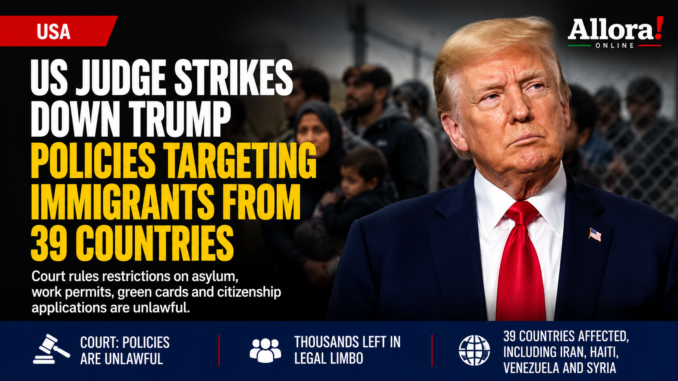
Federal court rules immigration restrictions unlawfully left thousands of applicants in legal limbo
A major legal setback has been handed to the Trump administration after a federal judge ruled that a series of immigration policies targeting applicants from 39 countries were unlawful.
Chief U.S. District Judge John McConnell of Rhode Island found that policies adopted by the U.S. Citizenship and Immigration Services (USCIS) improperly blocked decisions on asylum applications, work permits, green cards and citizenship requests for people from dozens of countries across Africa, Asia, Latin America and the Middle East.
According to the ruling, the measures left thousands of immigrants trapped in what the judge described as an “indeterminate legal limbo,” despite having followed all legal immigration procedures established by Congress and federal regulations.
Judge: “People Were Penalised Because of Their Birthplace”
In his decision, Judge McConnell stated that the affected immigrants had complied with all legal requirements but found themselves waiting for months, and in some cases years, for applications that USCIS refused to process.
The court concluded that the agency lacked the statutory authority to implement the policies and suggested that the measures were influenced by anti-immigrant sentiment rather than lawful administrative considerations.
“USCIS’s hold on adjudications cannot be attributed to anything that these individuals did wrong,” McConnell wrote. “Rather, it arises solely by the happenstance of their birth.”
The judge added that the policies placed the lives of countless individuals on hold simply because of the countries where they were born.
Immigration Crackdown After Security Incident
The restrictions were introduced as part of the Trump administration’s broader immigration crackdown following the 2025 shooting of two National Guard members in Washington, D.C.
Prosecutors alleged that the attack was carried out by an Afghan immigrant, Rahmanullah Lakanwal, who has pleaded not guilty.
Following the incident, President Donald Trump pledged to significantly restrict migration from what he described as “Third World Countries” while the U.S. immigration system recovered. His administration subsequently expanded full or partial travel bans to 39 nations.
Countries affected by the restrictions included Afghanistan, Iran, Haiti, Somalia, Venezuela and Syria. Administration officials argued that the measures were necessary for national security and enhanced vetting procedures.
Victory for Immigrant Advocacy Groups
The ruling represents a major victory for a coalition of immigrant service organisations and labour unions that challenged the policies in federal court earlier this year.
The lawsuit argued that the federal government could not lawfully suspend legal immigration pathways or discriminate against applicants based solely on their nationality.
Skye Perryman, President of Democracy Forward, the legal organisation representing the plaintiffs, welcomed the ruling.
“This decision reaffirms a basic principle: the federal government cannot shut down lawful immigration pathways or discriminate against people based on where they come from,” she said.
What Happens Next?
The Department of Homeland Security (DHS) did not immediately comment on the ruling.
Legal experts expect the Trump administration to appeal the decision, as immigration remains one of the most contentious issues in American politics.
If upheld, the ruling could immediately affect thousands of pending immigration cases, reopening pathways for applicants whose requests have been frozen under the challenged policies.
The case is likely to become another significant chapter in the ongoing legal battle over immigration policy in the United States, with potential implications for asylum seekers, permanent residents and citizenship applicants across the world.