Trump Targets Massie: The Republican Civil War Is No Longer Hidden
19/05/2026Allora!Ultim'oraComments Off on Trump Targets Massie: The Republican Civil War Is No Longer Hidden
Donald Trump has once again raised the temperature inside American politics, this time launching a direct and brutal attack against one of the most independent voices within the Republican Party: Thomas Massie.
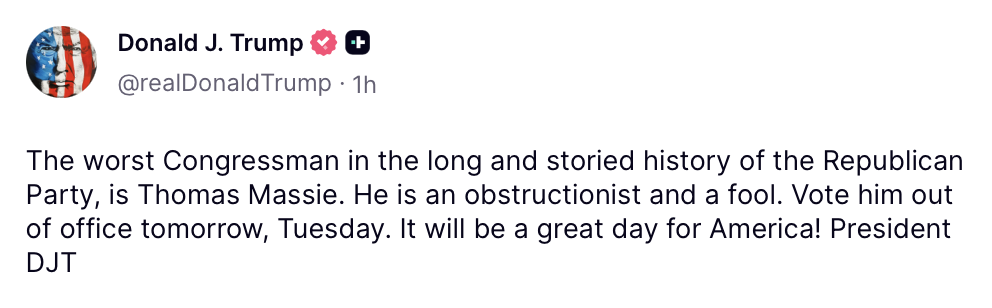
“The worst Congressman in the long and storied history of the Republican Party is Thomas Massie. He is an obstructionist and a fool. Vote him out of office tomorrow, Tuesday. It will be a great day for America!”
The message is remarkable not only for its tone, but for what it reveals about the current state of the Republican Party.
Massie, a libertarian-leaning congressman from Kentucky, has long been one of the few Republicans willing to openly challenge party leadership — including Trump himself. Fiercely conservative on spending, skeptical of foreign military intervention, and deeply committed to constitutional limits on government power, Massie represents a faction of the Republican base that increasingly fears America is drifting toward another endless conflict overseas.
And that is likely where the real tension lies.
Trump’s attack comes at a moment of growing instability in the Middle East, with Washington weighing military options against Iran and global energy markets already under pressure. While many Republicans continue to rally behind Trump’s aggressive posture, others inside the “America First” movement are becoming uneasy about the possibility of another major war.
Massie has become one of the clearest voices of that resistance.
This is why Trump’s post feels larger than a personal insult. It is a warning shot aimed at anyone inside the Republican Party who dares to challenge his authority or question his geopolitical strategy.
The language itself is striking.
Calling a member of your own party “the worst Congressman in history” reflects how deeply American politics has entered an era of permanent confrontation. Internal disagreement is no longer treated as debate — it is treated as betrayal.
Trump continues to dominate Republican politics through confrontation, loyalty tests, and direct communication with his base. For millions of supporters, that style is exactly why they trust him. For critics, however, it is further evidence that the Republican Party is becoming less a political movement and more a personality-driven machine centered entirely around one man.
The danger for Republicans is obvious: the deeper the party divides between Trump loyalists and independent conservatives, the harder it becomes to maintain unity ahead of a volatile election cycle.
And while the world watches the possibility of a wider conflict in the Middle East, another battle is unfolding inside America itself — a battle over the future identity of the Republican Party.
di Domenico Maceri PhD Chuck Schumer “pensava di fratturare l’unità repubblicana ma i repubblicani hanno piegato lui”. Con queste parole Donald Trump ha caratterizzato il leader democratico del Senato che si è arreso, ponendo fine […]
14/05/2026Allora!ApprofondimentoComments Off on Trump a Pechino con Musk e i big della Silicon Valley: il vertice con Xi può cambiare gli equilibri mondiali
Donald Trump è arrivato a Pechino per uno dei summit più delicati e strategici della sua nuova presidenza. Ad accoglierlo nella capitale cinese c’è Xi Jinping, con cui discuterà di commercio, terre rare, energia, tecnologia, Iran e […]
di Domenico Maceri, PhD Nel 2023 la Corte Suprema americana eliminò i programmi di “affirmative action” che misero fine alla leggera preferenza che le università concedevano all’ammissione di studenti di gruppi minoritari. I criteri di […]