The Maldives sell a fantasy to the world.
Turquoise lagoons.
White sand.
Luxury villas suspended over calm water.
A paradise marketed as untouched, peaceful and impossibly beautiful.
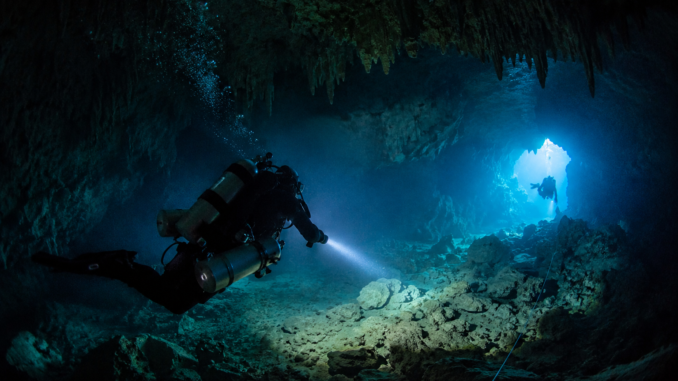
But beneath those postcard waters lies another world entirely — dark, pressurized and unforgiving.
It is a world of underwater caves, volcanic tunnels, violent currents and absolute silence. A world where one mistake, one wrong turn, one equipment failure can erase even the most experienced diver in seconds.
Last week, that hidden world swallowed five Italians.
What began as a scientific and recreational diving expedition ended in one of the deadliest underwater tragedies involving Italian citizens in recent memory. Five divers died inside a cave system near Alimathà in the Vaavu Atoll. A Maldivian military rescuer later died trying to retrieve them. International recovery specialists were flown in from Finland to attempt a mission authorities described as “extremely dangerous” and “highly complex.”
Now investigators in both Italy and the Maldives are trying to reconstruct what happened nearly 60 meters below the surface of the Indian Ocean.
The victims were not amateurs.
Among them was Monica Montefalcone, a respected marine ecologist from the University of Genoa who had spent years studying coral ecosystems and climate change in tropical waters. Colleagues described her as meticulous, highly disciplined and exceptionally experienced underwater.
Her daughter, Giorgia Sommacal, was with her.
So were Muriel Oddenino, a young marine biology researcher known for her work on Maldivian sponges, Federico Gualtieri, a recent graduate preparing for future research projects abroad, and Gianluca Benedetti, an experienced diving instructor and expedition leader.
They had arrived in the Maldives as part of a broader marine research trip connected to environmental monitoring and biodiversity studies. But according to the University of Genoa, the fatal dive itself was not officially part of the scientific mission.
That distinction now sits at the center of a growing investigation.
The dive site — known among technical divers for its cave systems and shark activity — is not considered a standard recreational location. The entrance begins around 50 meters below sea level, already beyond the legal recreational diving limit enforced in the Maldives. Beyond that entrance lies a labyrinth of chambers, tunnels and narrow passages descending deeper into darkness.
Underwater cave diving is among the most dangerous forms of diving in the world.
Unlike open water, there is no direct path to the surface. Visibility can disappear instantly if sediment is disturbed. Nitrogen narcosis can impair judgment. Equipment redundancy becomes essential. A panic reaction inside a confined underwater tunnel can turn fatal within moments.
Some experts compare it less to recreational diving and more to entering outer space.
At some point during the descent, something went catastrophically wrong.
Authorities still do not know exactly what.
Benedetti’s body was recovered first, near the cave entrance. The others vanished deeper inside the system.
The initial rescue attempts quickly exposed how dangerous the environment truly was. Maldivian military divers entered the cave searching for the missing Italians. Then the operation itself became deadly.
Sergeant Major Mohamed Mahudhee, an experienced member of the Maldives National Defence Force, died after one of the rescue dives, reportedly from decompression sickness.
His death shocked the Maldives and forced local authorities to suspend operations temporarily.
Recovering the bodies would require outside specialists.
That is when Divers Alert Network Europe, known globally as DAN Europe, assembled a Finnish technical cave-diving team with experience in extreme underwater rescue operations — including personnel connected to the famous Thailand cave rescue operation years earlier.
When they arrived in the Maldives, the mission resembled something closer to military deep-recovery work than tourism.
The divers used closed-circuit rebreathers capable of recycling exhaled gas.
They carried Trimix breathing mixtures designed for deep penetration dives.
They deployed underwater propulsion scooters to navigate long submerged corridors.
Every light had backups.
Every system had redundancy.
Every movement required precision.
The cave itself had become a grave.
Hours-long dives followed. Slow penetrations into the underwater maze. Tight decompression windows. Constant risk.
Eventually, the bodies were located deep inside the third chamber of the cave system.
Too deep.
Too far.
Too late.
Now come the questions that tragedies like this always leave behind.
Who authorized the dive?
Was there a specific permit allowing depths beyond recreational limits?
Was the dive scientific, technical or private?
Did the divers have the appropriate cave-diving configuration?
Did weather and currents play a role?
Was there an equipment failure?
Or was this simply the brutal mathematics of deep cave diving — where even highly experienced professionals sometimes never come back?
The Maldives government says the research authorization granted to the expedition did not explicitly mention cave diving.
The tour operator says it was unaware of any planned descent beyond 30 meters.
Italian prosecutors have opened an investigation.
Authorities are expected to analyze dive computers, underwater cameras and technical data recovered from the equipment.
But beyond legal responsibility lies something more unsettling.
This was not a story of reckless tourists chasing social media thrills.
These were scientists.
Researchers.
Highly trained divers.
People who knew the sea intimately and spent their lives studying it.
And perhaps that is what makes the tragedy so haunting.
Because the ocean does not negotiate with experience.
At 60 meters below the surface, inside a flooded volcanic cave, human skill has limits. Technology has limits. Planning has limits.
The sea always has the final word.