By Tom Padula
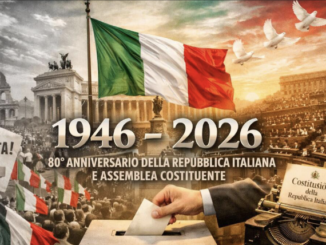
Italy’s Republic 80th Anniversary (1946–2026) will soon be celebrated throughout Italy and across Italian communities around the world.
As a modern nation, Italy emerged through a long and difficult process of unification, following a series of wars of independence that culminated in the proclamation of the Kingdom of Italy on 17 March 1861. Yet, despite political unification, the country has never been entirely unified in social and economic terms. Significant differences remain between regions, particularly between the North and the South.
Successive governments have worked to strengthen the bonds between Southern, Central and Northern Italy, as well as the Islands. In my view, considerable progress has been made and continues to be made, even if political disagreements persist regarding the best way to govern such a historically diverse peninsula. Indeed, I would argue that these cultural differences are part of what makes Italy one of the world’s most attractive tourist destinations.
Italy had not been a unified political entity since the fall of the Roman Empire. In fact, it could be argued that Italy did not truly exist as a nation-state until the Risorgimento. Today, Italy is not only a unified nation but also an important member of a broader European project: the European Union.
To understand the significance of Italian unification, it is useful to look briefly at the historical circumstances that preceded it.
Following Napoleon’s defeat at the Battle of Waterloo in 1815, France lost its dominant position in Europe. The continent then faced the difficult task of restoring political order after more than two decades of revolution and warfare.
This process took place during the Congress of Vienna (September 1814 – June 1815), where the major European powers — Austria, Prussia, Russia, Great Britain and the restored Kingdom of France — redrew the political map of Europe.
It was within this context that Austrian Chancellor Klemens von Metternich famously described Italy as merely a “geographical expression.”
The phrase became one of the most quoted observations about the Italian peninsula. At the beginning of the nineteenth century, Italy was not a single nation but rather a patchwork of kingdoms, duchies and territories, many of which were under foreign influence or direct control.
Although Italians shared many cultural traditions, historical experiences and linguistic roots — despite the existence of numerous regional dialects — there was no common political structure capable of uniting the peninsula.
From Metternich’s conservative perspective, nationalism represented a dangerous threat to European stability because it challenged the authority of traditional monarchies and the balance of power established after the Napoleonic Wars.
The Congress of Vienna was therefore founded on three fundamental principles: legitimacy, balance of power and conservatism.
These principles would dominate European politics for decades, but they could not suppress the growing aspirations of peoples seeking national self-determination. In Italy, these aspirations eventually gave rise to the Risorgimento, the movement that led to national unification and laid the foundations of the modern Italian state.
As Italians celebrate the 80th anniversary of the Republic, it is worth remembering that the nation’s journey toward unity, democracy and prosperity has been long and often difficult. The Republic born in 1946 represented another historic milestone in that journey, replacing monarchy with democratic institutions and opening a new chapter in Italy’s history.
Eighty years later, the Italian Republic remains a testament to the resilience, creativity and determination of the Italian people, both at home and throughout the global Italian diaspora.