(AP)
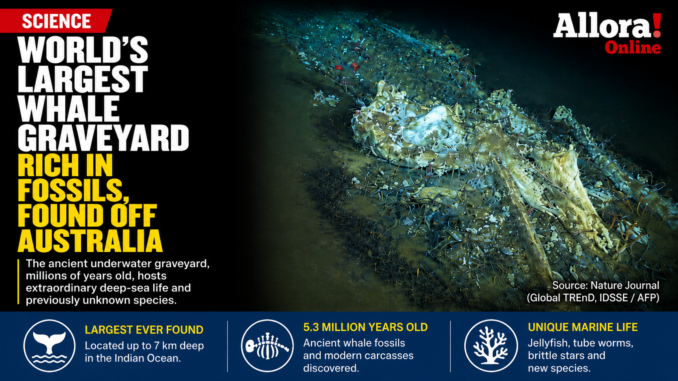
Scientists have uncovered what is being described as the largest, deepest and oldest whale graveyard ever discovered, lying thousands of metres beneath the waters off Australia’s coastline.
The remarkable find, located in the south-eastern Indian Ocean at depths reaching seven kilometres, has revealed a hidden underwater world where marine life has continued to thrive around the remains of whales that died millions of years ago.
Researchers identified five separate whale-fall sites during a series of deep-sea expeditions conducted in 2023 using manned submersibles. The discovery included fossilised whale skulls belonging to both beaked whales and baleen whales, with some remains dating back as far as 5.3 million years.
The findings were published this week in the scientific journal Nature.
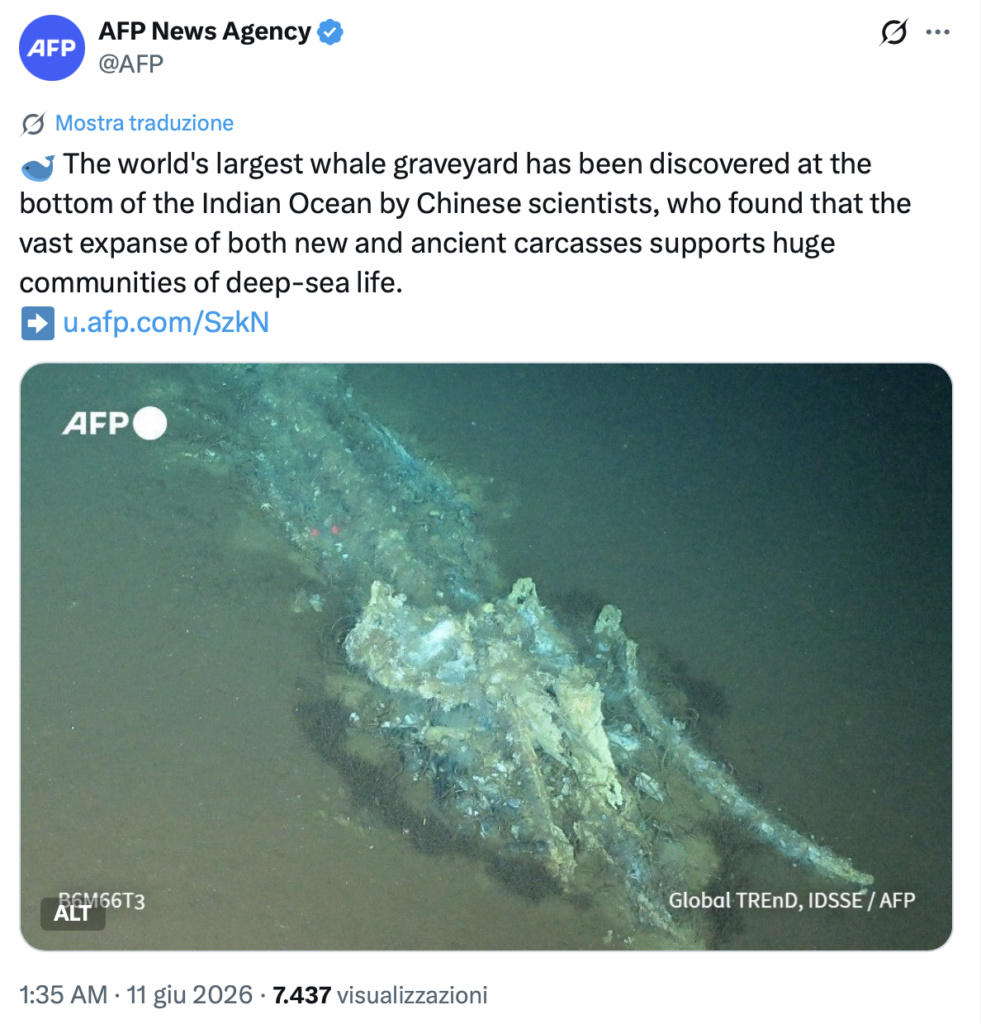
Whale graveyards are formed when the carcasses of large whales sink to the ocean floor after death. Their enormous size and nutrient-rich bones create unique ecosystems capable of sustaining a diverse range of marine species for decades, and in some cases much longer.
According to researchers, the newly discovered graveyard hosts an extraordinary variety of life, including sea cucumbers, tube worms, brittle stars, squat lobsters, clams and jellyfish.
Many of the organisms collected during the expedition may represent species previously unknown to science.
“The potential number of specimens is just astounding,” said palaeontologist Stephen Godfrey of the Calvert Marine Museum in Maryland, commenting on the significance of the discovery.
Xikun Song, a biologist at the Chinese Academy of Sciences’ Institute of Deep-sea Science and Engineering and a member of the research team, explained that whale carcasses create rare biological hotspots in some of the most isolated regions of the planet.
“The very nature of the deep ocean makes these sites exceptionally difficult for scientists to locate,” Song said.
The discovery highlights the crucial ecological role whales have played throughout Earth’s history. Even after death, their remains continue to support complex food webs in environments where nutrients are otherwise scarce.
Researchers believe the graveyard could provide valuable insights into the evolution of deep-sea ecosystems, biodiversity and the long-term impact of whale falls on ocean life.
The site also offers a rare glimpse into ancient marine environments that existed millions of years before humans began exploring the oceans.
As scientists continue analysing samples collected from the graveyard, further discoveries are expected, including the possible identification of entirely new species adapted to one of the most extreme habitats on Earth.
Source: Nature Journal, research conducted by the Chinese Academy of Sciences’ Institute of Deep-sea Science and Engineering, reported by the Associated Press (AP).