
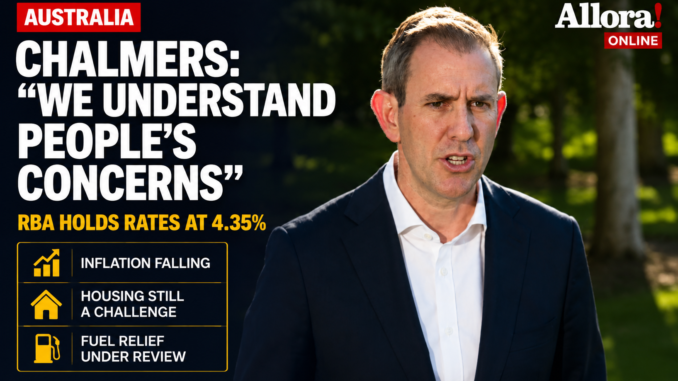
Australian Treasurer Jim Chalmers has welcomed the Reserve Bank of Australia’s decision to leave interest rates unchanged at 4.35 per cent, while acknowledging that households remain under significant financial pressure amid ongoing global economic uncertainty.
Speaking in Brisbane following the Reserve Bank’s announcement, Chalmers said the government understood the challenges facing Australian families and businesses, particularly as international conflicts continue to fuel inflationary pressures.
“We welcome the RBA’s decision, but we also recognise that the global economy remains in a difficult place,” Chalmers told reporters.
The Treasurer pointed directly to the conflict in the Middle East as a major contributor to higher living costs, arguing that Australians have been forced to bear the economic consequences of a war taking place thousands of kilometres away.
“The end of this war can’t come soon enough. Australians have already paid a hefty price for this conflict on the other side of the world,” he said.
Inflation Remains a Key Concern
Chalmers stressed that inflation is substantially lower than when the Albanese Government first came to office.
“When we came to government, inflation was above six per cent. We have made substantial progress, but the war in the Middle East has made that challenge harder, not easier,” he said.
The Treasurer defended the government’s cost-of-living measures, particularly temporary fuel excise relief, arguing that it has helped reduce inflationary pressures rather than worsen them. According to Chalmers, recent inflation data demonstrated that fuel tax relief had contributed positively to keeping price growth under control.
Fuel Excise Relief Under Review
While reaffirming that fuel excise relief was always intended to be temporary, Chalmers said the government would continue monitoring economic conditions before making any decisions about extending the measure.
“We’ve always said the fuel excise relief would be temporary, and we’ll continue reviewing it on a week-by-week basis,” he said.
The Treasurer added that both petrol and diesel prices remain under close scrutiny as the government seeks to balance cost-of-living assistance with broader economic stability.
One Nation Support Reflects Economic Anxiety
One of the most politically significant moments of the press conference came when Chalmers was asked whether persistent inflation and the absence of interest rate cuts could drive more voters toward Pauline Hanson’s One Nation.
Rather than dismissing the suggestion, the Treasurer acknowledged that many Australians are experiencing genuine economic concerns.
“We understand that global uncertainty is intensifying. People have legitimate concerns about where they fit into this story of change and uncertainty,” he said.
Chalmers argued that governments have a responsibility to respond to those concerns rather than ignore them.
“Governments have a choice. They can dismiss those concerns, deny those concerns, or try to address them. We are trying to address them.”
Housing Remains the Defining Economic Challenge
The Treasurer identified housing affordability as one of the biggest sources of anxiety facing Australians, particularly younger generations struggling to enter the property market.
He defended the government’s proposed housing and tax reforms, arguing that maintaining the existing system would have locked even more Australians out of home ownership.
“It would have been easier politically to leave things exactly as they are, but that would have locked more generations out of the Australian dream of owning their own home,” Chalmers said.
The government continues to push reforms to capital gains tax arrangements and other housing-related measures, despite criticism from business groups and opposition parties.
Tax Reform Debate Continues
Chalmers rejected claims that there had been insufficient consultation on the proposed reforms, noting that multiple Senate inquiries had already examined aspects of the government’s housing and taxation agenda.
He argued that significant economic reforms are always contested but maintained that the government was acting in the national interest.
“Tax reform is always contentious. There will never be unanimous agreement. But these reforms are about making housing fairer for first-home buyers and reducing the tax burden on workers,” he said.
Looking Ahead
While the Reserve Bank’s decision provides temporary stability for borrowers, Chalmers acknowledged that economic uncertainty remains elevated.
With inflation, housing affordability, global conflict and cost-of-living pressures continuing to dominate public debate, the Albanese Government faces increasing pressure to demonstrate that its economic policies can deliver tangible relief for Australian households.
For now, the Treasurer’s message is clear: the government believes it is making progress, but recognises that many Australians are still feeling the strain of an uncertain economic environment.