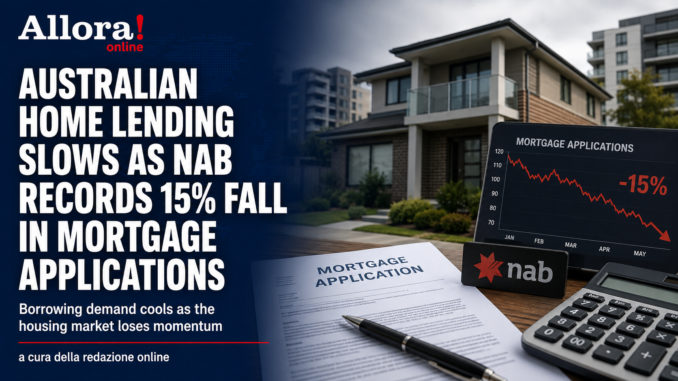
Australia’s home lending market is showing further signs of weakness, with National Australia Bank reporting a 15 per cent fall in mortgage applications during the third quarter of 2026. The decline adds to double-digit falls already recorded by the country’s other major banks.
NAB’s latest quarterly update shows demand for new home loans weakened sharply despite the overall value of its mortgage book continuing to grow.
Applications from owner-occupiers fell 14 per cent, while borrowing applications from property investors dropped 17 per cent over the three-month period.
Overall, NAB said home loan applications were down 15 per cent compared with the second quarter.
All Big Four banks report declines
The figures confirm a broader slowdown across Australia’s major banks.
Westpac has reported a decline of about 20 per cent in mortgage applications, while Commonwealth Bank recorded a 15 per cent fall and ANZ a 12 per cent decline.
The weakness comes as households continue to face high interest rates, cost-of-living pressures and broader economic uncertainty.
NAB chief executive Andrew Irvine said the Middle East conflict, higher domestic interest rates and recent federal tax changes were creating additional uncertainty for customers.
Earnings rise despite weaker mortgage demand
Despite the slowdown in home lending, NAB posted a 2 per cent increase in quarterly cash earnings to $1.83 billion.
The bank also reported a decline in the ratio of non-performing loans.
However, the number of loans placed on a “watch” list increased, reflecting signs of current or potential financial stress among customers who are still making repayments.
Credit impairment charges fell during the quarter.
Investor lending expected to weaken further
NAB expects the investor mortgage market to remain under pressure.
Its projections point to -1.4 per cent growth in investor home lending in the next financial year.
Owner-occupier lending is also expected to soften before recovering to projected growth of around 4.5 per cent.
The bank forecasts interest rates could fall to 3.6 per cent by the end of 2027, but still expects property investor borrowing to remain subdued.
House prices fall while rents remain strong
Australia’s property market continues to show mixed signals.
NAB says national house price declines are being led by Sydney and Melbourne, while rental growth remains elevated.
Housing completions are still low compared with demand and rental vacancy rates remain tight.
That combination is continuing to support rents even as borrowing demand and house prices weaken.
Business lending remains resilient
The picture is stronger in business lending.
NAB, Australia’s largest business lender, reported a 2 per cent increase in business lending during the quarter.
The bank said business credit growth remained robust despite softer conditions in residential lending.
The latest figures point to a clear shift in household behaviour: Australians are becoming more cautious about taking on large mortgages while high interest rates and economic uncertainty continue to weigh on the housing market.