The NATO summit in Turkey opened under heavy political tension. Donald Trump praised Recep Tayyip Erdoğan, attacked Italy, Germany and France over their lack of support during the Hormuz crisis, and renewed pressure on European allies to raise defence spending. Giorgia Meloni, Antonio Tajani and Guido Crosetto are in Ankara as the Alliance announces major defence, drone, missile and secure-cloud agreements.
Ankara becomes the centre of NATO diplomacy
The NATO summit in Ankara has opened with a clear message: the Atlantic Alliance is entering a new phase — more industrial, more military and far more politically tense.
The Turkish capital is hosting heads of state and government, defence ministers, foreign ministers and major defence industry leaders. On the table are Ukraine, Russia, defence spending, drones, missiles, air surveillance, cybersecurity and the future balance of the transatlantic relationship.
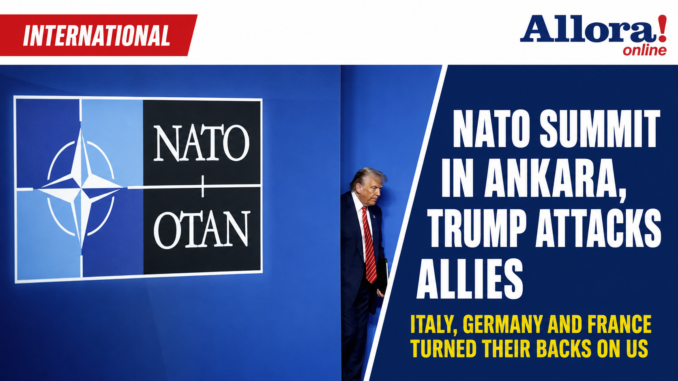
But once again, the dominant voice is Donald Trump. The US president arrived in Ankara with an aggressive political message, praising Turkish President Recep Tayyip Erdoğan while sharply criticising several European allies, including Italy.
Trump targets Italy, Germany and France
The harshest remarks came at the start of Trump’s bilateral meeting with Erdoğan.
Trump accused Italy, Germany and France of turning their backs on the United States during the crisis in the Strait of Hormuz and the broader Iran dossier.
He said Washington did not need military help, but wanted to test whether allies would stand with the US after years of American support for Europe.
According to Trump, Italy, Germany and France failed that test.
The remarks were politically explosive. They were delivered in front of the Turkish president and just before the key working sessions of the NATO summit.
The message was clear: Trump wants to reshape the relationship with European allies around reciprocity, defence spending and willingness to follow Washington in international crises.
The Meloni question
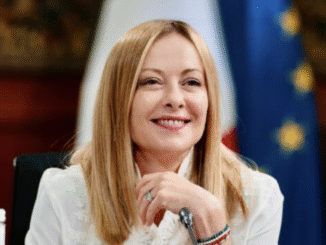
One of the main targets of Trump’s criticism was Giorgia Meloni.
The US president described the Italian prime minister as “a good person”, but said his relationship with her had deteriorated because Italy refused to support the United States on Hormuz and Iran.
“She was not there for us,” Trump said, adding that this had made him unhappy.
Meloni, who arrived in Ankara for the summit, chose a cautious line. After the official dinner hosted by Erdoğan for NATO leaders, she described relations with Trump as “cordial” and avoided escalating the dispute.
The Italian prime minister sat at the same table as Trump, Erdoğan, Mark Rutte, Emmanuel Macron, Friedrich Merz and Keir Starmer.
Tajani: “Trump’s words speak for themselves”
The Italian government has avoided a direct confrontation.
Foreign Minister Antonio Tajani, also in Ankara, said Trump’s remarks “speak for themselves”, adding that Italy would not respond to such statements.
Tajani stressed that the United States remains a strategic partner for Italy and that transatlantic relations go far beyond individual declarations.
He also confirmed Italy’s commitment to gradually increase security and defence spending towards the 5% target over the next decade, while underlining that NATO is not only a military alliance but also a political alliance.
Erdoğan at the centre of the summit
Trump reserved warm words for Erdoğan.
The US president called the Turkish leader a “great friend” and a respected figure on the world stage, adding that Turkey has become a powerful military country under his leadership.
The Ankara summit therefore also marks a possible reset in US-Turkey relations. One of the most sensitive issues is the possible return of Turkey to the F-35 fighter jet programme, from which Ankara was expelled in 2019 after purchasing Russia’s S-400 air defence system.
Trump said the sale of F-35 aircraft to Turkey would be considered. The prospect has alarmed Israel, with Benjamin Netanyahu warning against providing Ankara with advanced weapons systems.
Greenland reopens another dispute
Trump also revived the Greenland issue.
The US president said Greenland should be controlled by the United States, calling the Arctic island strategically important because of the presence of Chinese and Russian vessels in the region.
Danish Prime Minister Mette Frederiksen, also in Ankara, responded firmly, saying she expected NATO allies to fully respect Denmark’s sovereignty and accept that Greenland is not for sale.
It is another point of tension inside a summit already marked by political friction.
Rutte: “NATO as it was is no longer sustainable”
NATO Secretary-General Mark Rutte set out the new direction of the Alliance.
According to Rutte, NATO can no longer operate as it did in the past, with the United States carrying the main burden of European defence. Europe must take on a greater share of responsibility, while Washington increasingly looks towards the Pacific.
“We need a much stronger Europe within a stronger NATO,” Rutte said.
The line is now clear: more spending, more defence production, more operational capability and less dependence on the US for conventional defence.
Defence deals worth tens of billions
The Ankara summit is also a major industrial showcase.
At the NATO Defence Industry Forum, allies and companies are announcing contracts and projects worth tens of billions of dollars. The focus is on air surveillance, drones, ammunition, counter-drone systems, air defence and secure digital infrastructure.
Among the key announcements is NATO’s plan to acquire new GlobalEye surveillance aircraft produced by Sweden’s Saab, replacing the ageing E-3 AWACS fleet.
Denmark, Finland, Germany and Norway have also announced the purchase of MQ-4C Triton unmanned aircraft to strengthen NATO intelligence, surveillance and reconnaissance capabilities. These systems will integrate with the Alliance Ground Surveillance fleet based at Sigonella in Italy.
Leonardo’s role in NATO’s secure cloud
Italy is also present on the technology front.
Accenture has signed an agreement worth about €200 million with the NATO Communications and Information Agency to develop the Protected Business Network, a seven-year programme to modernise the Alliance’s digital and cloud infrastructure.
Italy’s Leonardo will serve as a strategic partner in the project, handling the security of the new multi-cloud infrastructure.
The system is designed to support classified communications and protected services for around 29,000 users, including military personnel and political decision-makers.
Leonardo will implement a Zero Trust architecture through its Global Cybersec Platform, using artificial intelligence to detect and counter external threats and cyberattacks.
Drones, missiles and ammunition: NATO accelerates
NATO will invest more than $40 billion over the next five years to strengthen allied counter-drone capabilities.
Rutte presented the new NATO Drone Edge Initiative, aimed at rapidly expanding drone deployment while building robust systems to detect, identify and neutralise drone threats.
Nine NATO countries will also work together on a common 155mm ammunition prototype to boost production, interoperability and operational readiness.
The lesson from Ukraine is now central to NATO planning: drones, artillery, air defence and ammunition are no longer secondary assets. They are the core of modern deterrence.
Ukraine: Zelensky asks for Patriot missiles
Ukrainian President Volodymyr Zelensky arrived in Ankara with one urgent request: more air defence.
Zelensky is expected to meet Trump and ask for additional missiles for Patriot air defence systems, considered essential to protect Ukrainian cities, infrastructure and armed forces from Russian attacks.
Rutte summed up NATO’s priority in three words: “Air defence, air defence, air defence.”
The secretary-general insisted that all allies must continue supporting Kyiv because Ukraine’s security is directly linked to the security of the entire Euro-Atlantic area.
Europe and NATO seek a new balance
European Commission President Ursula von der Leyen described the moment as a new era for European security.
EU member states are increasing defence spending, rebuilding their industrial base and trying to develop greater strategic autonomy inside the NATO framework.
Rutte also praised the European Union’s SAFE programme, calling it a success because it mobilises funding to strengthen Europe’s defence industry.
The shared message from NATO and the EU is now explicit: Europe can no longer outsource most of its defence.
Ankara as the summit of NATO 3.0
The Turkish summit is not just another diplomatic meeting.
It is an attempt to turn financial commitments into real military capability. Higher spending is not enough: NATO needs factories, supply chains, ammunition, technology, interoperability and faster production.
Ankara is becoming the laboratory of a new NATO: more European in conventional defence, more industrial, more technological, but still deeply marked by political tensions.
Trump wants more loyal and more paying allies. Rutte wants a stronger Europe. Zelensky wants air defence. Erdoğan wants to consolidate Turkey’s role. Meloni is trying to balance Atlantic loyalty, diplomatic caution and European strategic autonomy.
A summit of contradictions
The Ankara summit shows an Alliance that is more necessary than ever, but also more nervous than ever.
The Russian threat, the war in Ukraine, the Middle East, the Pacific, Greenland, relations with Turkey and American pressure on defence spending are reshaping NATO from within.
Trump attacks allies but remains inside the Alliance. Europeans promise more spending but ask for time. Italy defends its relationship with Washington while also pushing for a stronger European defence pillar.
NATO remains the cornerstone of the West. But Ankara shows that this cornerstone is changing shape.
And not without tremors.