The broadcaster, journalist and former senator was remembered in Melbourne as outspoken, generous, fearless and impossible to ignore
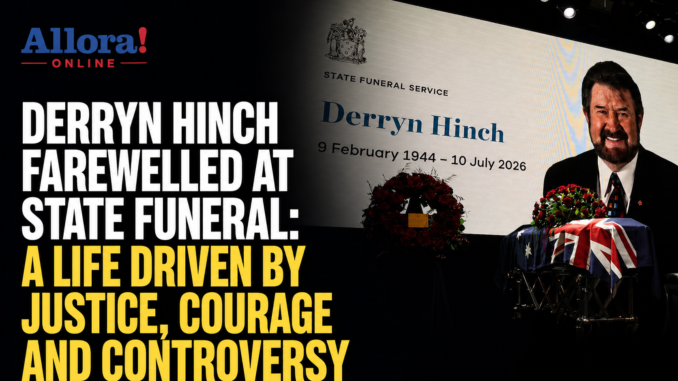
Derryn Hinch has been farewelled at a state funeral in Melbourne, where family, friends and colleagues remembered one of Australia’s most recognisable media figures as a man of strong convictions, sharp humour and an enduring sense of justice.
Hinch died on July 10 at the age of 82 after several years of declining health.
The service in Port Melbourne brought together leading figures from journalism, entertainment and public life, who reflected on a career that stretched from newspapers and radio to television and the Australian Senate.
He was remembered as loud, brave, difficult, generous, entertaining and deeply committed to the causes he believed in.
A Brother’s Tribute
One of the most moving tributes came from Hinch’s brother, Desmond “Des” Hinch, whose message was read by broadcaster Craig Willis.
Des recalled Derryn as the “pesky little brother” with whom he shared a bedroom during childhood.
The room had been divided by an imaginary line, but Derryn’s side was always filled with a chaotic jumble of possessions. Among them was a kaleidoscope.
Des used that childhood object as a symbol of his brother’s life: colourful, constantly changing and made up of many different pieces.
He asked those attending the service to remember one special moment involving Derryn — something he said, wrote or did, perhaps an interview, a book or even a recipe.
Together, he said, those memories would form the complex and ever-changing mosaic of Hinch’s life.
Jacki Weaver’s Emotional Goodbye
Australian actress Jacki Weaver, Hinch’s third wife and a close friend for almost 50 years, delivered her eulogy by video because she was unable to attend in person.
She began with humour, describing herself as Derryn’s third wife and warmly acknowledging all the women he had loved.
“I won’t mention you individually. We don’t have the time,” she joked, before adding that they would “need a bigger boat”.
The laughter gave way to emotion as Weaver recalled the depth of their long relationship.
She said she had loved him “from the very start to the very end”.
In tears, she closed her tribute with a simple farewell: “Good night, sweet dreams.”
A Voice That Could Not Be Ignored
Hinch began his career in newspapers in New Zealand before moving to Australia, where he worked across print, radio and television.
Over the decades he became one of the country’s most prominent and controversial broadcasters.
He often joked that he had been sacked from “16 or 17” high-profile jobs, treating each dismissal almost as a badge of honour.
Veteran journalist Ray Martin remembered Hinch as a man with no interest in subtlety.
“There was nothing subtle about Derryn,” Martin said.
“He was born with a megaphone for a voice. His typewriter was just about as loud.”
Martin described him as “brave and brash, with an ego that could light up a small city”.
The comment captured the contradiction at the heart of Hinch’s personality: he could be forceful, provocative and self-confident, but he was also widely liked by those who knew him personally.
His Love of Words — and Himself
Martin also recalled Hinch’s love of language and Scrabble.
Hinch wrote several books during his career. Two were about Scrabble, while six were about himself.
“Because he quite liked himself as well,” Martin joked.
Behind the humour was recognition of a man who wrote millions of words and spent a lifetime communicating with the public.
He understood the power of language and used it to challenge authority, influence debate and keep himself at the centre of national conversation.
A Career Defined by Justice
A strong sense of justice was the central theme running through the service.
Hinch became famous for his campaigns against convicted sex offenders and for repeatedly challenging contempt-of-court laws by publishing information that courts had ordered to remain suppressed.
He was convicted three times and spent time in prison.
To his supporters, those decisions showed courage and a willingness to sacrifice his own freedom for what he believed was right.
To his critics, they represented a dangerous blurring of the line between journalism, public interest and the rule of law.
Hinch never avoided that argument.
He understood the consequences of his actions and accepted them, often turning his own legal battles into another chapter of his public life.
“There Will Never Be Another One Like Him”
Tony Tardio, the longtime newsreader at radio station 3AW, offered one of the most vivid summaries of Hinch’s life.
He recalled a man who interviewed the famous, challenged the powerful, wrote millions of words and became a major star of both radio and television.
Hinch took on difficult and sometimes unpopular causes. He went to jail, spent time under home detention, founded a political party and served in the Australian Senate.
He also struggled with alcohol, came close to death, received a liver transplant and gained another 16 years of life.
“And had a bloody good time doing it all,” Tardio said.
From Broadcasting to the Senate
Hinch’s public career eventually moved beyond the media.
He founded Derryn Hinch’s Justice Party and was elected to the Australian Senate, carrying the same combative style from the studio into parliament.
His political platform focused heavily on public safety, child protection and access to information about convicted sex offenders.
He did not soften his language after entering politics.
Hinch remained confrontational, direct and determined to dominate the debate.
For supporters, that was his strength. For critics, it was evidence that he often preferred headlines to compromise.
Either way, he remained impossible to ignore.
A Complicated Private Life
Hinch was married five times and, near the end of his life, had reunited with former partner Lynda Stoner.
His romantic life was part of the larger-than-life public image that followed him throughout his career.
Yet the funeral showed that behind the stories, jokes and public fascination was a man who had formed deep and lasting relationships.
The affection shown by former partners, friends and colleagues revealed a different side of the broadcaster: private, loyal and capable of inspiring love even among those who had experienced his more difficult qualities.
Music and Memory
The funeral included several musical performances.
Rhonda Burchmore sang They Can’t Take That Away From Me, Bob Valentine performed That’s Life, and Nikki Nicholls sang one of Hinch’s favourite songs, You Are So Beautiful.
Hinch’s goddaughter, Ellie O’Connell, performed the national anthem at the beginning of the service and later returned to sing an original song written for her godfather.
The music brought intimacy to a ceremony dedicated to a man whose life had been lived amid the noise of newsrooms, radio studios, television sets and political battles.
A Man Who Divided and Charmed
Derryn Hinch was never a neutral figure.
His campaigns created controversy. His refusal to obey court orders led to convictions. His broadcasting style attracted both loyal audiences and determined opponents.
Yet the word that repeatedly emerged during the funeral was “likeable”.
He could be arrogant, loud and provocative, but he could also be warm, funny and generous.
He had the rare ability to fight someone fiercely in public and still win their affection in private.
That contradiction helped explain why he remained such a powerful figure for so long.
Journalism as Combat
Hinch belonged to a generation that treated journalism as both a mission and a performance.
He did not fear becoming part of the story. In many cases, he actively placed himself at its centre.
His nickname, the “Human Headline”, perfectly captured his ability to transform himself into news.
His career also raised difficult questions that remain relevant today.
How far should a journalist go in the name of justice? Can the public interest ever justify breaking a court order? Who decides when personal conscience should take priority over the law?
Hinch answered those questions through his actions, accepting the punishment when he crossed legal boundaries.
The Final Headline
The state funeral did not erase the controversies of Derryn Hinch’s life, nor should it have.
Instead, it presented the full picture of a man who lived intensely and rarely apologised for taking up too much space.
He was a journalist, author, broadcaster, prisoner, activist, transplant recipient, party founder and senator.
He fell many times, but always found a way back to a microphone.
Derryn Hinch truly was the “Human Headline”.
His final headline may be the one written by those who gathered in Melbourne to remember him: brave, brash, imperfect, generous and unforgettable.