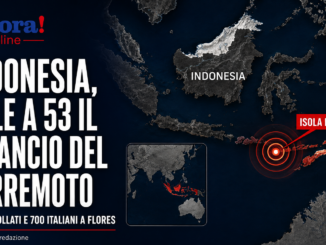
Rescue teams are searching damaged buildings across eastern Indonesia after a powerful magnitude-7.7 earthquake. It killed at least 47 people near Flores Island.
More than 2,000 residents have evacuated their homes.
Additionally, authorities warn that people remain trapped under rubble and the death toll could rise.
Rescue operations are continuing across East Nusa Tenggara in Indonesia.
However, a devastating magnitude-7.7 earthquake struck off the coast of Flores Island early on Saturday.
At least 47 people have been confirmed dead, with authorities warning that the toll may increase as teams search collapsed and heavily damaged buildings.
The earthquake struck shortly before 5am local time and caused widespread damage to homes, hospitals, clinics and places of worship.
Officials say some people remain trapped inside buildings, making rescue efforts the immediate priority.
Helicopters and aircraft deployed
Indonesia’s National Disaster Management Agency said emergency teams were focusing first on locations where people were believed to be trapped.
Two helicopters and a plane were being prepared to support the operation, while ground crews continued to inspect damaged structures.
In Sikka, one of the hardest-hit areas, local authorities are establishing temporary shelters and medical tents for residents and patients.
Officials have urged people to avoid spending long periods inside damaged buildings and to stay away from coastal areas while the risk from aftershocks remains.
More than 2,000 people evacuated
The earthquake triggered a tsunami warning, with waves of less than one metre recorded in parts of eastern Indonesia.
More than 2,000 people have left their homes and moved to safer locations.
Some residents have gathered in open fields, while others in coastal villages have moved to higher ground because of fears of further earthquakes or a sudden rise in sea level.
The northern part of Flores Island is believed to be among the worst-affected areas.
Panic in Labuan Bajo
The earthquake was strongly felt in Labuan Bajo, one of Indonesia’s most popular tourist destinations and a major gateway to Komodo National Park.
Residents and tourists described scenes of panic as hotel guests rushed outside after feeling prolonged shaking.
One local resident said parts of a nearby limestone hill broke away during the quake.
Aftershocks continued to be felt later in the day, adding to anxiety among residents and visitors.
Several hotels and resorts were reportedly damaged, while two Chinese nationals were injured and taken to hospital.
Active fault blamed
Indonesia’s Meteorology, Climatology and Geophysics Agency said the earthquake was caused by movement along an active fault off the northern coast of Flores.
The same fault system was linked to a major earthquake in the region in 1992.
Strong shaking was reported across East Nusa Tenggara, West Nusa Tenggara and parts of South Sulawesi.
A separate strong earthquake was recorded on Sumatra nearly 16 hours later, although there were no immediate reports of casualties or significant damage from that event.
Communities left traumatised
The disaster has also left many residents deeply shaken.
Local organisations have begun providing psychological support, particularly for children and families who are afraid to return home.
Volunteers are organising activities and community support programs to help reduce fear and anxiety.
Some families say the latest quake has revived memories of previous earthquakes that struck the region in 2022.
Many are choosing to sleep outdoors or remain on higher ground while aftershocks continue.
Urgent need for food and medicine
Local fundraising campaigns have begun collecting donations for affected communities.
The most urgent needs include food, medicines and hygiene supplies.
By Saturday evening, online fundraising efforts had already collected more than 200 million rupiah.
Authorities are also working to restore essential services and repair health facilities so normal medical care can resume as quickly as possible.
Tourism resumes cautiously
Indonesia’s tourism ministry said cruise activities in Labuan Bajo could resume, but warned visitors and operators to remain alert for further aftershocks.
The region is a major tourism hub and home to Komodo National Park, famous for the endangered Komodo dragon.
For now, however, the focus remains on rescue and recovery.
As emergency crews continue searching through damaged buildings, authorities are warning that the full scale of the disaster may not yet be known.
The priority remains finding those still trapped and getting thousands of displaced residents through the immediate emergency.