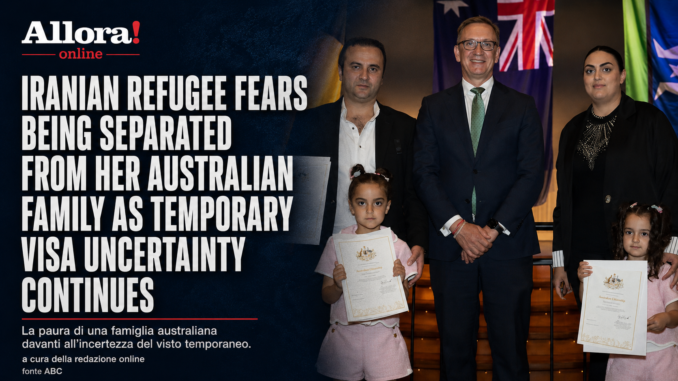
Iranian refugee Mahsa Mazaheri has spent the past eight years living in Australia on short-term bridging visas that must be renewed every few months. She has an Australian citizen husband, two Australian citizen daughters and runs a small business, but still has no automatic pathway to permanent residency.
Mahsa Mazaheri says she wakes up every day fearing she could be separated from her family.
She arrived in Australia from Iran by boat in 2013 with her mother and was sent to offshore detention on Naoero, formerly Nauru, and Christmas Island.
The pair were medically evacuated to mainland Australia in 2014 after her mother’s health deteriorated.
Since then, Ms Mazaheri has remained in immigration limbo.
A family in Australia, but no permanent status
Ms Mazaheri is now married and has two daughters, aged four and three.
Her husband also arrived in Australia from Iran by boat, but unlike Ms Mazaheri, he was allowed to apply for refugee protection onshore and has since become an Australian citizen.
Their two daughters are also Australian citizens.
Ms Mazaheri, however, continues to rely on a Bridging Visa E, which can expire every three or six months.
Each renewal brings uncertainty over whether she will be allowed to remain.
“I have the kids, we have a family, and I just want permanent safety,” she said.
Around 700 people remain in similar limbo
According to the Human Rights Law Centre, more than 700 people who were previously held in offshore detention are now living in Australia without permanent status.
Under current migration policy, they are classified as “transitory persons”.
Some have lived in Australia for more than a decade, built families, worked, paid taxes and become part of their communities, but still remain on insecure temporary visas.
The Department of Home Affairs says transitory persons living in Australia under regional processing arrangements do not have a permanent settlement pathway.
They are encouraged to consider third-country options or voluntary return to their country of origin.
Medicare and long-term planning remain uncertain
The temporary visa arrangement also has practical consequences.
Ms Mazaheri says she has at times lost access to Medicare while waiting for a visa renewal to be processed.
That has also affected her ability to care for her mother, who requires ongoing medical support.
She also cannot freely travel overseas and says she cannot make long-term plans for her family or business.
For a parent of two young Australian children, that uncertainty has become increasingly difficult.
Calls for ministerial intervention
The Human Rights Law Centre says Ms Mazaheri’s case is among many submitted to Immigration Minister Tony Burke.
The organisation argues that people in this group are effectively prevented from applying for permanent visas, including partner visas, unless the minister personally intervenes.
The Human Rights Law Centre, Asylum Seeker Resource Centre and GetUp are calling on the government to grant permanent residency to the group.
For Ms Mazaheri, the issue is no longer simply about immigration status.
It is about whether she can remain with the family she has built in Australia.
After more than a decade in the country, she says she wants one thing above all: the certainty that she will not be separated from her husband and daughters.