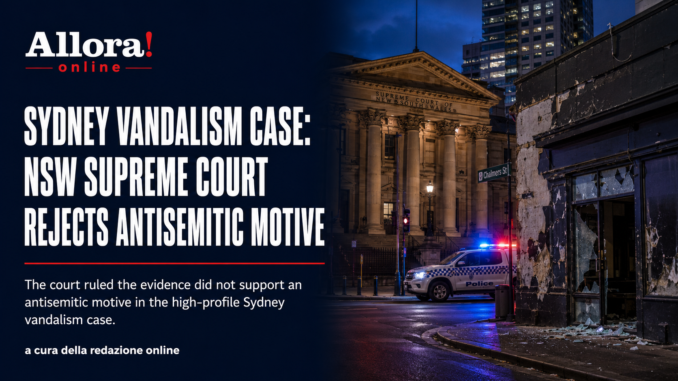
The NSW Supreme Court has ruled that Mohommed Farhat, who admitted to a series of vandalism offences in Sydney’s eastern suburbs, did not act as an “antisemitic bigot” but rather as a “vandal for hire”. The court also rejected the State’s attempt to impose a further year of strict supervision after his prison sentence.
The decision marks a significant development in the case involving vandalism in Woollahra in November 2024.
Farhat, 22, pleaded guilty to 15 offences after vehicles and property were sprayed with slogans including “F*** Israel” and “PKK coming”.
He was sentenced to one year and eight months in prison, with his sentence due to expire in October 2026.
The State had sought a one-year extended supervision order that would have imposed 55 restrictive conditions on him after his release.
Judge says Farhat was “incited and directed”
Justice Desmond Fagan found that Farhat had been “incited and directed” by another person to carry out the vandalism in exchange for $4,000 and drugs.
The judge found that Farhat did not intend to express hatred towards Jewish people.
Justice Fagan described the “F*** Israel” graffiti as a crude expression of political hostility towards the State of Israel, rather than inherently antisemitic language.
He also found that the fact the slogans were painted in an area with a significant Jewish population did not automatically make them antisemitic.
The court nevertheless stressed the seriousness of the offending, including its intimidating nature, vulgarity and damage to property.
IHRA definition criticised
The judgment also examined the broader question of how antisemitism should be defined.
Evidence before the court referred to the International Holocaust Remembrance Alliance (IHRA) definition, but Justice Fagan said it did not assist in deciding Farhat’s case.
He criticised the wording as overly broad and imprecise and said it did not necessarily reflect the ordinary understanding of the term “antisemitic” in Australia.
The court also reaffirmed that Australians are entitled to strongly criticise the actions of the State of Israel, while others are equally entitled to reject or disagree with those views.
That freedom, however, does not extend to property damage or intimidation.
“Label wrongly applied”
Justice Fagan criticised the way police statements and intelligence reports had repeatedly characterised the vandalism as antisemitic.
He found that the label had been adopted without sufficient analysis and had influenced the way Farhat was treated within the criminal justice system.
The court ultimately found there was not enough evidence to justify an extended supervision order on the basis that Farhat posed a serious risk of committing a terrorism offence.
Farhat said drugs had taken over his life
In a previous letter to the Local Court, Farhat said he had been heavily affected by drug addiction and negative influences at the time of the offences.
He said he had not understood the seriousness of his actions or their impact on Jewish and Turkish communities.
Farhat also said conversations with a member of the Jewish community later helped him understand the consequences of what he had done.
The Supreme Court decision does not overturn his convictions or sentence.
It does, however, draw an important legal distinction: hostility towards the State of Israel cannot automatically be treated as antisemitism without considering intent, context and meaning.