Concern is growing in Canberra over the Trump administration’s escalating campaign against the International Criminal Court. The United States has already imposed sanctions on several ICC officials, while Secretary of State Marco Rubio has vowed to intensify efforts to “dismantle” the court. Australia, while remaining publicly cautious, has made clear it does not support sanctions against the ICC or its officials.
The widening confrontation between Washington and the International Criminal Court (ICC) is creating an increasingly difficult diplomatic challenge for some of America’s closest allies.
Australian officials are reportedly deeply concerned about the Trump administration’s efforts to weaken the court, while the federal government has also maintained contact with Australians working at the ICC who could potentially be targeted by future US sanctions.
The issue is particularly sensitive because Australia is a longstanding supporter of the court, while the United States has never ratified the Rome Statute.
New sanctions on senior ICC officials
US Secretary of State Marco Rubio has announced fresh sanctions on ICC President Tomoko Akane and senior trial lawyer Abdoulaye Seye.
Washington argues that the court has attempted to exercise jurisdiction over citizens of countries that have not consented to ICC authority.
Rubio has described that as a dangerous precedent and has urged other countries to end funding and participation in what the Trump administration calls a politicised and unaccountable institution.
Australia has no intention of doing so.
DFAT: Australia does not support sanctions
A spokesperson for the Department of Foreign Affairs and Trade said Australia “does not support sanctioning the ICC or its officials”.
Canberra continues to regard the court as an important institution for pursuing accountability for the world’s most serious international crimes, including genocide, war crimes and crimes against humanity.
Australia has also reiterated its respect for the court’s independence and its role in upholding international law.
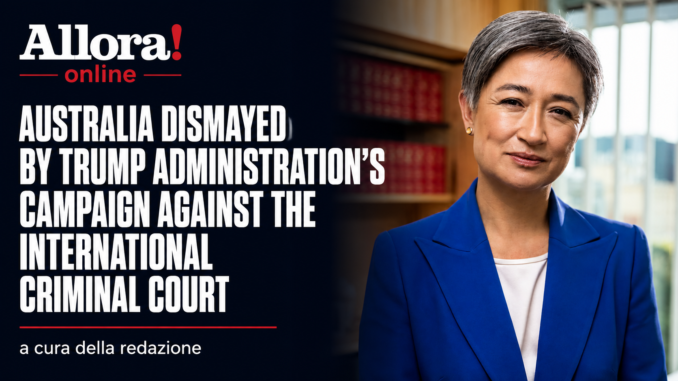
However, neither Foreign Minister Penny Wong nor Attorney-General Michelle Rowland has issued a strongly worded public statement directly criticising Washington.
The difficult balance with the United States
That caution reflects an obvious diplomatic reality.
The United States remains Australia’s most important strategic ally, and Marco Rubio is a key figure for Canberra within the Trump administration.
An Australian government source, speaking anonymously, described the US campaign against the ICC as highly destructive and said concern was growing that Washington had no intention of backing away.
There is also concern that limited public resistance from Western allies could weaken their credibility when calling on authoritarian governments to respect international law and global institutions.
Why Washington is targeting the ICC
The current dispute is part of a much longer confrontation between the United States and the court.
The Trump administration has repeatedly argued that the ICC is an unelected international bureaucracy that threatens US sovereignty.
Tensions intensified after the court issued arrest warrants for Israeli Prime Minister Benjamin Netanyahu and former defence minister Yoav Gallant.
Washington has since stepped up sanctions and diplomatic pressure against ICC officials.
Europe more outspoken, Australia more cautious
The European Union has reacted more forcefully, saying it “deeply regrets” the latest US sanctions and reiterating its unwavering support for the ICC.
Australia has chosen more restrained language, but its underlying position is clear: Canberra does not intend to abandon the court or join Washington’s campaign against it.
The issue now becomes a significant test for the Albanese government’s foreign policy.
On one side is the strategic alliance with the United States.
On the other is Australia’s longstanding commitment to an international system based on rules, accountability and multilateral institutions.
The key question is how far Canberra will be willing to publicly challenge Washington if the Trump administration expands its sanctions against the court and its officials.