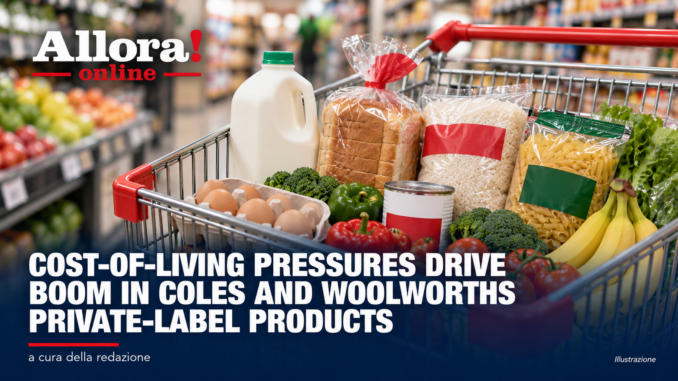
Australians are increasingly turning to supermarket-owned brands as cost-of-living pressures reshape grocery shopping habits. Coles now offers around 5,600 exclusive products, while Woolworths has also sharply expanded its own-brand and exclusive ranges. The trend is strengthening the supermarkets’ control over pricing, product development and shelf space — but it is also increasing scrutiny over supply chains, labelling and the true origin of food products.
Australians are buying more supermarket-owned products, and the shift is becoming one of the most significant changes in the grocery market.
Coles now has around 5,600 “Exclusive to Coles” products, up by about 1,600 in just one year. Sales across the range rose by 6.1 per cent, faster than the group’s overall sales growth.
Woolworths has also expanded aggressively. In its latest financial year, the retailer introduced more than 445 new products and refreshed around 680 own-brand or exclusive lines. Sales of those products increased by 5.5 per cent, with particularly strong growth in meat and fresh food.
Private label is no longer just the cheapest option
For years, supermarket home brands were associated mainly with low-cost basics.
That is no longer the case.
Private-label ranges now extend across premium products, fresh food, meat, pet food, international cuisine and specialty lines. In many cases, consumers may not immediately recognise that a brand is controlled exclusively by the supermarket.
This gives the major retailers more influence over product design, pricing, promotion and shelf placement.
For shoppers, the attraction is straightforward: better perceived value at a time when household budgets remain under pressure.
Coles and Woolworths gain more control over the shelf
The growth of private-label products changes the balance of power between supermarkets and traditional brands.
A retailer is no longer simply selling products supplied by other companies.
Increasingly, it is also developing and marketing competing products under its own or exclusive labels.
That creates a more difficult environment for independent suppliers and established manufacturers.
A branded producer may find itself negotiating with the same retailer that controls shelf space while also competing against a supermarket-owned alternative.
Cost of living is accelerating the shift
The move towards private label is closely connected to cost-of-living pressures.
Consumers facing higher mortgage, rent, energy and grocery bills are more likely to compare prices and switch away from traditional brands when they believe the quality difference is small.
This gives supermarkets a strong incentive to keep expanding their own ranges.
The result is a retail market where price remains critical, but brand loyalty is becoming weaker.
The tomato-origin controversy raises a second issue
The growth of private labels also increases the importance of supply-chain transparency.
A recent Four Corners investigation tested 221 tomato-based products across 39 brands. According to the investigation, 22 per cent did not match the origin stated on the label, while a further 6 per cent required additional verification.
The testing raised questions about some tomato pastes and passatas marketed as Australian or Italian, with laboratory analysis indicating that some samples were chemically consistent with tomatoes grown in China.
The companies dispute the findings
It is important to note that the test results are investigative findings, not final legal determinations.
Coles, Aldi and Simplot, the owner of Leggo’s, disputed the conclusions.
Simplot said it had traceability documentation supporting the Australian origin of the products questioned and pointed to its auditing and supply-chain verification systems.
Coles said there was no evidence that its tomato paste was sourced from China, while Aldi said it relied on trusted suppliers.
The issue remains under scrutiny, including by regulators.
Why “Italian” matters commercially
The origin issue is particularly significant when a product is marketed as Italian.
“Italian” is not simply a geographic description. It carries commercial value and can influence consumer expectations about quality, authenticity and price.
If a shopper chooses a passata because they believe the tomatoes are genuinely Italian, that origin claim becomes part of the value proposition.
The same applies to “Australian grown”.
If origin claims are inaccurate, that can disadvantage both consumers and genuine Italian or Australian producers who face higher costs to produce and certify their goods.
Retailer power comes with greater responsibility
The more products supermarkets develop and control themselves, the greater their responsibility becomes.
Private-label growth gives Coles and Woolworths more power over the entire retail chain — from product specifications and pricing to shelf position and promotion.
But that commercial advantage also increases expectations around traceability, supplier oversight and labelling accuracy.
When a consumer buys an exclusive supermarket product, they may see the retailer itself as the party ultimately responsible for what is being sold.
The real shift is about market power
The private-label boom is therefore about more than cheaper groceries.
It reflects a broader shift in the relationship between retailers, suppliers and consumers.
Coles and Woolworths are increasingly becoming owners of the customer relationship, rather than simply intermediaries between producers and shoppers.
That gives them more influence over the food market — but it also exposes them to greater scrutiny.
As cost-of-living pressures push more Australians towards supermarket-owned brands, price will remain a key factor. But trust in labels, origin claims and supply chains is becoming just as important.