By Tom Padula
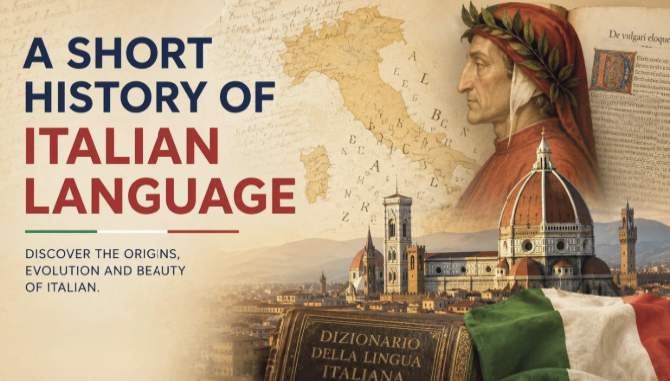
The history of Italian literature is one of the richest and most influential in the world. It developed from the languages spoken in ancient Italy, particularly Latin, and gradually formed a distinct literary language that became modern Italian. Over many centuries, Italian writers produced poetry, novels, plays, essays and works of political and philosophical thought that have influenced European and world culture.
After the fall of the Roman Empire, Latin remained the language of education, religion and official documents. However, ordinary people spoke various local forms of Latin that gradually developed into regional dialects. During the Middle Ages, writers began using the volgare, or everyday spoken language, rather than classical Latin. Sicily was one of the first important centres of Italian poetry. In the thirteenth century, the Sicilian School, encouraged by Emperor Frederick II, developed courtly poetry in a language that helped prepare the way for Italian literature.
The greatest figure in the formation of Italian literature was Dante Alighieri (1265–1321). His masterpiece, La Divina Commedia (The Divine Comedy), is one of the supreme works of world literature. Written largely in the Tuscan vernacular, it tells of Dante’s imaginary journey through Hell, Purgatory and Paradise. Dante’s use of the Tuscan language demonstrated that the vernacular could express profound philosophical, religious and poetic ideas. His work played a decisive role in establishing Tuscan as the foundation of literary Italian.
Two other great writers of the fourteenth century were Francesco Petrarca and Giovanni Boccaccio. Petrarch became famous for his Canzoniere, a collection of poems, many inspired by his idealised love for Laura. His elegant poetry influenced generations of European writers and helped establish the sonnet as one of the great forms of lyric poetry. Boccaccio is best known for Il Decameron, a collection of one hundred stories told by young people who escape Florence during the Black Death. His lively prose, humour and realistic descriptions of human behaviour made him one of the founders of European narrative literature.
During the Renaissance, Italy became the centre of an extraordinary revival of art, learning and literature. Ludovico Ariosto wrote Orlando Furioso, an imaginative epic combining adventure, romance and fantasy. Niccolò Machiavelli, author of Il Principe (The Prince), became one of history’s most important political thinkers. His realistic examination of power and government continues to be studied throughout the world. Other major writers included Torquato Tasso, whose epic Gerusalemme Liberata celebrated the First Crusade.
In the following centuries, Italian literature continued to develop. The nineteenth century was deeply influenced by the Risorgimento, the movement for Italian independence and national unity. Alessandro Manzoni wrote I Promessi Sposi (The Betrothed), one of Italy’s greatest novels. Set in seventeenth-century Lombardy, it combined history, religion, social criticism and human drama. Manzoni’s clear Tuscan-based language became especially important in the development of a common national Italian language.
The twentieth century produced another remarkable generation of writers. Gabriele D’Annunzio was famous for his rich and dramatic style. Luigi Pirandello, winner of the Nobel Prize for Literature, revolutionised modern theatre with plays such as Sei Personaggi in Cerca d’Autore (Six Characters in Search of an Author). His works explored identity, reality and the masks people wear in society.
Other major twentieth-century writers include Italo Svevo, author of La Coscienza di Zeno; Giuseppe Ungaretti, one of Italy’s greatest modern poets; Eugenio Montale, also a Nobel Prize winner; Cesare Pavese, known for his novels and poetry about loneliness and post-war Italy; and Leonardo Sciascia, whose works examined Sicily, justice, politics and organised crime. Italo Calvino became internationally celebrated for his imaginative novels, while Umberto Eco achieved worldwide success with Il Nome della Rosa (The Name of the Rose).
Today, Italian literature continues to evolve through writers from different regions, backgrounds and generations. From Dante’s medieval poetry to contemporary novels, the Italian language has remained a powerful instrument of artistic expression.
The history of Italian literature is therefore also the history of Italy itself: its regions, struggles, beliefs, imagination and constant search for beauty and meaning. Let’s add the Literature of the Diaspora of Italians in the world to fully appreciate the vast influence of Italy’s Italians in and out of Italy, past and present… and in the future!